

Introduction
The aviation industry is undergoing a major transformation as airlines, governments, and fuel producers seek sustainable alternatives to conventional jet fuel. With increasing concerns about climate change and carbon emissions, Sustainable Aviation Fuel (SAF) has emerged as one of the most promising solutions for decarbonizing air travel.
Aviation currently contributes approximately 2-3% of global carbon dioxide emissions, and demand for air travel continues to rise worldwide. As a result, the industry faces mounting pressure to reduce its environmental footprint while maintaining operational efficiency. Sustainable Aviation Fuel offers a viable pathway toward achieving net-zero emissions goals without requiring significant modifications to existing aircraft or airport infrastructure.
This article explores what Sustainable Aviation Fuel is, its benefits, production methods, market trends, challenges, and its role in shaping the future of aviation.
What is Sustainable Aviation Fuel?
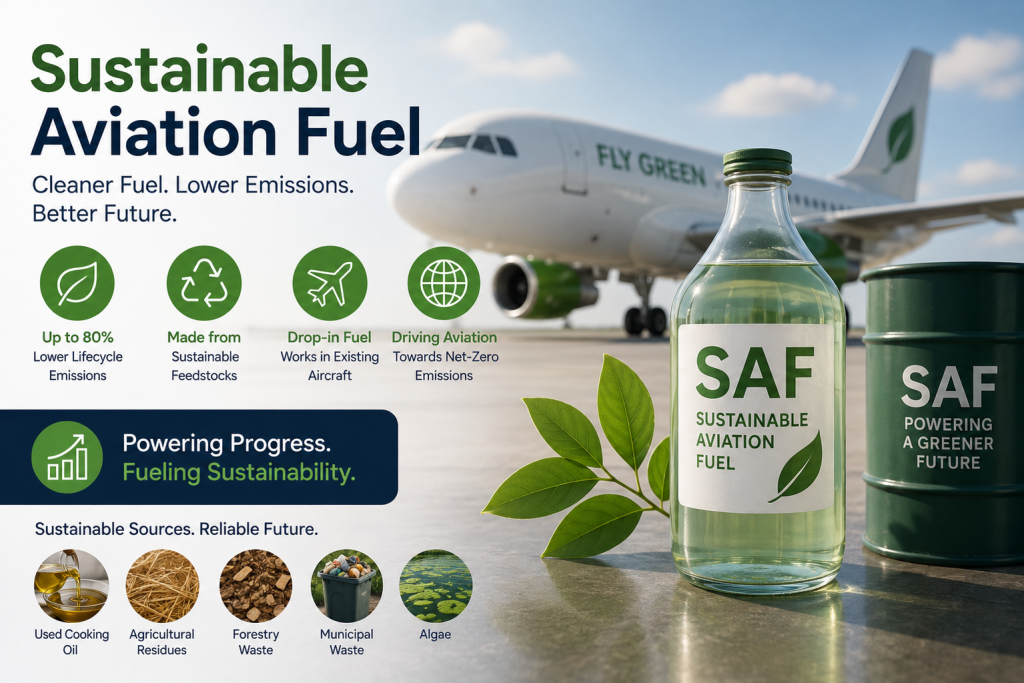
Sustainable Aviation Fuel (SAF) refers to renewable or waste-derived fuel that can be used as an alternative to traditional fossil-based jet fuel. Unlike conventional aviation fuel, SAF is produced from sustainable feedstocks such as agricultural residues, municipal waste, used cooking oil, algae, forestry waste, and other renewable resources.
SAF is designed to be a “drop-in” fuel, meaning it can be blended with conventional jet fuel and used in existing aircraft engines without significant modifications. Depending on the production pathway and feedstock used, SAF can reduce lifecycle greenhouse gas emissions by up to 80% compared to traditional jet fuel.
Why is Sustainable Aviation Fuel Important?
Reducing Carbon Emissions
One of the primary reasons for the growing adoption of SAF is its ability to significantly lower carbon emissions. While aircraft emissions cannot be completely eliminated in the short term, SAF helps reduce the overall carbon intensity of aviation operations.
Supporting Net-Zero Goals
Many airlines and aviation organizations have pledged to achieve net-zero carbon emissions by 2050. SAF is expected to contribute a substantial share of emission reductions needed to meet these ambitious targets.
Enhancing Energy Security
SAF production utilizes locally available feedstocks, reducing dependence on imported fossil fuels and enhancing national energy security. Countries investing in domestic SAF production can strengthen their energy resilience while promoting sustainable development.
Promoting Circular Economy Practices
Several SAF production pathways rely on waste materials, including used cooking oil, agricultural residues, and municipal solid waste. This supports circular economy principles by converting waste streams into valuable energy resources.
Key Feedstocks Used in SAF Production
Sustainable Aviation Fuel can be produced using a wide range of feedstocks. Some of the most commonly used sources include:
Used Cooking Oil and Animal Fats
Waste oils and fats are among the most widely utilized feedstocks for SAF production. These materials undergo processing to create hydroprocessed esters and fatty acids (HEFA), currently the most commercially mature SAF pathway.
Agricultural Residues
Crop residues such as corn stover, wheat straw, and sugarcane bagasse can be converted into sustainable aviation fuel through advanced biochemical and thermochemical processes.
Forestry Waste
Wood chips, sawdust, and other forestry by-products offer substantial potential for SAF production while minimizing waste from forest management activities.
Municipal Solid Waste
Household and commercial waste can be transformed into aviation fuel through gasification and Fischer-Tropsch synthesis technologies, providing both waste management and clean energy benefits.
Algae
Algae-based fuels represent a promising long-term opportunity due to their high productivity and minimal land requirements. However, large-scale commercialization remains under development.
Major Production Technologies
Several technological pathways are currently approved for producing Sustainable Aviation Fuel.
Hydroprocessed Esters and Fatty Acids (HEFA)
HEFA is the most commercially established SAF production technology. It converts oils and fats into jet fuel through hydrogen treatment and refining processes.
Fischer-Tropsch Synthesis
This method converts biomass or waste-derived syngas into liquid hydrocarbons suitable for aviation applications. It offers significant scalability potential.
Alcohol-to-Jet (ATJ)
The ATJ process transforms alcohols such as ethanol and isobutanol into jet fuel, expanding the range of available renewable feedstocks.
Power-to-Liquid (PtL)
Power-to-Liquid technology uses renewable electricity, captured carbon dioxide, and green hydrogen to create synthetic aviation fuels. Although still emerging, PtL fuels could play a crucial role in future decarbonization efforts.
Current Market Trends
The global Sustainable Aviation Fuel market is experiencing rapid growth due to supportive government policies and increasing airline commitments.
Airlines across North America, Europe, and Asia-Pacific are signing long-term SAF procurement agreements to secure future fuel supplies. Major airports are also investing in SAF infrastructure to support growing demand.
Government initiatives, including tax incentives, blending mandates, and carbon reduction programs, are accelerating market expansion. Regulatory frameworks such as the European Union’s ReFuelEU Aviation initiative are expected to significantly increase SAF adoption over the coming decade.
In addition, strategic partnerships between energy companies, airlines, airports, and technology developers are strengthening supply chains and driving innovation throughout the SAF ecosystem.
Challenges Facing the SAF Industry
Despite its strong potential, Sustainable Aviation Fuel faces several challenges.
Limited Production Capacity
Current SAF production volumes remain relatively small compared to global jet fuel demand. Expanding production capacity will require substantial investment in new facilities and technologies.
Higher Costs
SAF is generally more expensive than conventional jet fuel due to feedstock costs, limited economies of scale, and complex production processes. Cost competitiveness remains a major hurdle for widespread adoption.
Feedstock Availability
Ensuring sufficient sustainable feedstock supply without affecting food production or causing land-use changes is essential for long-term industry growth.
Infrastructure and Supply Chain Constraints
Developing robust transportation, storage, and distribution infrastructure is necessary to support increased SAF usage worldwide.
The Future of Sustainable Aviation Fuel
The future of Sustainable Aviation Fuel appears highly promising. As technological advancements continue and production scales up, SAF costs are expected to decline significantly.
Industry analysts anticipate substantial growth in SAF capacity over the next decade, supported by stronger regulatory frameworks, corporate sustainability commitments, and rising consumer awareness regarding environmentally responsible travel.
While SAF alone cannot fully decarbonize aviation, it will serve as a critical pillar in the industry’s broader sustainability strategy alongside electric aircraft, hydrogen propulsion, operational efficiencies, and carbon capture technologies.
Conclusion
Sustainable Aviation Fuel is transforming the aviation sector by providing a practical and effective solution for reducing greenhouse gas emissions. Its compatibility with existing aircraft infrastructure, significant carbon reduction potential, and ability to utilize renewable and waste-based feedstocks make it a cornerstone of sustainable aviation.
As investments increase and production technologies mature, SAF is expected to play an increasingly important role in enabling the aviation industry to achieve its environmental goals while meeting growing global air travel demand. The transition toward sustainable aviation has already begun, and Sustainable Aviation Fuel stands at the center of this transformation.