
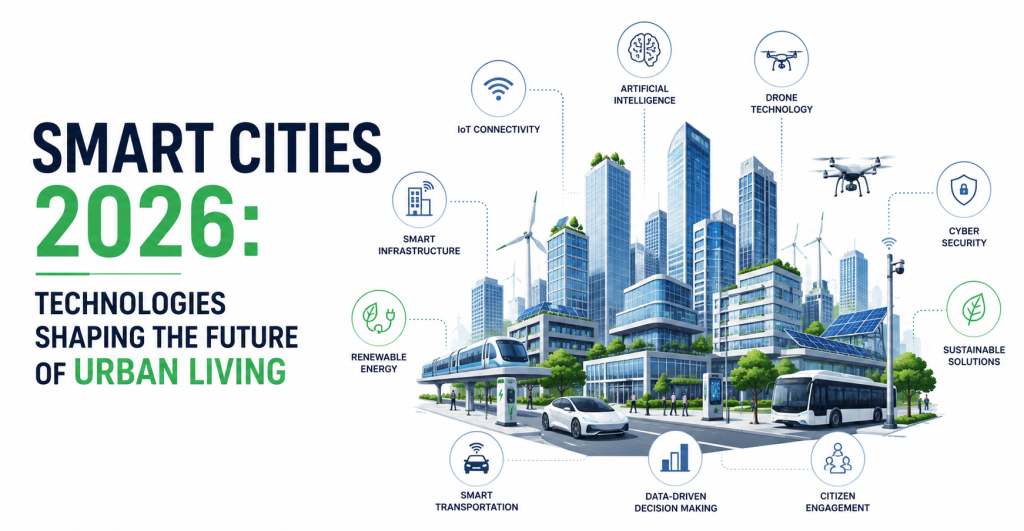

The future of urban living is rapidly taking shape as smart city technologies become a central focus for governments, businesses, and technology innovators worldwide. In 2026, cities are embracing intelligent infrastructure to improve transportation, public safety, energy efficiency, healthcare, and digital governance. Driven by advancements in Artificial Intelligence (AI), the Internet of Things (IoT), 5G, cloud computing, and edge computing, smart cities are creating sustainable environments that enhance the quality of life for millions of people.
The Rise of Smart Cities in 2026
Rapid urbanization continues to place increasing pressure on transportation systems, utilities, healthcare, and public services. To address these challenges, city administrations are investing in digital infrastructure capable of collecting and analyzing real-time data. Intelligent technologies help optimize city operations, improve resource management, and enable faster decision-making while reducing operational costs.
Modern smart cities integrate digital technologies into everyday services, allowing authorities to monitor traffic, manage energy distribution, detect infrastructure issues, and improve emergency response through connected systems. These innovations are helping cities become more resilient while supporting long-term economic and environmental goals.
Artificial Intelligence Is Powering Urban Transformation
Artificial Intelligence has become one of the key drivers behind smart city development. AI-powered analytics enable governments to process massive volumes of urban data, identify patterns, and make informed decisions that improve city operations. From predictive maintenance of roads and bridges to optimizing public transportation schedules, AI is increasing efficiency across multiple sectors.
Machine learning models also assist city planners by forecasting population growth, traffic patterns, energy demand, and environmental changes. This data-driven approach enables smarter planning while reducing waste and improving public services.
Smart Mobility Is Redefining Transportation
Transportation remains one of the most visible areas of smart city innovation. Intelligent traffic management systems use AI and IoT sensors to monitor vehicle movement in real time, helping reduce congestion and improve travel times. Connected public transportation networks provide passengers with live updates, digital ticketing, and optimized route planning.
Electric vehicle infrastructure is expanding steadily, with smart charging stations supporting the transition toward cleaner mobility. Smart parking technologies also help drivers locate available parking spaces, reducing unnecessary traffic and fuel consumption.
Sustainability Is at the Core of Smart Cities
Environmental sustainability has become a major priority for cities worldwide. Smart energy grids are improving electricity distribution by balancing supply and demand while integrating renewable energy sources such as solar and wind power. Intelligent street lighting systems automatically adjust brightness based on surrounding activity, reducing electricity consumption without compromising public safety.
Water management systems equipped with IoT sensors monitor pipelines, detect leaks, and improve resource conservation. Smart waste management solutions optimize collection routes using real-time data, helping cities lower operational costs while reducing carbon emissions.
Digital Governance Is Improving Citizen Services
Governments are increasingly adopting digital platforms that simplify interactions between citizens and public authorities. Residents can access permits, licenses, tax payments, healthcare services, and public records through secure online portals.
Digital identity solutions and secure authentication technologies are improving accessibility while reducing paperwork and administrative delays. These initiatives enhance transparency, strengthen citizen engagement, and make government services more efficient.
Cybersecurity and Data Privacy Remain Essential
As cities become more connected, protecting digital infrastructure has become increasingly important. Smart city ecosystems rely on secure networks that protect sensitive information while ensuring uninterrupted public services.
Governments and technology providers continue investing in advanced cybersecurity frameworks, AI-powered threat detection, encrypted communications, and privacy-focused data management practices to safeguard connected infrastructure against evolving cyber threats.
Economic Opportunities Continue to Expand
The rapid adoption of smart city technologies is generating significant opportunities across industries including telecommunications, construction, cloud computing, renewable energy, cybersecurity, transportation, and artificial intelligence.
Businesses developing innovative urban technologies are benefiting from increased public and private sector investments, while new employment opportunities continue to emerge in digital infrastructure, software development, engineering, and data analytics.
Future Outlook for Smart Cities
Industry experts expect smart city investments to continue growing throughout the coming years as governments prioritize climate resilience, digital transformation, and sustainable urban development. Future cities will increasingly rely on connected infrastructure capable of responding dynamically to changing environmental, economic, and population demands.
Collaboration between governments, technology companies, research institutions, and infrastructure providers will remain essential for building cities that are efficient, inclusive, secure, and environmentally responsible.
Key Smart City Trends in 2026
- Artificial Intelligence enabling predictive urban planning.
- IoT sensors delivering real-time infrastructure monitoring.
- Smart traffic management reducing congestion.
- Expansion of electric vehicle charging infrastructure.
- Digital twins improving city planning and maintenance.
- Smart energy grids supporting renewable energy integration.
- Intelligent water and waste management systems.
- 5G and edge computing accelerating connected services.
- AI-powered public safety and emergency response solutions.
- Secure digital government services improving citizen experiences.
Conclusion
Smart cities are reshaping the future of urban living by combining digital innovation with sustainable development. As AI, IoT, intelligent infrastructure, and connected services continue to evolve, cities will become more efficient, environmentally responsible, and responsive to the needs of their citizens. Continued investment in smart technologies is expected to drive economic growth, improve public services, and create safer, greener, and more connected communities across the globe.