
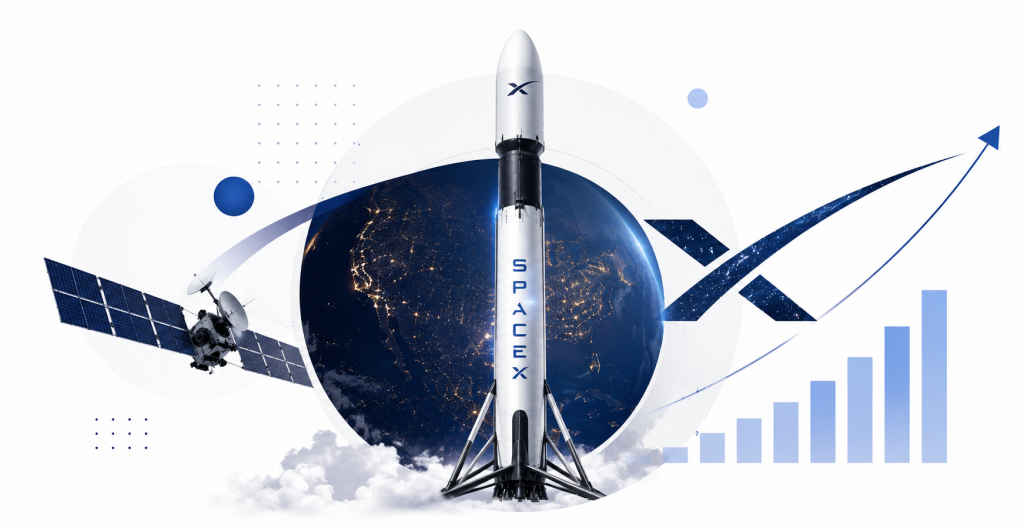

Not long ago, the idea of a private company competing with national space agencies sounded unrealistic. Space exploration was largely the domain of governments, requiring enormous budgets, decades of planning, and highly specialized expertise. Today, that narrative has changed dramatically, and much of the credit goes to SpaceX.
Over the past two decades, SpaceX has evolved from an ambitious startup into one of the most influential companies in the world. While its rocket launches and ambitious Mars plans regularly generate headlines, the latest buzz surrounding the company is focused on something else its rapidly growing valuation.
As investors pour billions into emerging technologies and future-focused industries, SpaceX has become one of the most closely watched private companies on the planet. But what exactly is driving its valuation, and why are financial markets, technology enthusiasts, and business leaders paying such close attention?
More Than a Rocket Company
One of the biggest misconceptions about SpaceX is that it is simply a rocket manufacturer.
In reality, the company has positioned itself at the intersection of multiple high-growth industries. It operates in aerospace, telecommunications, satellite services, artificial intelligence infrastructure, defense technology, and future space exploration.
This broad reach makes SpaceX different from traditional aerospace companies. Investors are not valuing the company solely based on the number of launches it performs each year. Instead, they are evaluating its potential to influence several industries simultaneously.
The result is a company that many analysts view as a long-term technology powerhouse rather than a conventional space business.
The Power of Turning Science Fiction Into Reality
Few companies have successfully converted futuristic ideas into commercial success at the scale SpaceX has achieved.
Reusable rockets were once considered impractical. Today, they are a core part of SpaceX’s operations. The company routinely launches rockets, lands them safely, and reuses them for future missions.
This achievement transformed the economics of space travel.
Lower launch costs mean more satellites, more scientific missions, more commercial opportunities, and greater accessibility for organizations worldwide. By solving one of the industry’s biggest cost challenges, SpaceX created a significant competitive advantage that continues to strengthen its market position.
Investors tend to reward companies that redefine industries rather than simply participate in them, and SpaceX is a prime example.
Starlink Is Changing the Investment Story
While rockets built the company’s reputation, Starlink is increasingly becoming the business that drives investor excitement.
Starlink’s mission is simple yet powerful: deliver reliable internet connectivity to virtually any location on Earth.
In many remote regions, internet infrastructure remains limited or nonexistent. Traditional solutions often require expensive ground networks and years of development. Starlink approaches the problem differently by using a growing constellation of satellites orbiting the planet.
For users in rural communities, remote businesses, maritime operations, and disaster-affected regions, satellite internet offers a valuable alternative.
What makes Starlink particularly attractive to investors is its recurring revenue model. Unlike launch services, which generate income project by project, internet subscriptions can provide continuous cash flow. This creates the potential for a stable and scalable business capable of supporting SpaceX’s larger ambitions.
Many market observers believe Starlink could eventually become as important as the company’s launch operations, if not more.
A Front-Row Seat to the Future
Investors are often willing to pay a premium for companies that offer exposure to future industries.
SpaceX sits at the center of several long-term trends that are expected to shape the coming decades:
- Global internet connectivity
- Commercial space exploration
- Satellite-based communications
- Lunar missions
- Space-based infrastructure
- Deep-space transportation
Rather than betting on a single market, investors see SpaceX as a gateway to multiple emerging opportunities.
This diversified future potential is one reason its valuation continues to attract attention despite broader market uncertainty.
Starship: The Billion-Dollar Vision
Every major technology company has a project that symbolizes its future. For SpaceX, that project is Starship.
Unlike existing rockets, Starship is designed to be larger, more powerful, and fully reusable. Its goal is not merely to launch satellites but to support a new era of space transportation.
If successful, Starship could transform how cargo, scientific equipment, and even people travel beyond Earth.
The implications are enormous.
Future lunar missions, large-scale satellite deployments, deep-space research, and eventually Mars exploration could all depend on technologies similar to Starship.
While many of these opportunities remain years away, investors frequently assign value based on future possibilities. The potential success of Starship plays a major role in shaping expectations around SpaceX’s long-term worth.
Why Traditional Valuation Models Struggle
One reason SpaceX’s valuation sparks debate is that traditional valuation methods don’t always capture its unique position.
Most companies are valued using predictable metrics such as earnings, revenue growth, and market share.
SpaceX is different.
A significant portion of its value comes from innovation, technological leadership, intellectual property, and future market creation. Investors are not only evaluating what SpaceX earns today but also what it might enable tomorrow.
This is similar to how investors once viewed companies like Amazon, Tesla, and other disruptive businesses during their growth phases.
The difference is that SpaceX is attempting to transform an industry that extends far beyond Earth itself.
Competition Is Growing, But So Is Opportunity
As SpaceX continues to expand, competition is becoming more intense.
Governments around the world are investing heavily in space programs. Private companies are launching their own satellite networks, developing launch vehicles, and exploring new commercial opportunities.
However, increased competition also highlights the growing importance of the industry.
The global space economy is expected to expand significantly over the coming years as demand rises for communication services, navigation systems, Earth observation technologies, and commercial missions.
Because SpaceX currently occupies a leadership position in several of these areas, many investors believe it is well placed to benefit from future growth.
Beyond Financial Headlines
The fascination with SpaceX’s valuation goes beyond finance.
For many people, the company represents something larger: the possibility of solving complex challenges through innovation.
Its achievements have inspired entrepreneurs, engineers, students, and investors worldwide. Whether launching astronauts, connecting remote communities, or pursuing interplanetary exploration, SpaceX continues to demonstrate how ambitious goals can reshape industries.
That broader influence is one reason discussions about the company’s valuation attract so much public attention.
Final Thoughts
SpaceX’s valuation is making headlines because it reflects confidence in a future that once seemed impossible.
The company is no longer just launching rockets. It is helping redefine communications, transportation, connectivity, and space exploration. Through innovations like reusable rockets, Starlink, and Starship, SpaceX has positioned itself at the center of some of the world’s most transformative technological shifts.
While questions remain about future growth and market conditions, one thing is certain: SpaceX has become far more than a space company. It has become a symbol of what can happen when bold ideas meet relentless execution and that is exactly why the world continues to watch.