
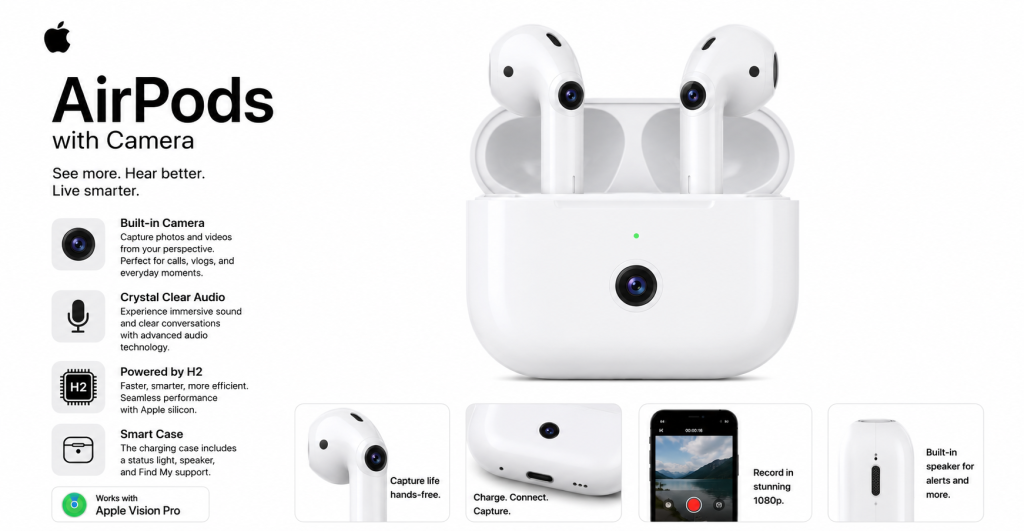

The concept of AirPods with integrated cameras is emerging as one of the most exciting innovations in the wearable technology industry. As consumers increasingly seek smarter and more connected devices, technology companies are exploring ways to combine audio, artificial intelligence (AI), augmented reality (AR), and visual sensing into a single wearable product. AirPods with cameras represent the next evolution of wireless earbuds, offering users a hands-free way to capture images, interact with digital environments, and access advanced AI-powered features.
Industry experts believe that camera-equipped earbuds could transform how people communicate, navigate, consume content, and interact with the world around them. The growing adoption of AI, computer vision, and wearable electronics is expected to drive significant interest in this emerging product category over the coming decade.
What Are AirPods with Cameras?
AirPods with cameras are wireless earbuds equipped with miniature camera sensors capable of capturing images, videos, and environmental data. Unlike traditional earbuds that focus solely on audio playback and voice communication, these next-generation devices integrate visual intelligence features.
The cameras may not necessarily be designed for photography in the traditional sense. Instead, they can function as sensors that enable real-time object recognition, gesture control, spatial awareness, and augmented reality experiences. Combined with AI algorithms, these cameras can interpret surroundings and provide contextual information directly to users through audio feedback.
The integration of cameras into earbuds creates a unique wearable ecosystem where audio and visual data work together to enhance user experiences.
Key Technologies Driving Innovation
Artificial Intelligence and Computer Vision
AI-powered computer vision systems are central to the development of camera-enabled AirPods. These technologies allow earbuds to identify objects, recognize faces, translate text, and understand environmental conditions in real time.
For example, users could receive audio descriptions of nearby landmarks, navigation assistance, or instant language translations without needing to look at a smartphone screen.
Augmented Reality Integration
Camera-equipped earbuds could play an important role in future AR ecosystems. By collecting spatial information from the environment, the devices can help create immersive AR experiences that blend digital content with the physical world.
This capability could support gaming, virtual meetings, education, and professional training applications.
Miniaturized Imaging Sensors
Advancements in sensor miniaturization have made it possible to fit powerful cameras into extremely small wearable devices. Modern imaging technologies consume less power while delivering higher-quality data, making them suitable for compact products such as wireless earbuds.
Edge Computing
Edge AI processing allows data captured by onboard cameras to be analyzed locally, reducing latency and improving privacy. This technology enables real-time decision-making without relying entirely on cloud-based systems.
Industry Drivers
Rising Demand for Smart Wearables
Consumers are increasingly adopting smartwatches, fitness trackers, smart glasses, and wireless earbuds. The success of these products has created strong demand for multifunctional wearables that offer enhanced convenience and connectivity.
AirPods with cameras align perfectly with this trend by combining audio, visual sensing, and AI capabilities into a single device.
Growth of AI-Powered Consumer Electronics
The rapid expansion of generative AI and intelligent assistants is encouraging manufacturers to develop hardware capable of supporting advanced AI experiences. Camera-equipped earbuds can serve as an always-available interface for AI-powered interactions.
Expansion of Augmented Reality Applications
As AR technology becomes more mainstream, the need for wearable devices that can gather environmental data continues to increase. Camera-enabled AirPods could become valuable components within broader AR ecosystems.
Accessibility and Assistive Technology
One of the most promising applications involves assisting visually impaired individuals. AI-enabled cameras can identify objects, read text aloud, and provide navigation support, significantly improving accessibility and independence.
Challenges Ahead
Privacy Concerns
The inclusion of cameras in everyday wearable devices raises concerns regarding privacy and data security. Users and regulators may demand strict safeguards to prevent unauthorized recording and misuse of personal information.
Battery Life Limitations
Camera operation and AI processing require substantial power. Manufacturers must develop efficient battery technologies and power management systems to ensure practical usage durations.
Technical Complexity
Integrating cameras, microphones, processors, and wireless connectivity into compact earbuds presents significant engineering challenges. Maintaining comfort, performance, and durability remains a key priority for manufacturers.
Regulatory Compliance
Governments worldwide may introduce regulations governing wearable cameras, data collection, and AI-driven surveillance features, potentially influencing product development and market adoption.
Market Impact and Timeline
If successful, camera AirPods could expand the hearables market beyond audio into ambient computing. The global wireless earbuds sector continues growing, and Apple holds a commanding share, often estimated around 40-60% depending on the metric. Adding visual intelligence opens doors to accessibility features, productivity tools, navigation, and deeper health insights. Originally targeted for 2026, recent updates suggest a possible delay to late 2027, aligning with Apple’s major product pushes like the 20th-anniversary iPhone. This would allow more time for the advanced Siri AI to mature. Prototypes are already being tested internally, indicating the hardware is close, but software readiness is key.
Final Thoughts
The future of AirPods with cameras appears highly promising as advancements in artificial intelligence, computer vision, and wearable electronics continue to accelerate. Major technology companies are investing heavily in next-generation wearable devices capable of delivering richer, more immersive experiences.
Over the next decade, camera-equipped earbuds may evolve into intelligent personal assistants that understand both what users hear and what they see. From real-time language translation and navigation assistance to augmented reality and accessibility solutions, these devices have the potential to redefine wearable technology.
As innovation continues and technical barriers are overcome, AirPods with cameras could emerge as a transformative product category, bridging the gap between audio devices, smart glasses, and AI-powered personal computing.