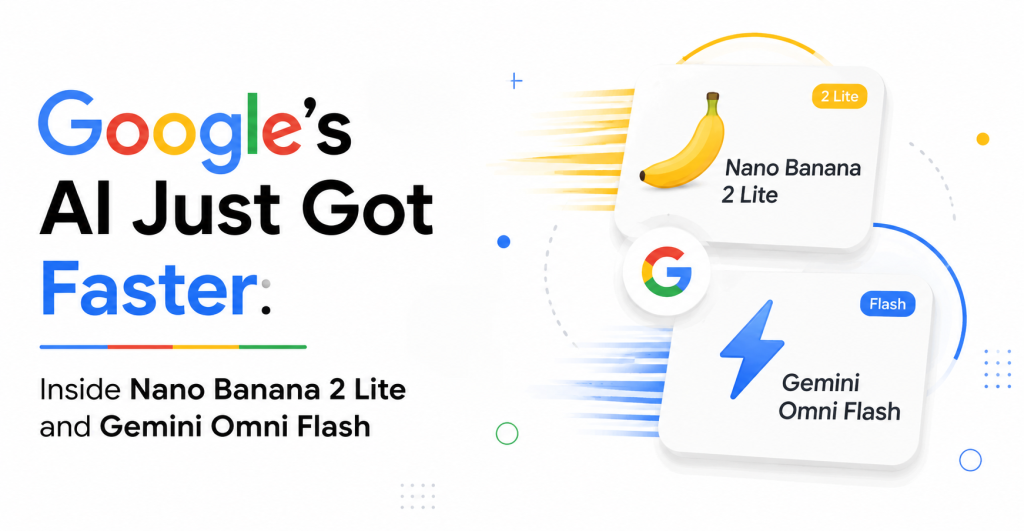

Just when it seemed the AI industry couldn’t move any faster, Google has introduced another major update that is turning heads across the technology world. With the rollout of Nano Banana 2 Lite and Gemini Omni Flash, the company is showing that the future of artificial intelligence isn’t only about building smarter models it’s about making them faster, lighter, and more practical for everyday use.
Over the past two years, AI has transformed from an experimental technology into an essential part of daily life. Businesses rely on it to automate workflows, creators use it to produce content, developers build intelligent applications with it, and millions of people interact with AI-powered tools every single day. As demand continues to grow, users are looking for more than impressive capabilities they want speed, affordability, and a seamless experience.
Google’s latest AI rollout is designed to meet those expectations. Nano Banana 2 Lite focuses on delivering high-quality image generation with greater efficiency, while Gemini Omni Flash brings faster and more responsive multimodal AI experiences. Together, they reflect Google’s strategy of making advanced AI tools more accessible to creators, businesses, and developers without requiring massive computing resources.
In an increasingly competitive AI landscape, every new release shapes how people create, communicate, and work. Google’s newest models are not just another product launch they represent the next step toward AI that feels faster, more practical, and better suited to the demands of modern digital life.
Why This Launch Is Making Headlines
The AI industry is no longer competing only on intelligence. Today’s race is equally about speed, efficiency, affordability, and user experience. Whether someone is designing marketing content, editing videos, building applications, or generating creative ideas, they expect AI to deliver results almost instantly.
That is where Google’s latest models aim to make a difference.
Instead of simply creating larger and more powerful systems, the company is focusing on optimizing performance so AI becomes more responsive, scalable, and useful across a wide range of real-world applications. For businesses, this could mean faster content production and lower operational costs. For developers, it opens opportunities to build more responsive AI-powered applications. For creators, it allows them to spend less time waiting for results and more time refining their ideas.
As artificial intelligence becomes deeply integrated into everyday workflows, innovations like Nano Banana 2 Lite and Gemini Omni Flash highlight a clear shift in the industry’s direction AI is no longer just becoming smarter; it is becoming significantly faster and more accessible.
Nano Banana 2 Lite: Small Model, Big Potential
One of the biggest highlights of Google’s latest announcement is Nano Banana 2 Lite. Despite its playful name, the model represents a serious step toward making AI image generation faster and more efficient.
Traditional AI image models often require significant computing power and longer processing times, especially when handling complex prompts. Nano Banana 2 Lite is designed to reduce that gap by delivering high-quality results while using fewer resources.
For creators, this means less waiting and more creating. Designers can quickly generate concept art, marketers can produce campaign visuals in minutes, and developers can integrate AI-powered image generation into their applications without placing heavy demands on computing infrastructure.
Perhaps the biggest advantage is accessibility. Faster and lighter models allow a broader range of users including startups, freelancers, educators, and small businesses to experiment with AI-powered creativity without requiring enterprise-level hardware.
Rather than replacing professional design tools, Nano Banana 2 Lite is positioned as a productivity enhancer that speeds up the creative process and helps users move from idea to execution much faster.
Gemini Omni Flash Brings AI to Life
Alongside Nano Banana 2 Lite, Google has introduced Gemini Omni Flash, a model designed to make multimodal AI interactions faster and more responsive.
Unlike traditional AI systems that focus mainly on text, Gemini Omni Flash is built to understand and generate multiple forms of content, including images and videos. This allows users to create richer digital experiences from a single AI workflow.
Imagine generating an image, refining it through simple prompts, and then transforming it into a short video all within the same ecosystem. That level of integration could significantly reduce the time needed for content production.
For content creators, this opens exciting possibilities. Social media marketers can produce campaign assets more quickly, educators can create engaging visual lessons, and businesses can generate marketing materials without relying on multiple software platforms.
The result is an AI experience that feels faster, more connected, and better suited to the growing demand for multimedia content.
Why This Matters Beyond Technology
The launch of these models is about more than impressive software it reflects a broader shift in how artificial intelligence is becoming part of everyday work.
Businesses increasingly depend on AI for marketing, customer support, design, research, and software development. As adoption grows, users care less about technical specifications and more about whether AI can help them complete tasks efficiently.
Google appears to understand this changing expectation. Instead of focusing solely on larger models with more parameters, the company is investing in solutions that prioritize speed, usability, and affordability.
This strategy could make AI more practical for millions of users who simply want reliable tools that fit naturally into their daily workflows.
Competition in the AI Race Is Intensifying
Google’s announcement also comes during an increasingly competitive period for artificial intelligence.
Major technology companies continue releasing new AI models, each trying to improve speed, accuracy, creativity, and user experience. Competition is no longer limited to who has the smartest chatbot it now includes image generation, video creation, multimodal capabilities, developer tools, and enterprise solutions.
Every new release pushes the industry forward, encouraging faster innovation while giving users more choices than ever before.
For businesses, this growing competition is positive because it drives better products, lower costs, and more advanced AI capabilities.
Looking Ahead
The rollout of Nano Banana 2 Lite and Gemini Omni Flash suggests that the next chapter of artificial intelligence will focus on making powerful technology easier to use rather than simply making it more complex.
Faster image generation, smoother multimedia creation, and more efficient AI workflows will likely become standard expectations instead of premium features.
As artificial intelligence continues evolving, businesses, creators, and developers who adopt these tools early may gain a significant advantage by producing content faster, reducing operational costs, and accelerating innovation.
Final Thoughts
Google’s latest AI rollout demonstrates that the future of artificial intelligence is not only about creating smarter models it is about building tools that work faster, respond more naturally, and fit seamlessly into everyday life.
Nano Banana 2 Lite and Gemini Omni Flash represent another important milestone in Google’s AI journey, showing how intelligent technology is becoming more practical, accessible, and creator-friendly.
As competition across the AI industry continues to accelerate, users can expect even more powerful tools that simplify creativity, improve productivity, and unlock new possibilities across industries.
For now, one thing is clear: Google’s newest AI models are not simply keeping pace with the AI revolution they are helping shape where it goes next.