
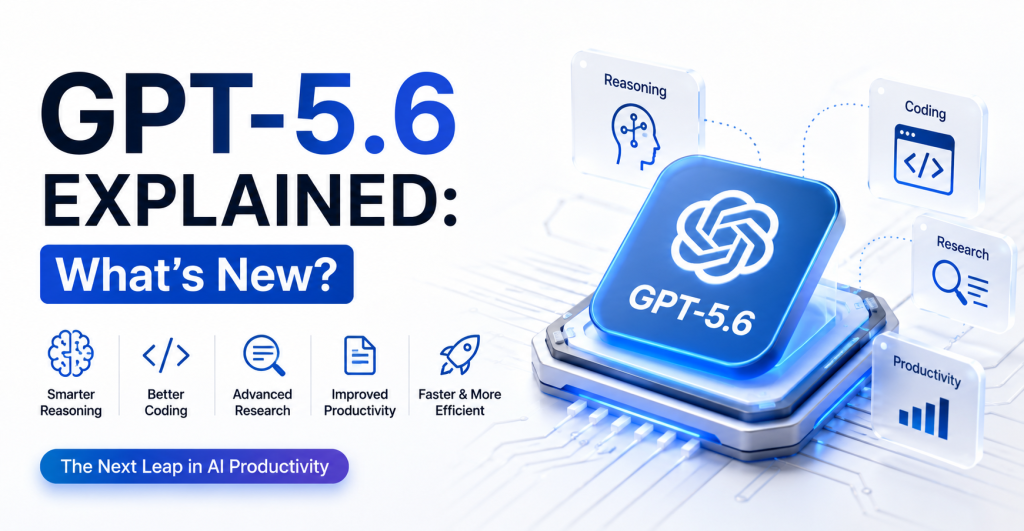

Artificial intelligence is evolving at an incredible pace, and OpenAI’s GPT-5.6 is the latest milestone. Released in July 2026, the model introduces significant improvements in reasoning, efficiency, coding, research, and productivity. Rather than simply generating better text, GPT-5.6 is designed to handle complex workflows, collaborate with users, and automate multi-step tasks more effectively than previous generations.
As businesses, developers, marketers, and students increasingly rely on AI for daily work, GPT-5.6 represents a shift from conversational AI to a true productivity assistant.
What Is GPT-5.6?
GPT-5.6 is OpenAI’s newest flagship AI model family, built to provide more intelligence per token while reducing costs and improving response quality. Instead of focusing solely on chat, GPT-5.6 enhances:
- Advanced reasoning
- Long-form research
- Software development
- Business productivity
- Scientific analysis
- Document creation
- Design assistance
The new release introduces three model variants:
- GPT-5.6 Sol – Highest capability for complex reasoning and professional work
- GPT-5.6 Terra – Balanced performance and cost for everyday business tasks
- GPT-5.6 Luna – Lightweight and cost-efficient for high-volume workloads
Why GPT-5.6 Is Different
Earlier AI models primarily answered questions or generated content. GPT-5.6 goes much further by planning, executing, refining, and verifying tasks with greater autonomy.
Major improvements include:
Better Reasoning
The model spends more time solving difficult problems before responding.
This improves:
- Logical thinking
- Math
- Programming
- Multi-step analysis
- Strategic planning
Instead of producing the first likely answer, GPT-5.6 evaluates multiple possibilities before generating a response.
Smarter Coding
Developers receive:
- Better debugging
- Cleaner code generation
- Stronger understanding of large codebases
- Improved software architecture suggestions
GPT-5.6 can coordinate multiple development tasks while reducing unnecessary tool usage, making coding workflows faster and more efficient.
Improved Research
One of GPT-5.6’s biggest strengths is handling lengthy research projects.
Examples include:
- Financial analysis
- Market research
- Legal document review
- Technical reports
- Scientific literature
The model can process large amounts of information while maintaining context throughout long conversations.
Better Document Creation
GPT-5.6 produces more polished outputs for:
- Reports
- Business presentations
- Excel models
- Word documents
- Marketing materials
It also follows formatting instructions more accurately than previous versions, reducing manual editing.
Faster and More Efficient
One of the biggest improvements isn’t just intelligence—it’s efficiency.
OpenAI reports that GPT-5.6 completes many tasks using fewer tokens while maintaining or improving output quality. This helps lower computing costs and speeds up responses, making the model more practical for enterprise-scale deployments.
ChatGPT Work: AI That Completes Tasks
Alongside GPT-5.6, OpenAI introduced ChatGPT Work, an AI workspace designed for professionals.
Instead of simply answering prompts, ChatGPT Work can assist with ongoing projects by:
- Creating presentations
- Writing reports
- Building spreadsheets
- Managing documents
- Browsing information
- Coordinating workflows across connected tools
The goal is to reduce repetitive work and support users through longer, more complex tasks.
Who Benefits the Most?
Businesses
Organizations can automate:
- Documentation
- Customer support
- Research
- Internal knowledge management
- Workflow automation
Developers
Programming teams gain:
- Faster debugging
- Better code generation
- Improved documentation
- Enhanced testing assistance
Marketers
Content teams can create:
- Blog articles
- SEO content
- Social media campaigns
- Product descriptions
- Market reports
with greater consistency and speed.
Students and Researchers
Academic users benefit from:
- Literature reviews
- Research summaries
- Study guides
- Data interpretation
- Writing assistance
GPT-5.6 vs Previous Models
Compared with earlier GPT models, GPT-5.6 delivers improvements in several key areas:
| Feature | Earlier GPT Models | GPT-5.6 |
|---|---|---|
| Reasoning | Good | Significantly improved |
| Coding | Strong | More accurate and efficient |
| Research | Good | Better long-context understanding |
| Productivity | Basic assistance | End-to-end workflow support |
| Document creation | High quality | More polished and format-aware |
| Efficiency | Standard | Higher performance with fewer tokens |
These enhancements make GPT-5.6 more suitable for enterprise use cases and demanding professional workflows.
Growing Enterprise Adoption
Technology companies are already integrating GPT-5.6 into workplace tools. Microsoft has announced GPT-5.6 as the preferred model for Microsoft 365 Copilot, bringing its capabilities to applications such as Word, Excel, PowerPoint, and other productivity services. This reflects the broader industry trend of embedding advanced AI into everyday business software.
The Future of AI Productivity
GPT-5.6 signals a broader shift in artificial intelligence—from answering isolated questions to helping users complete complex, multi-step projects. As AI becomes more integrated into professional workflows, organizations are expected to adopt these tools for research, software development, content creation, business operations, and decision-making.
Future advancements are likely to focus on deeper automation, stronger collaboration with users, and seamless integration across workplace applications, making AI an increasingly essential part of modern productivity.
Conclusion
GPT-5.6 is more than an incremental update—it represents a significant step toward AI systems that can reason, create, and assist across complex workflows. With improvements in reasoning, coding, research, document generation, and efficiency, it offers practical benefits for professionals, businesses, developers, and students alike. As AI adoption continues to accelerate, GPT-5.6 is poised to play a central role in shaping the next generation of digital productivity and intelligent work.