
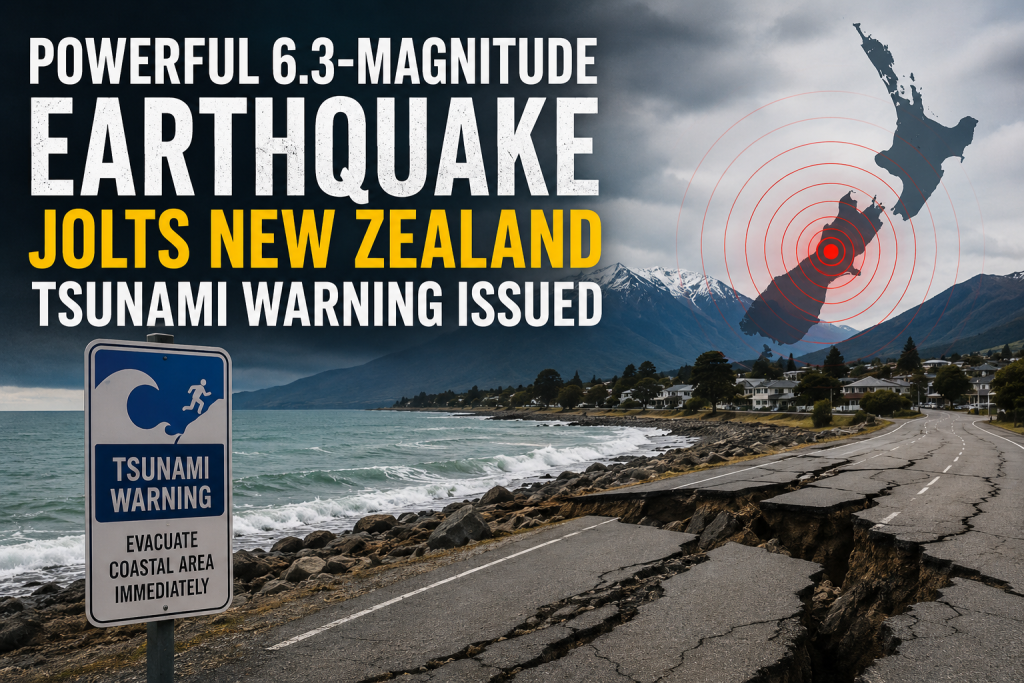

A 6.3-magnitude earthquake struck near Te Anau on New Zealand’s South Island on Thursday, triggering a temporary tsunami warning and prompting emergency authorities to monitor coastal regions for potential hazards. The quake was widely felt across Southland, Otago, and Canterbury, with thousands of residents reporting strong shaking.
Authorities initially warned residents to stay away from beaches, harbors, rivers, and estuaries due to the possibility of dangerous tsunami activity. However, after further assessment, the tsunami threat was downgraded, although officials continued advising caution because of the risk of strong currents and unpredictable surges.
Epicenter Near Te Anau
According to initial reports, the earthquake occurred near Te Anau, a gateway to the renowned Fiordland National Park. The tremor occurred at a depth of approximately 53 kilometers, making it widely perceptible across southern New Zealand.
Residents described the earthquake as a prolonged and intense shaking, with many evacuating buildings as a precaution. Several aftershocks were also recorded shortly after the main event.
Tsunami Warning Issued and Later Downgraded
Following the earthquake, New Zealand’s emergency management authorities issued a tsunami warning for parts of the South Island coastline. Coastal communities were advised to move away from beaches and low-lying shoreline areas while authorities evaluated the risk.
Within a short period, officials downgraded the warning after determining that no significant tsunami had formed. Nevertheless, emergency agencies emphasized that hazardous marine conditions, including unusually strong currents and surges, could continue for several hours.
Infrastructure Assessment Underway
Authorities have begun inspecting roads, bridges, and public infrastructure across the affected region. As a precaution, some transport routes were temporarily restricted while engineers assessed potential damage and monitored for rockfalls or debris.
At the time of reporting, there were no immediate reports of major casualties or widespread structural damage, though inspections remain ongoing.
Why New Zealand Experiences Frequent Earthquakes
New Zealand is situated along the Pacific Ring of Fire, one of the world’s most seismically active regions where the Pacific and Australian tectonic plates interact. This geological setting results in frequent earthquakes and occasional volcanic activity, making the country highly susceptible to seismic events.
While many earthquakes cause minimal damage, authorities maintain sophisticated monitoring systems and emergency response protocols to minimize risks to residents and visitors.
Authorities Urge Continued Vigilance
Emergency officials have urged residents to remain alert for aftershocks and to continue following official advisories. Coastal residents have been advised to avoid beaches, marinas, and river mouths until authorities declare conditions completely safe.
New Zealand’s geological monitoring agencies continue to assess seismic activity and provide real-time updates as the situation evolves.
Conclusion
The powerful earthquake serves as another reminder of New Zealand’s location within one of the world’s most active seismic zones. Although the immediate tsunami threat has subsided and no major damage has been reported, authorities continue to monitor aftershocks and coastal conditions while conducting infrastructure inspections. Residents are encouraged to stay informed through official emergency channels until all advisories are lifted.
FAQs
What was the magnitude of the New Zealand earthquake?
The earthquake was initially reported as magnitude 6.3, striking near Te Anau on New Zealand’s South Island.
Was a tsunami warning issued?
Yes. Authorities issued a temporary tsunami warning, which was later downgraded after assessments indicated no major tsunami threat.
Were there any casualties?
As of the latest available information, there were no immediate reports of fatalities or significant injuries, though assessments are ongoing.
Why does New Zealand experience frequent earthquakes?
New Zealand lies on the Pacific Ring of Fire, where the Pacific and Australian tectonic plates meet, making it one of the world’s most earthquake-prone regions.