

The global labor market has demonstrated remarkable resilience over the past few years, yet unemployment continues to be one of the most closely watched economic indicators by governments, businesses, and policymakers. While many economies have largely recovered from the disruptions caused by the COVID-19 pandemic, emerging challenges such as technological transformation, geopolitical tensions, demographic shifts, and uneven economic growth continue to shape employment opportunities worldwide.
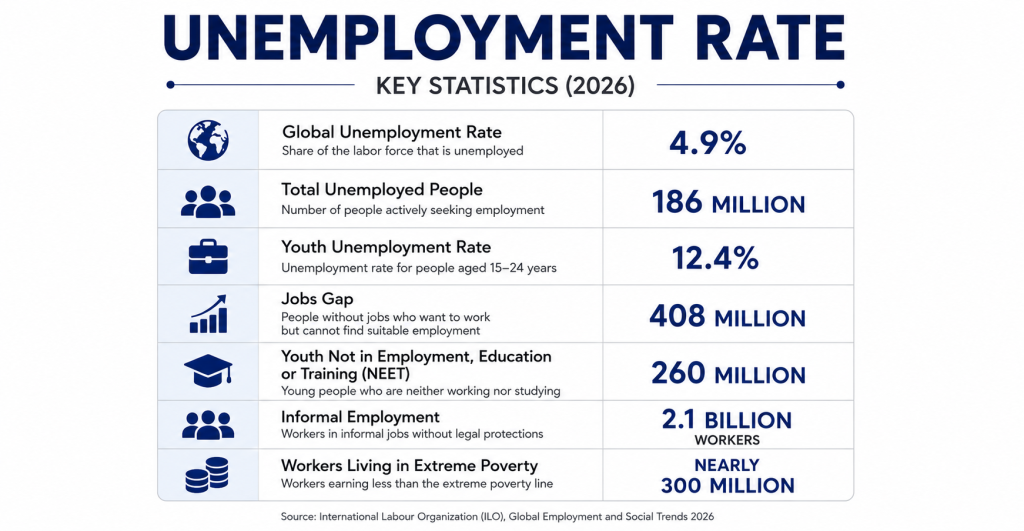
According to the latest International Labour Organization (ILO) estimates, the global unemployment rate is projected to remain at 4.9% in 2026, representing approximately 186 million unemployed people worldwide. Although this reflects relative stability compared to previous years, experts emphasize that unemployment figures alone do not fully capture labor market health. Millions of people remain underemployed, employed in informal jobs, or have stopped actively searching for work due to limited opportunities.
Labor Markets Show Stability but Underlying Challenges Persist
The post-pandemic recovery has enabled many countries to rebuild employment levels, particularly in service industries, manufacturing, and technology-driven sectors. However, slowing global economic growth and persistent inflationary pressures have made hiring decisions more cautious in many industries.
The International Labour Organization estimates that the world’s jobs gap—which includes unemployed individuals and those willing to work but unable to find suitable employment—stands at approximately 408 million people. This broader measure illustrates that labor market challenges extend well beyond official unemployment statistics and continue to affect millions of households across both developed and developing economies.
Key Global Unemployment Statistics (2026)
| Indicator | Latest Figure | Insights |
|---|---|---|
| Global Unemployment Rate | 4.9% | Reflects relatively stable global labor markets. |
| Estimated Unemployed Population | 186 Million | People actively seeking employment worldwide. |
| Global Jobs Gap | 408 Million | Includes unemployed individuals and those unable to access work. |
| Global Youth Unemployment Rate | 12.4% | Significantly higher than the overall unemployment rate. |
| Youth Not in Employment, Education or Training (NEET) | 260 Million | Highlights persistent employment challenges among young people. |
| Informal Employment | 2.1 Billion Workers | Workers lacking formal employment protections and benefits. |
| Workers Living in Extreme Poverty | Nearly 300 Million | Employment alone does not guarantee adequate income. |
Youth Continue to Face the Greatest Employment Challenges
Young workers remain among the most vulnerable groups in today’s labor market. The ILO estimates the global youth unemployment rate at 12.4%, which is more than double the overall global unemployment rate. This trend reflects increasing competition for skilled positions, limited work experience among graduates, and growing mismatches between education systems and employer requirements.
Additionally, around 260 million young people worldwide are classified as Not in Employment, Education, or Training (NEET). Prolonged periods without work or education can reduce lifetime earnings, weaken productivity, and create long-term social and economic challenges.
Many employers are increasingly prioritizing candidates with digital skills, artificial intelligence expertise, cloud computing knowledge, cybersecurity capabilities, and advanced technical qualifications, making continuous upskilling more important than ever.
Regional Employment Trends Present a Mixed Picture
Labor market performance continues to vary considerably across regions.
India’s unemployment rate remained at 5.5% in June 2026, reflecting a relatively stable labor market despite fluctuations across urban and rural sectors. Female unemployment remains comparatively higher, indicating that improving women’s labor force participation remains an important policy objective.
China continues to experience employment pressure among recent university graduates. A record number of graduates entered the labor market in 2026, increasing competition for professional positions. Although employment conditions have gradually improved, youth unemployment remains elevated compared to historical averages.
Among OECD economies, unemployment remained close to 5.0%, reflecting resilient labor markets despite slower economic growth and tighter monetary policies implemented in several countries over the past two years.
Technology Is Reshaping Employment Opportunities
Rapid technological advancement continues to transform labor markets across virtually every sector. Artificial intelligence, automation, robotics, and digital transformation are changing the skills employers seek while simultaneously creating entirely new categories of employment.
Demand continues to grow for professionals specializing in artificial intelligence, software development, cybersecurity, cloud infrastructure, renewable energy technologies, and data analytics. At the same time, routine administrative tasks and repetitive manufacturing jobs are becoming increasingly automated.
Experts believe technological innovation will continue to generate employment opportunities, but only if workers have access to reskilling and lifelong learning initiatives that enable them to adapt to evolving workplace requirements.
Informal Employment Remains a Global Concern
While official unemployment figures have improved in many countries, job quality remains an equally important issue. Approximately 2.1 billion workers worldwide continue to work in the informal economy without employment contracts, health insurance, pensions, or other social protections.
In addition, nearly 300 million workers continue to live in extreme poverty despite being employed. These figures highlight that employment growth alone is insufficient unless accompanied by improvements in wages, productivity, and working conditions.
Governments are increasingly focusing on policies that promote formal employment, strengthen labor protections, and encourage private-sector investment capable of generating higher-quality jobs.
Women Continue to Face Labor Market Barriers
Gender disparities remain one of the defining characteristics of global employment. Women continue to participate in the labor force at lower rates than men in many economies due to caregiving responsibilities, unequal access to opportunities, wage disparities, and structural barriers.
Increasing female labor force participation has become a major policy objective for many governments, as greater workforce inclusion can help address labor shortages while contributing to stronger long-term economic growth.
Investment in childcare services, flexible work arrangements, equal pay initiatives, and skills development programs is expected to play an increasingly important role in narrowing employment gaps.
Outlook for 2026 and Beyond
Economists expect the global unemployment rate to remain broadly stable throughout 2026. However, several uncertainties—including geopolitical conflicts, changing trade policies, inflation, climate-related disruptions, and rapid technological change—could influence hiring trends over the coming years.
Governments, businesses, and educational institutions are placing greater emphasis on workforce development, vocational training, digital education, and innovation to prepare workers for future labor market demands.
Although the global unemployment rate remains below the elevated levels experienced during the pandemic, policymakers caution that the quality of employment will be just as important as the quantity of jobs created. Closing skills gaps, expanding formal employment opportunities, supporting youth employment, and improving workforce participation among women will remain central priorities for building resilient labor markets.
As economies continue adapting to technological and structural transformation, unemployment statistics will remain one of the most important indicators for measuring economic progress, workforce resilience, and long-term sustainable development.