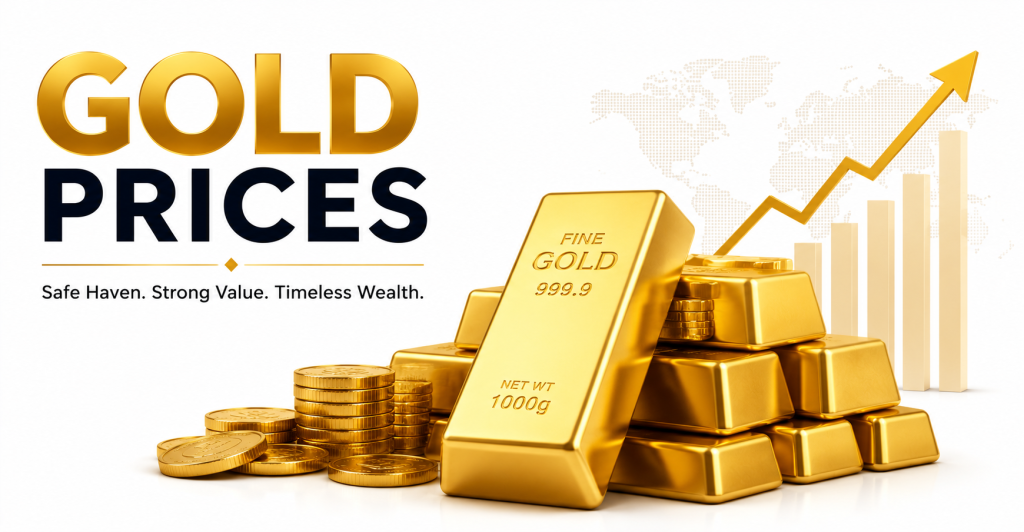

Gold prices continue to attract global attention as investors seek safe-haven assets amid ongoing economic uncertainty, geopolitical tensions, and evolving monetary policies. The precious metal has maintained strong momentum in recent months, supported by robust central bank purchases, expectations of interest rate adjustments, and persistent demand from both institutional and retail investors.
Traditionally viewed as a store of value, gold remains one of the world’s most important investment assets during periods of financial volatility. While equity and bond markets often react sharply to economic developments, gold has historically demonstrated resilience, making it a preferred choice for portfolio diversification and wealth preservation.
Safe-Haven Demand Supports Gold Prices
One of the primary drivers behind recent strength in gold prices is continued demand for safe-haven investments. Global economic uncertainty, changing trade policies, and geopolitical conflicts have encouraged investors to shift part of their portfolios toward assets considered less vulnerable to market fluctuations.
Financial analysts note that whenever uncertainty increases across global markets, investor interest in gold typically rises. This trend has remained evident throughout 2026, with investment demand contributing significantly to price stability despite fluctuations in other asset classes.
Market participants are also closely monitoring inflation trends, employment data, and economic growth indicators, as these factors heavily influence investor sentiment toward precious metals.
Central Banks Continue Expanding Gold Reserves
Central banks around the world remain among the largest buyers of gold, reinforcing long-term confidence in the precious metal. Many monetary authorities continue diversifying their foreign exchange reserves by increasing gold holdings to reduce dependence on individual reserve currencies.
Emerging economies have been particularly active in expanding official gold reserves over the past several years. These purchases not only strengthen national reserve portfolios but also provide consistent support for global gold demand.
Analysts believe that sustained central bank buying will remain an important structural factor supporting gold prices over the medium and long term, even during periods of temporary market corrections.
Interest Rate Expectations Influence Market Direction
Gold prices are closely linked to interest rate expectations, particularly those of major central banks. Since gold does not generate interest income, lower borrowing costs generally improve its attractiveness relative to interest-bearing assets such as government bonds.
Investors continue to assess signals from central banks regarding future monetary policy decisions. Expectations of gradual interest rate reductions have helped maintain positive sentiment in the gold market, while any indication of prolonged higher rates can temporarily moderate buying activity.
Currency movements also play a critical role. A weaker U.S. dollar often supports higher gold prices because the metal becomes relatively less expensive for international buyers using other currencies.
Jewelry and Investment Demand Remain Strong
Beyond financial markets, physical demand continues to provide important support for gold prices. Jewelry remains one of the largest sources of global gold consumption, particularly across Asia and the Middle East, where cultural traditions and seasonal celebrations contribute to steady purchasing activity.
Investment products such as gold exchange-traded funds (ETFs), digital gold platforms, bullion coins, and gold bars have also experienced continued investor interest. Retail investors increasingly view gold as a long-term hedge against inflation and currency depreciation.
Growing accessibility through digital investment platforms has made gold ownership easier for individual investors, further broadening participation in the precious metals market.
Mining Industry Responds to Higher Prices
Higher gold prices have encouraged mining companies to increase exploration activities and invest in expanding production capacity. Several mining firms continue developing new projects while adopting advanced technologies to improve operational efficiency and reduce production costs.
Automation, artificial intelligence, and digital monitoring systems are becoming increasingly common across mining operations, helping companies optimize resource extraction while improving workplace safety and environmental performance.
Despite these investments, industry experts note that bringing new mines into commercial production often requires several years, meaning supply growth generally responds slowly to sustained price increases.
Global Factors Continue to Drive Volatility
Gold prices remain highly sensitive to global economic developments. Inflation reports, employment figures, central bank announcements, currency fluctuations, and geopolitical events frequently influence short-term market movements.
International trade developments, energy price fluctuations, and political uncertainty also contribute to changing investor sentiment. As a result, gold markets often experience periods of heightened volatility even when long-term fundamentals remain supportive.
Investors are increasingly balancing opportunities presented by equities, cryptocurrencies, and fixed-income securities while maintaining gold as an important component of diversified investment portfolios.
Digital Innovation Is Expanding Gold Investment
Technology is transforming how investors access the gold market. Online trading platforms, digital gold products, blockchain-based ownership records, and mobile investment applications have simplified gold investing for both retail and institutional participants.
These innovations have increased market accessibility while improving transparency and liquidity. Younger investors, in particular, are increasingly incorporating digital gold products into their investment strategies alongside traditional financial assets.
Financial institutions continue introducing innovative products that allow investors to gain exposure to gold without requiring physical storage or transportation.
Outlook
Market analysts expect gold to remain an important asset throughout the remainder of 2026 as investors continue monitoring inflation, interest rates, economic growth, and geopolitical developments. While short-term price fluctuations are likely as markets react to new economic data, the broader investment case for gold remains supported by strong central bank demand, ongoing portfolio diversification, and persistent global uncertainty.
In addition, growing demand from emerging markets, technological advancements in investment platforms, and continued interest from institutional investors are expected to provide further support for the precious metal over the coming years.
As global financial conditions continue to evolve, gold is likely to maintain its position as one of the world’s most trusted safe-haven assets. Whether held for wealth preservation, inflation protection, or portfolio diversification, the precious metal remains a key indicator of investor confidence and global economic sentiment, ensuring that gold prices will continue to be closely watched by financial markets worldwide.