
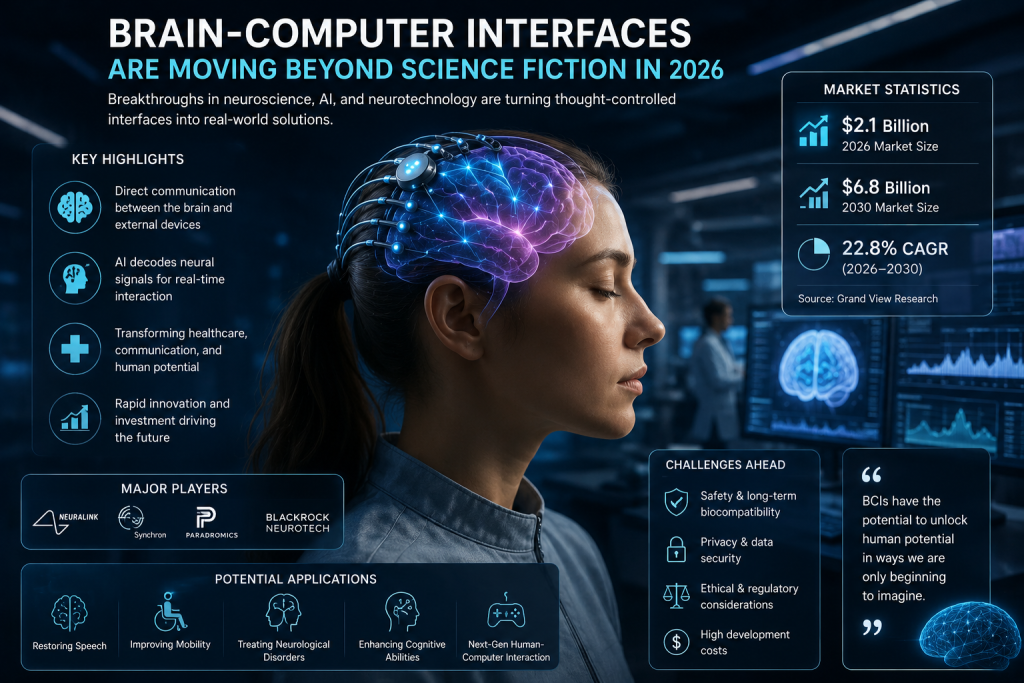

For decades, brain-computer interfaces (BCIs) existed primarily in science fiction, often portrayed as futuristic technologies capable of connecting the human brain directly with machines. In 2026, that vision is rapidly becoming reality. Recent breakthroughs in neuroscience, artificial intelligence, and neuroengineering have accelerated the development of brain-computer interfaces, transforming them from experimental concepts into real-world medical and technological innovations.
Technology companies, research institutions, and healthcare organizations worldwide are investing heavily in BCI development. As clinical trials expand and AI capabilities improve, experts believe brain-computer interfaces could fundamentally change how humans communicate, interact with digital systems, and restore lost neurological functions.
The Rise of Brain-Computer Interface Technology
Brain-computer interfaces establish direct communication pathways between the brain and external devices. By capturing and interpreting neural signals, BCIs allow individuals to control computers, robotic limbs, and other connected systems using only their thoughts.
Early BCI research was largely limited to laboratories and academic institutions. However, advancements in artificial intelligence, sensor technologies, and machine learning have significantly improved signal accuracy and real-time responsiveness, making commercial applications increasingly feasible.
The growing convergence of neuroscience and artificial intelligence is driving unprecedented innovation across the neurotechnology sector.
Why Interest in BCIs Is Growing Rapidly
Several factors are contributing to the increasing global interest in brain-computer interfaces.
One of the primary drivers is the potential to improve the quality of life for individuals living with neurological disorders, paralysis, or severe communication impairments. BCIs offer new possibilities for restoring speech, mobility, and independence.
Beyond healthcare, growing curiosity surrounding human-machine interaction and next-generation computing experiences is attracting attention from both consumers and technology companies.
As artificial intelligence continues to evolve, many experts view BCIs as a critical component of future human-computer interaction.
Artificial Intelligence Is Accelerating Innovation
Artificial intelligence plays a central role in modern brain-computer interface systems.
AI algorithms help decode complex neural activity patterns, enabling faster and more accurate interpretation of brain signals. Machine learning models continuously improve system performance by adapting to individual users and refining signal recognition capabilities over time.
This combination of neuroscience and AI is making brain-computer interfaces more reliable, efficient, and practical for real-world applications.
Transforming Healthcare and Human Communication
Healthcare remains the most significant application area for brain-computer interfaces.
Researchers are developing BCI technologies that can help restore communication abilities for patients affected by conditions such as paralysis, stroke, spinal cord injuries, and neurodegenerative diseases.
Advanced systems are already demonstrating the ability to convert neural activity into text or speech, enabling individuals with severe physical limitations to communicate more effectively.
Scientists are also exploring how BCIs may support rehabilitation therapies, cognitive assistance, and motor function restoration in the future.
Technology Companies and Researchers Driving Progress
Several leading organizations are actively advancing brain-computer interface innovation.
Companies developing implantable and non-invasive BCI technologies are focusing on improving safety, accuracy, scalability, and long-term usability. Significant investments from both private and public sectors continue to accelerate research and commercialization efforts.
Collaboration among neuroscientists, AI researchers, healthcare professionals, and technology companies is expected to further expand the capabilities of next-generation BCI platforms.
Challenges Still Need to Be Addressed
Despite remarkable progress, brain-computer interfaces still face several challenges.
Safety and regulatory approval remain critical considerations, particularly for implantable devices. Privacy concerns surrounding neural data collection and cybersecurity also continue to generate discussion among policymakers and researchers.
Additionally, the complexity of decoding brain activity, high development costs, and limited accessibility may slow widespread adoption in the near term.
Addressing these challenges will be essential to achieving large-scale commercialization.
What the Future Holds
Industry experts believe brain-computer interfaces could become one of the most transformative technologies of the coming decade.
Future advancements may enable seamless interaction between humans and digital systems, improved medical treatments, enhanced accessibility tools, and entirely new forms of communication.
As neuroscience and artificial intelligence continue to advance, the line between biological intelligence and digital technology may become increasingly interconnected.
A New Era of Human-Machine Interaction
Brain-computer interfaces represent a major technological milestone. What was once considered science fiction is steadily evolving into practical reality.
Although widespread adoption may still take time, ongoing innovation is reshaping expectations about how humans and machines can interact. In 2026, brain-computer interfaces are no longer merely futuristic concepts—they are emerging as one of the most exciting frontiers in modern technology.