
People are not necessarily trusting AI because it is more accurate in every case; they are trusting it because it feels faster, cleaner, and more decisive. The current search experience has shifted from “find sources” to “get an answer,” and that shift is changing user behavior in a way that looks increasingly like a market transition rather than a passing preference.
The Search Fatigue Problem
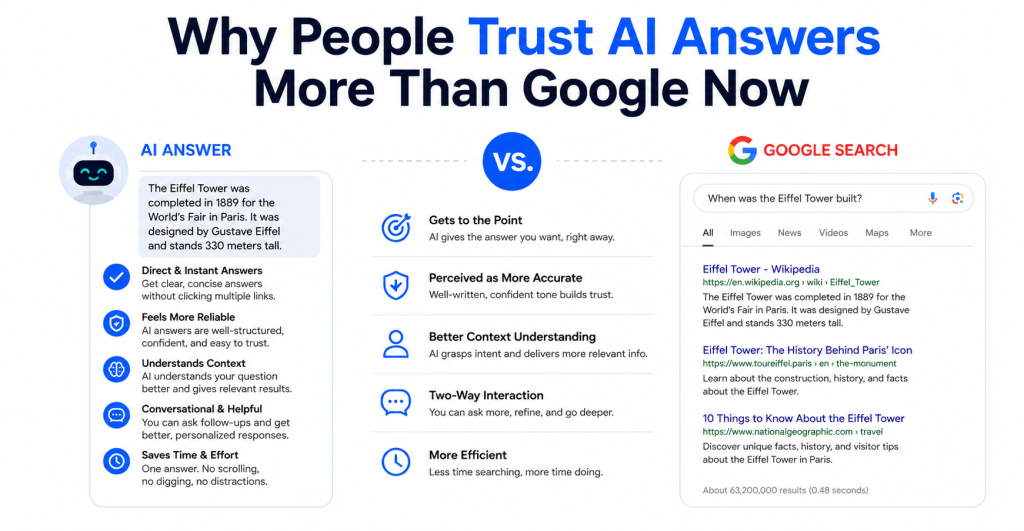
Traditional search has become cognitively expensive. Users are often forced to sift through ads, sponsored placements, duplicate pages, and SEO-heavy content before they reach a usable answer, which creates friction at exactly the moment they want speed. AI reduces that burden by compressing multiple steps into one interaction: ask, receive, refine, and move on. That matters because trust is often not just about correctness; it is also about how much effort the system saves the user.
This is where the trust gap begins to widen. In one survey, 60% of respondents said AI provides better, clearer answers than traditional search, while 37% said they start searches with AI tools instead of Google. The appeal is simple: fewer clicks, fewer distractions, and less interpretation work. In a digital environment overloaded with options, clarity itself has become a trust signal.
Why AI Feels More Authoritative
AI answers are delivered in complete sentences, with a tone that resembles explanation rather than retrieval. That presentation creates an impression of reasoning, even when the underlying output may still require verification. Search results, by contrast, present evidence fragments that force the user to assemble meaning on their own. In practice, many users interpret polished prose as expertise, especially when they are busy, uncertain, or comparing several options at once.
The Market Shift Underway
What is happening now is bigger than a UX preference; it is a redistribution of discovery power. AI is becoming the first interface for information, while traditional search remains the verification layer. That hybrid journey means users may begin with AI, then cross-check with search only after the shortlist has already been formed. For brands, this is a major shift because early-stage influence is moving upstream into AI-generated summaries.
The commercial implications are already visible. Nearly half of consumers said AI influences which brands they trust, and 47% have used AI to help make a purchase decision. More than half have used it to find the best prices, and a similar share have used it to compare products. This is not a niche behavior among early adopters; it is becoming part of the mainstream buying process, especially among younger users who are adopting AI as a daily utility.
Why Younger Users Lead
Younger audiences are driving the trust shift because they are less attached to the old “ten blue links” model and more comfortable treating AI as a conversational interface. A survey of users under 29 found that 76.3% trusted answers from AI more than from a traditional Google search. That is a meaningful signal because younger users often set the habit curve for the broader market. Once a behavior becomes normal in one cohort, it tends to spread into adjacent age groups through work, shopping, and everyday digital routines.
The scale of platform adoption reinforces that trend. One survey report noted that ChatGPT alone serves 700 million active users weekly, while other AI tools also reach hundreds of millions of users across the ecosystem. At that scale, trust is no longer an abstract brand sentiment; it is a structural change in how information is brokered. The more people use AI for repeated tasks, the more they normalize its answers as a starting point.
A New Discovery Layer
The biggest opportunity in this shift is not simply “AI usage.” It is the emergence of a new discovery layer between intent and action. In the older search model, users typed a query and then evaluated a long list of results. In the new model, they ask a question and receive a synthesized recommendation, which means the AI system increasingly decides which brands, ideas, or products are even visible enough to be considered.
That creates a high-growth opportunity for businesses that understand how AI shapes first impressions. If a brand is easy for an AI model to summarize, compare, and position, it can gain disproportionate visibility in the consideration stage. If it is not, it may never make the shortlist. This is why the market is moving beyond SEO alone and toward optimization for AI-generated answers, where narrative clarity and structured information matter as much as keyword placement.
Trust Is Not the Same as Accuracy
The most important nuance is that trust in AI does not mean blind belief. Even where users prefer AI answers, many still verify them elsewhere before taking action. That behavior shows people are treating AI as a high-speed filter rather than an unquestioned authority. In other words, AI wins the first trust moment, while search often wins the final validation moment.
This distinction matters because it explains why AI can gain share even without perfect reliability. Users are often willing to accept “good enough and fast” at the front end, then refine later if the decision is important. The trust equation is therefore shaped by convenience, tone, and cognitive load as much as by factual precision. For marketers and publishers, that means the battle is no longer just about being found; it is about being favored in the answer itself.
Future Growth Drivers
The next phase of growth will likely be driven by three forces. First, users will keep gravitating toward interfaces that reduce effort and ambiguity, especially as information overload increases. Second, AI systems will become more embedded in purchase journeys, making recommendation behavior more commercially valuable. Third, brands will invest more heavily in making their information machine-readable, concise, and authoritative so that AI systems can quote or summarize them correctly.
Industry Outlook
The direction of travel is clear. AI is moving from novelty to default, from optional assistant to primary interface, and from experimental tool to commercial gatekeeper. That transition opens a large opportunity for product teams, content strategists, and brands that can adapt early. It also raises the stakes for organizations that still optimize only for traditional search behavior, because the first answer is increasingly the one that frames the entire decision.
For readers watching the market, the key takeaway is that trust is being redefined by experience design. People trust AI more than Google now not because they have abandoned skepticism, but because AI gives them a faster, less crowded, and more conversational path to certainty. In a market where attention is scarce and decisions are compressed, that is a powerful advantage.