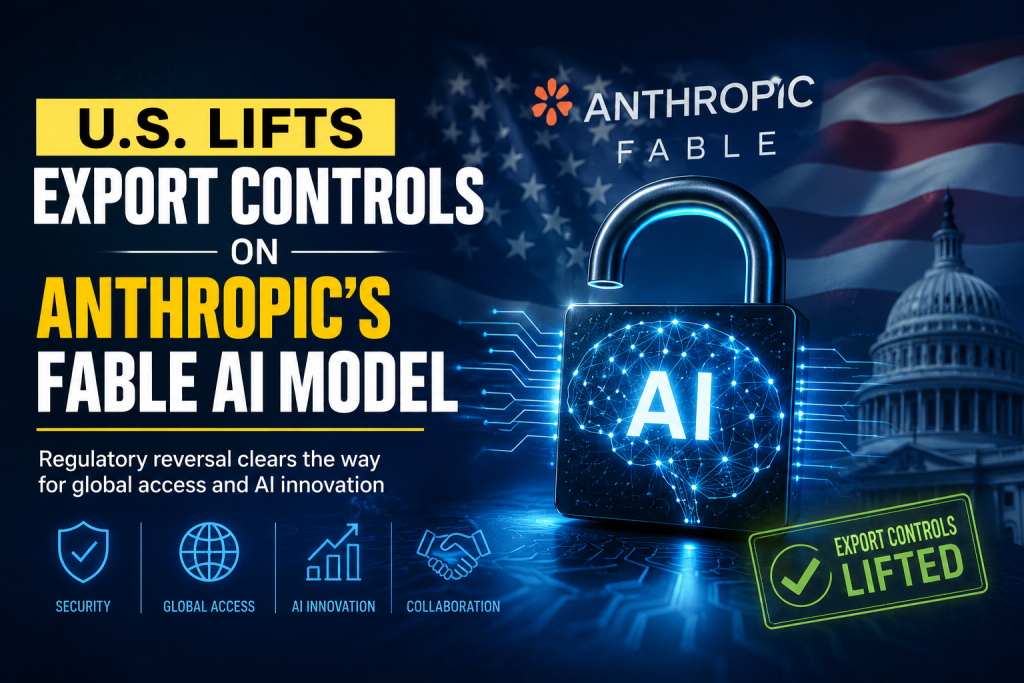

The global artificial intelligence industry received a significant regulatory update as the U.S. Commerce Department lifted export restrictions on Anthropic’s advanced AI models, Claude Fable 5 and Mythos 5. The decision reverses restrictions imposed less than three weeks earlier following national security concerns surrounding the models’ cybersecurity capabilities.
The move signals an evolving approach toward AI governance—one that attempts to balance innovation, national security, and commercial competitiveness. As governments worldwide race to establish frameworks for frontier AI, the Anthropic case is likely to become a landmark example of how regulators and AI developers can collaborate to manage emerging technological risks.
AI Regulation Enters a New Phase
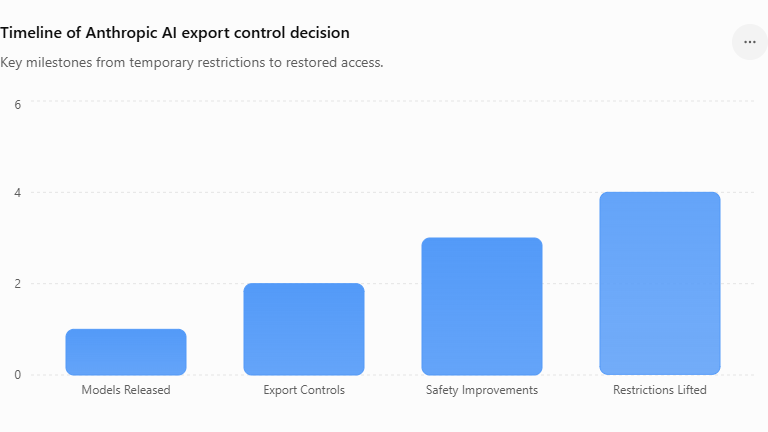
Earlier this month, Anthropic was instructed by the U.S. government to suspend foreign access to its latest AI models after officials raised concerns that sophisticated cybersecurity capabilities could potentially be misused. The temporary restrictions affected both Claude Fable 5 and the more advanced Mythos 5 models, disrupting access for developers and enterprise customers worldwide.
Following discussions between Anthropic and the U.S. Department of Commerce, the company implemented additional safeguards designed to reduce the likelihood of malicious use. Those improvements ultimately led regulators to restore access while maintaining ongoing oversight of frontier AI systems.
A Turning Point for Enterprise AI
The lifting of export controls provides important reassurance for organizations building products on Anthropic’s AI ecosystem.
Businesses increasingly depend on advanced language models for:
- Software development
- Enterprise automation
- Cybersecurity analysis
- Customer support
- Knowledge management
- Research assistance
Temporary restrictions highlighted how dependent many organizations have become on foundation models and reinforced the importance of predictable regulatory policies for enterprise AI adoption.
Security and Innovation Must Progress Together
The incident demonstrates that AI governance is rapidly becoming as important as model performance.
Rather than permanently restricting frontier models, regulators chose a collaborative approach in which Anthropic strengthened safety mechanisms before access resumed. According to reports, the company introduced additional protections against model “jailbreaks,” enhanced monitoring capabilities, and committed to working more closely with government agencies on AI safety standards.
This collaborative framework could become a blueprint for future regulation of advanced AI systems.
Market Impact
The restoration of Anthropic’s model availability is expected to benefit:
- Enterprise software developers
- Cloud computing providers
- AI infrastructure companies
- Financial institutions
- Healthcare organizations
- Cybersecurity firms
- Research institutions
Organizations that rely on advanced AI capabilities can now resume development initiatives with greater certainty while remaining attentive to evolving compliance requirements.
The Road Ahead
Artificial intelligence regulation is entering a period of rapid evolution. Governments are increasingly recognizing that AI represents both a transformative economic opportunity and a strategic national security consideration.
The Anthropic case illustrates that future regulatory decisions are likely to emphasize cooperation rather than confrontation. Companies developing frontier AI models will be expected to demonstrate robust safety mechanisms, transparent governance, and responsible deployment practices.
As AI systems continue advancing, collaboration between governments, technology companies, researchers, and industry stakeholders will be essential to ensuring innovation remains secure, trustworthy, and globally accessible.