
Artificial intelligence has become a core part of everyday technology, influencing how businesses interact with customers, automate operations, and make decisions. Among the most talked-about AI technologies in 2026 are AI chatbots and AI agents. Although these terms are often used interchangeably, they describe two different types of intelligent systems with distinct capabilities and purposes.
The rapid advancement of large language models, cloud computing, and automation platforms has accelerated the adoption of both technologies across industries. While chatbots continue to improve customer engagement, AI agents are taking automation to an entirely new level by performing tasks, making decisions, and collaborating with multiple digital tools. Understanding the difference between these technologies can help organizations choose the right solution for their specific needs.
Understanding AI Chatbots
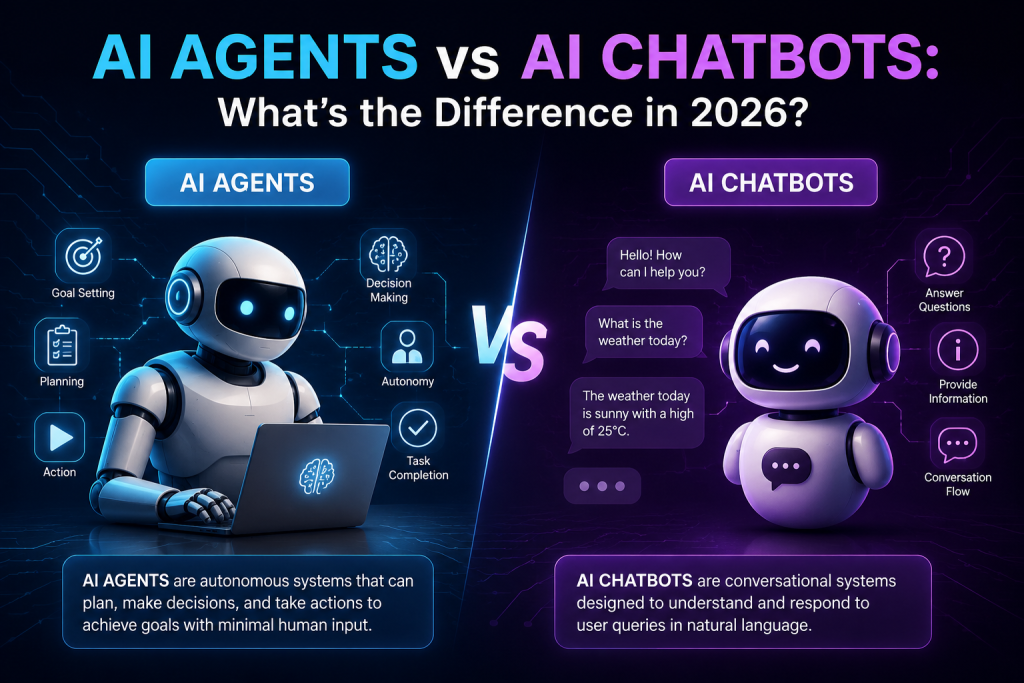
AI chatbots are conversational programs designed to interact with users using natural language. They answer questions, provide recommendations, and assist users through websites, messaging apps, or voice assistants. Unlike earlier rule-based bots that relied on predefined scripts, today’s AI chatbots understand context, recognize user intent, and generate human-like responses.
Businesses use AI chatbots to improve customer support, reduce response times, and provide assistance around the clock. Whether helping customers track orders, reset passwords, or learn about products, chatbots have become valuable digital assistants that enhance user experiences while lowering operational costs.
Despite their growing intelligence, most chatbots remain reactive systems. They respond when prompted but rarely initiate actions beyond the conversation itself.
What Makes AI Agents Different?
AI agents represent the next stage of intelligent automation. Rather than simply answering questions, they are designed to complete objectives with minimal human supervision. An AI agent can analyze a goal, create a plan, gather information, execute multiple tasks, and adjust its approach based on changing conditions.
For example, an AI agent assigned to prepare a business report can collect market data, organize information, generate charts, summarize findings, and deliver the final report without requiring constant instructions. Instead of acting as a conversational assistant alone, it behaves more like a digital coworker capable of completing complex assignments.
This ability to reason, plan, and act makes AI agents especially valuable for organizations seeking greater productivity and operational efficiency.
Comparing Their Core Capabilities
One of the biggest differences between AI chatbots and AI agents lies in their level of autonomy.
A chatbot waits for user input and provides relevant responses. Once the conversation ends, its task is complete. In contrast, an AI agent continues working toward an assigned objective until it reaches a satisfactory outcome or requires human approval.
AI agents can also connect with multiple software platforms, databases, cloud applications, calendars, project management systems, and analytics tools. This allows them to coordinate information across different environments, making them far more versatile than traditional chatbots.
Another important distinction is memory. While chatbots usually maintain context during a conversation, AI agents can preserve long-term knowledge, learn from previous interactions, and refine future decision-making.
Business Applications in 2026
The adoption of AI technologies has expanded rapidly across industries.
Customer service remains the strongest application for AI chatbots. Retailers use them to answer product questions, banks help customers manage accounts, healthcare providers schedule appointments, and educational institutions assist students with admissions and course information.
AI agents, however, are transforming internal business operations. Marketing teams use them to manage advertising campaigns and analyze customer behavior. Sales departments rely on them to identify qualified leads and prepare personalized outreach. Human resource teams automate candidate screening and interview scheduling, while finance departments use AI agents to generate reports and identify spending trends.
Software developers are also benefiting from AI agents that assist with coding, debugging, documentation, and testing, significantly reducing development time.
Advantages of AI Chatbots
AI chatbots remain popular because they are relatively easy to implement and deliver immediate value. They provide instant customer assistance, operate continuously without breaks, and can handle thousands of conversations simultaneously. Businesses also benefit from lower support costs and improved customer satisfaction through faster response times.
Their conversational abilities continue to improve, making interactions more natural and engaging than ever before.
Advantages of AI Agents
AI agents offer a broader range of capabilities that extend far beyond communication. They automate repetitive workflows, coordinate multiple business processes, perform research, analyze data, and make informed recommendations.
By handling time-consuming administrative work, AI agents allow employees to focus on creative thinking, strategic planning, and relationship building. Organizations adopting AI agents often experience improved efficiency, better decision-making, and increased scalability.
Challenges and Considerations
Although AI technologies continue to advance, they are not without limitations.
Chatbots may occasionally misunderstand user requests or provide inaccurate responses if they lack sufficient context or access to updated information.
AI agents present additional challenges related to security, governance, privacy, and accountability. Because they can perform actions independently, organizations must establish clear permissions, monitoring systems, and human oversight to ensure responsible operation.
Choosing the appropriate technology also depends on the complexity of business requirements. Not every organization needs fully autonomous AI agents, and in many cases, a chatbot remains the most practical solution.
The Future of AI in Business
The future of artificial intelligence is likely to combine the strengths of both technologies. Businesses are increasingly deploying chatbots as customer-facing interfaces while AI agents operate behind the scenes to execute tasks, retrieve information, and automate workflows.
As AI models become more capable and enterprise software grows increasingly interconnected, these intelligent systems will collaborate more effectively with human teams. Rather than replacing employees, they will augment human expertise by handling routine work and accelerating decision-making.
Conclusion
In 2026, AI chatbots and AI agents serve different but complementary roles in the digital landscape. Chatbots specialize in natural conversations and customer interaction, making them ideal for support and engagement. AI agents, on the other hand, are designed to think, plan, and execute complex tasks across multiple systems with minimal supervision.
Organizations that understand these differences can make smarter technology investments and unlock greater value from artificial intelligence. As businesses continue embracing digital transformation, the combination of conversational AI and autonomous AI agents will play a central role in shaping the future of work, innovation, and customer experiences.