
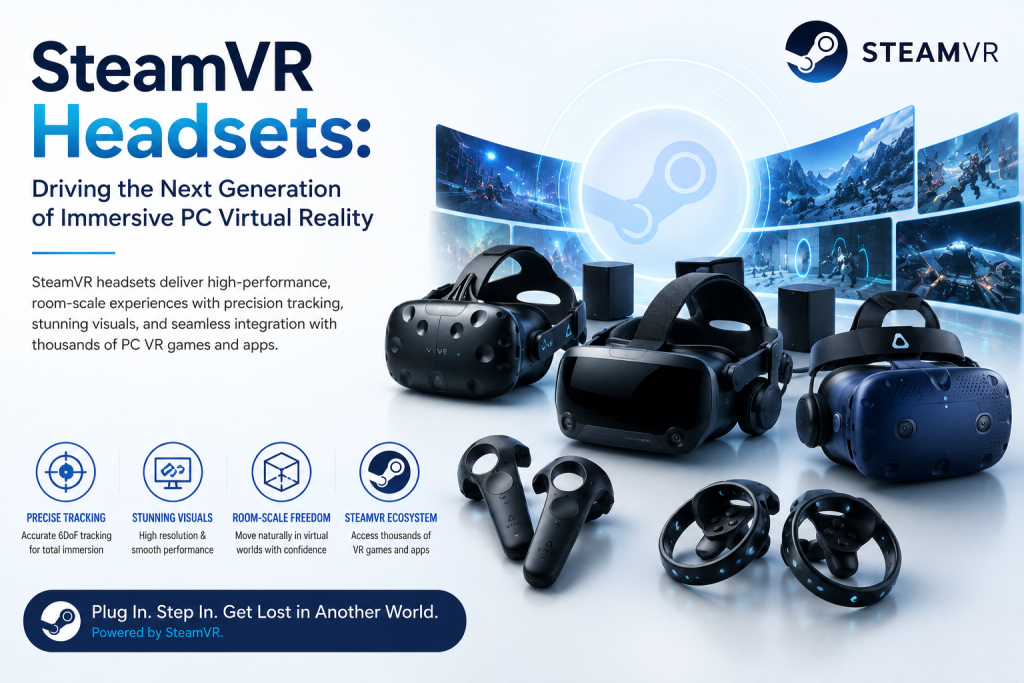

SteamVR headsets have become the backbone of the premium PC virtual reality (VR) ecosystem, offering gamers, professionals, developers, and enterprises highly immersive experiences with advanced motion tracking, high-resolution displays, and expansive content libraries. Developed around Valve’s SteamVR platform, these headsets support a wide range of compatible devices from manufacturers such as Valve, HTC, Pimax, Bigscreen, Varjo, and others, enabling users to access thousands of VR games and applications.
As VR technology evolves beyond gaming into education, healthcare, manufacturing, architecture, and simulation training, SteamVR headsets continue to benefit from improvements in display technology, graphics processing, eye tracking, mixed reality capabilities, and wireless connectivity. The ecosystem is also expected to expand further with Valve reportedly preparing its next-generation Steam Frame headset.
PC VR Continues to Evolve
SteamVR remains one of the largest PC-based virtual reality platforms, supporting thousands of VR titles across gaming, engineering, education, healthcare, and industrial design.
According to the latest Steam Hardware Survey, approximately 1.53% of active Steam users use VR headsets, representing millions of PC gamers worldwide. While VR remains a niche segment compared to traditional PC gaming, hardware capabilities and software content continue to improve.
SteamVR’s open ecosystem allows users to choose from multiple hardware vendors instead of being restricted to a single manufacturer. This flexibility has encouraged continuous innovation in headset design, tracking accuracy, display quality, and controller technology.
Next-Generation Displays Improve Immersion
Modern SteamVR headsets deliver significantly higher visual fidelity than earlier VR generations.
Many premium headsets now feature:
- Refresh rates of 90 Hz, 120 Hz, or even 144 Hz, provide smoother gameplay.
- Display resolutions exceeding 2,000 × 2,000 pixels per eye in high-end models.
- Field of view (FOV) between 110° and 130°, improving peripheral vision and immersion.
- Motion-to-photon latency typically below 20 milliseconds, reducing motion sickness.
These improvements create more realistic virtual environments suitable for gaming, flight simulation, medical visualization, and engineering applications.
SteamVR Headset Adoption Continues to Shift
The Steam ecosystem shows changing preferences as newer standalone and PC-compatible headsets enter the market.
Recent Steam Hardware Survey data indicates:
- Meta Quest 3 accounts for approximately 28% of SteamVR headset usage.
- Meta Quest 2 represents about 24% of connected headsets.
- Meta Quest 3S holds roughly 13%.
- Valve Index continues to maintain around 11% of SteamVR users, despite being one of the older premium PCVR headsets.
These figures demonstrate that although standalone headsets dominate unit shipments, many users continue connecting them to PCs through SteamVR for access to more demanding VR experiences.
Enterprise Applications Expand Beyond Gaming
Although gaming remains the largest application, SteamVR headsets are increasingly used across professional industries.
Manufacturing companies utilize VR for factory planning and employee training. Healthcare organizations employ VR simulations for surgical education and rehabilitation. Architects and engineers use immersive 3D visualization to review building designs before construction begins.
Automotive manufacturers rely on VR for virtual prototyping, while aerospace companies use SteamVR-compatible systems for maintenance simulations and technician training. Universities are also integrating VR into STEM education, allowing students to conduct immersive laboratory experiments and interactive learning sessions.
Wireless and Mixed Reality Capabilities Gain Momentum
The newest generation of SteamVR-compatible headsets supports wireless streaming through Wi-Fi 6E and Wi-Fi 7 technologies, reducing cable restrictions without significantly compromising image quality.
Mixed reality (MR) features are becoming increasingly common, enabling users to blend physical surroundings with digital content. High-resolution passthrough cameras improve productivity applications, collaborative design, and interactive workspaces.
Eye tracking, hand tracking, and inside-out positional tracking further enhance user interaction by reducing the need for external sensors while improving accuracy.
Artificial Intelligence Improves User Experience
Artificial intelligence is beginning to reshape virtual reality performance.
AI-powered rendering techniques such as foveated rendering concentrate GPU resources on the portion of the display the user is actively viewing, potentially reducing graphics workloads by 30–50% while maintaining visual quality.
Machine learning also improves gesture recognition, voice interaction, environmental understanding, and avatar animation, creating more natural interactions inside virtual environments.
Challenges Facing SteamVR Headsets
Despite technological progress, several challenges continue to limit broader adoption.
Premium PCVR systems often require gaming PCs equipped with powerful graphics cards, increasing the overall cost of ownership. High-end VR setups frequently exceed US$1,000–2,000 when combining the headset, controllers, base stations, and gaming PC.
Some users still experience motion sickness during extended sessions, although higher refresh rates and lower latency have significantly reduced this issue.
Developers also face the challenge of creating high-quality VR-exclusive content for a relatively small audience compared with traditional PC gaming.
Final Thoughts
The outlook for SteamVR headsets remains promising as display technology, graphics hardware, and software ecosystems continue advancing.
Valve is widely expected to strengthen the SteamVR ecosystem with its next-generation Steam Frame headset, while major VR manufacturers continue investing heavily in next-generation hardware featuring improved optics, higher-resolution displays, and advanced mixed reality capabilities.
Emerging technologies such as OLED microdisplays, pancake lenses, AI-assisted rendering, full-body tracking, and cloud-based VR streaming will further improve immersion while reducing headset size and weight.
As enterprise digital transformation accelerates and immersive computing gains traction across industries, SteamVR headsets are expected to play an increasingly important role beyond entertainment. From engineering visualization and healthcare training to collaborative design and industrial simulation, the SteamVR ecosystem is evolving into a comprehensive platform for both consumer and professional virtual reality.
With continual hardware innovation, expanding software libraries, and growing enterprise adoption, SteamVR headsets are well positioned to remain a cornerstone of premium PC virtual reality throughout the remainder of the decade.