
Artificial intelligence is transforming the search industry at an unprecedented pace. Traditional search engines have long relied on keyword matching and ranked web pages to deliver results, but AI-powered search experiences are introducing a more conversational and context-aware way to find information. As AI-generated summaries, intelligent assistants, and multimodal search become mainstream, businesses, publishers, and digital marketers are adapting their SEO strategies to remain visible in an increasingly AI-driven search ecosystem.
Key Insights
- AI-powered search is shifting SEO from keyword optimization toward creating authoritative, experience-driven, and user-focused content that directly answers search intent.
- Businesses investing in high-quality content, structured data, and topical authority are expected to perform better as AI search engines increasingly prioritize relevance, credibility, and contextual understanding.
The digital search landscape is entering a new era as artificial intelligence reshapes how people discover information online. For more than two decades, traditional search engines have served as the primary gateway to the internet by ranking web pages based on keywords, backlinks, and technical SEO signals. Today, AI-powered search is redefining those expectations by delivering conversational responses, contextual recommendations, and personalized results.
AI Is Reshaping the Search Experience
Modern AI search engines no longer depend solely on keyword matching. Instead, they analyze user intent, understand natural language, and generate concise answers by combining information from multiple authoritative sources.
This evolution enables users to receive comprehensive responses without opening multiple browser tabs, making information retrieval faster and more efficient. Voice search, image search, and AI assistants are also contributing to this shift by creating more intuitive ways to interact with digital content.
Traditional Search vs AI-Powered Search
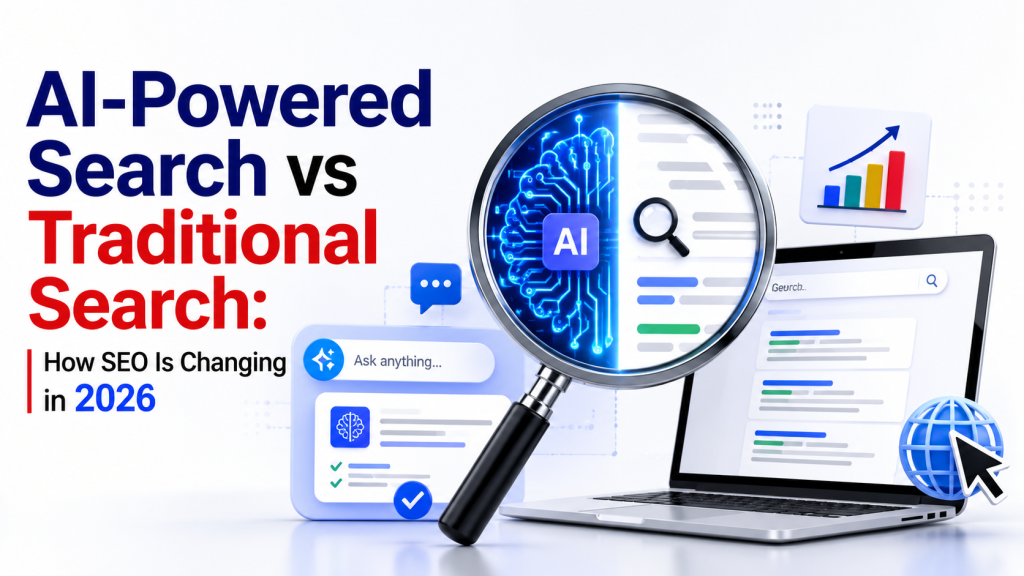
Traditional search engines primarily display a ranked list of web pages, allowing users to compare sources before selecting the most relevant result. Ranking has historically depended on factors such as keyword relevance, page speed, backlinks, metadata, and website authority.
AI-powered search, however, focuses on understanding the complete context of a query. Rather than presenting only links, AI systems summarize information, answer follow-up questions, explain complex topics, and provide recommendations in a conversational format.
While traditional search remains essential for deep research and website discovery, AI search is becoming increasingly popular for quick answers, productivity, and decision-making.
Why SEO Is Changing in 2026
The growing adoption of AI search experiences is encouraging marketers to rethink conventional SEO strategies.
Instead of optimizing pages solely around individual keywords, businesses are focusing on comprehensive topic coverage that demonstrates expertise and provides meaningful value to readers.
Search optimization is increasingly centered on answering real user questions, producing original insights, and creating content that AI systems can confidently understand and reference.
This transition reflects a broader movement away from search engine manipulation and toward information quality.
Content Quality Is Becoming the Primary Ranking Factor
High-quality content has always been important, but AI-powered search is placing greater emphasis on originality, trustworthiness, and topical authority.
Publishers are investing in expert-written articles, research-backed insights, case studies, and regularly updated resources that demonstrate credibility.
Rather than rewarding repetitive keyword usage, AI systems evaluate how effectively content satisfies user intent and delivers accurate, comprehensive information.
User Intent Is More Important Than Keywords
Keyword research remains valuable, but understanding search intent has become equally important.
Users increasingly ask complete questions instead of typing short keyword phrases. As a result, content creators are structuring articles around problems, solutions, comparisons, and practical guidance.
Businesses that align their content with informational, commercial, and transactional intent are likely to achieve stronger visibility across AI-powered search platforms.
The Growing Role of Structured Data
Structured data continues to play a significant role in helping search engines understand website content.
Clear headings, schema markup, FAQs, product information, reviews, and author details provide valuable context that improves content discoverability and enhances AI-generated search experiences.
Organizations investing in technically optimized websites are expected to benefit from improved indexing and richer search visibility.
How AI Search Is Impacting Businesses
Businesses across industries are adapting their digital marketing strategies to accommodate changing search behaviors.
E-commerce companies are optimizing product content for AI-generated shopping recommendations.
Financial institutions are creating educational resources that answer common customer questions.
Healthcare providers are improving informational content while emphasizing accuracy and credibility.
Technology companies are expanding knowledge hubs that demonstrate expertise across emerging topics.
These efforts reflect the growing importance of building long-term authority rather than chasing short-term keyword rankings.
New Opportunities for Digital Marketers
The evolution of AI search is creating opportunities for marketers willing to embrace innovation.
Successful SEO campaigns increasingly combine technical optimization, high-quality editorial content, first-hand expertise, multimedia assets, and user engagement signals.
Rather than competing solely for search rankings, brands are building comprehensive digital ecosystems that establish trust across multiple platforms.
Challenges in the AI Search Era
Despite its advantages, AI-powered search presents several challenges.
Publishers are concerned about reduced website traffic when AI-generated summaries answer user questions directly.
Content creators also face increased competition as AI tools accelerate content production across industries.
Maintaining originality, transparency, and factual accuracy has become more important than ever as businesses work to differentiate themselves in a crowded digital environment.
Additionally, organizations must monitor AI-generated content carefully to ensure compliance with copyright, editorial standards, and brand reputation.
The Future of SEO Beyond 2026
Industry experts believe SEO is evolving rather than disappearing.
Search optimization is becoming more holistic by combining technical excellence, authoritative content, user experience, structured information, and brand trust.
As AI continues transforming search behavior, businesses that prioritize genuine expertise, helpful content, and long-term audience value are expected to remain competitive regardless of future algorithm changes.
The next generation of SEO will likely reward organizations that educate users, solve real-world problems, and consistently publish reliable information instead of relying on outdated optimization tactics.
Conclusion
Artificial intelligence is redefining how people search, discover, and consume information online. While traditional search engines remain an essential part of the digital ecosystem, AI-powered search is accelerating a fundamental shift toward conversational experiences, contextual understanding, and personalized results.
For businesses, publishers, and marketers, the message is clear: the future of SEO lies in creating trustworthy, user-focused content that demonstrates expertise, answers real questions, and delivers lasting value in an AI-first world.