
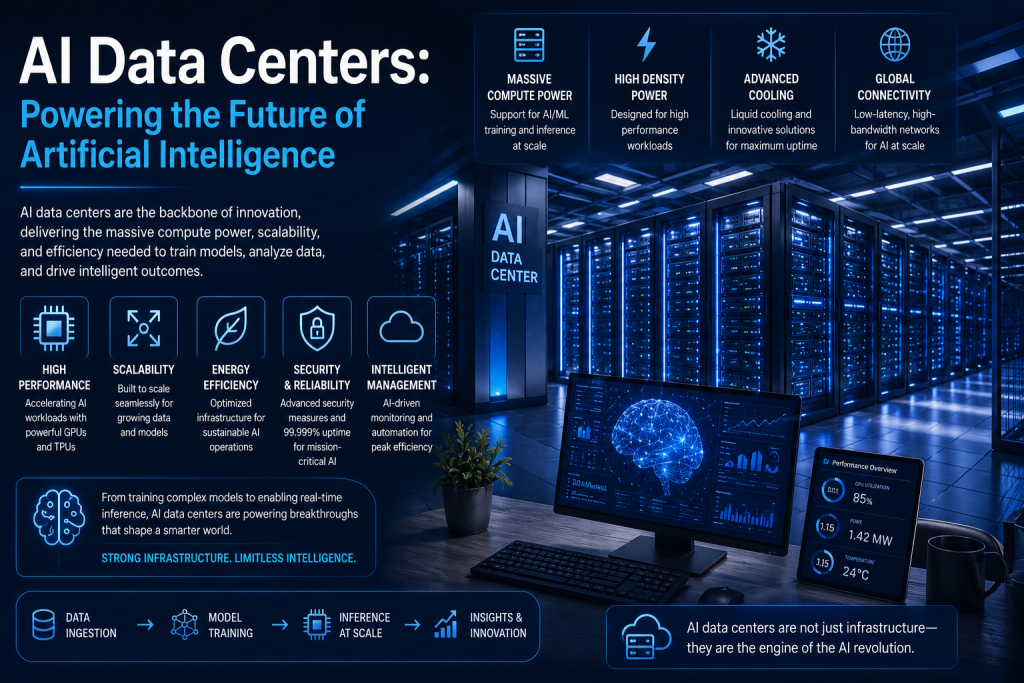

Artificial Intelligence (AI) is driving an unprecedented demand for computing power, transforming traditional data centers into highly specialized AI infrastructure hubs. As organizations across healthcare, finance, manufacturing, retail, telecommunications, automotive, and government deploy increasingly sophisticated AI models, the need for scalable, high-performance data centers has never been greater. AI data centers are becoming the backbone of the digital economy by providing the processing power, storage, and networking capabilities required to train, deploy, and operate advanced AI applications.
Unlike conventional data centers, AI data centers are optimized for massive parallel computing workloads. They integrate Graphics Processing Units (GPUs), AI accelerators, high-speed networking, liquid cooling systems, and energy-efficient architectures to support large language models (LLMs), generative AI, machine learning, and deep learning applications. As AI adoption accelerates worldwide, AI data centers are playing a critical role in enabling innovation, improving operational efficiency, and supporting next-generation digital services.
What Are AI Data Centers?
AI data centers are specialized facilities designed to handle the intensive computational requirements of artificial intelligence workloads. These facilities combine advanced computing hardware, optimized networking, intelligent cooling technologies, and scalable cloud infrastructure to support AI model training, inference, and data processing.
Key technologies powering AI data centers include:
- Graphics Processing Units (GPUs)
- AI Accelerators
- Tensor Processing Units (TPUs)
- High-Performance Computing (HPC)
- Cloud Computing
- Edge Computing
- High-Speed Networking
- Liquid Cooling Systems
- NVMe Storage
- AI Infrastructure Management
Together, these technologies provide the performance, scalability, and reliability required for modern AI applications.
Generative AI and Large Language Models
The rapid growth of generative AI has significantly increased demand for AI-optimized data centers capable of handling massive computational workloads.
Major applications include:
- Large Language Model (LLM) training
- AI inference
- Multimodal AI processing
- AI content generation
- Foundation model deployment
- AI agent infrastructure
These capabilities enable organizations to build faster, more intelligent, and scalable AI solutions.
Cloud Computing and AI Services
Cloud providers are investing billions of dollars to expand AI-ready infrastructure and support enterprise AI adoption.
Key innovations include:
- AI cloud platforms
- GPU-as-a-Service (GPUaaS)
- AI model hosting
- Serverless AI computing
- Hybrid cloud AI
- Multi-cloud deployment
These services make advanced AI computing accessible to organizations of all sizes without requiring significant on-premises investments.
High-Performance Computing (HPC)
AI data centers rely heavily on high-performance computing to process complex AI workloads efficiently.
Emerging opportunities include:
- Scientific simulations
- Climate modeling
- Genomics research
- Drug discovery
- Engineering simulations
- Financial risk modeling
HPC infrastructure enables organizations to solve computationally intensive problems faster and more accurately.
Healthcare and Life Sciences
Healthcare organizations are increasingly utilizing AI data centers to accelerate medical innovation and improve patient care.
Applications include:
- Medical imaging analysis
- Drug discovery
- Precision medicine
- Genomic sequencing
- Clinical research
- Predictive healthcare analytics
These technologies support faster diagnoses, improved treatment planning, and accelerated pharmaceutical research.
Financial Services
Financial institutions use AI infrastructure to analyze enormous volumes of transactional and market data in real time.
Key applications include:
- Fraud detection
- Algorithmic trading
- Credit risk assessment
- Customer analytics
- Regulatory compliance
- Financial forecasting
AI-powered computing enables faster, more secure, and data-driven financial services.
Manufacturing and Industrial AI
Manufacturers are deploying AI infrastructure to improve production efficiency and optimize industrial operations.
Key innovations include:
- Predictive maintenance
- AI-powered quality inspection
- Digital twins
- Industrial robotics
- Supply chain optimization
- Smart factory analytics
These applications increase productivity while reducing operational costs.
Edge AI and Distributed Computing
As AI applications move closer to end users, edge-enabled AI data centers are becoming increasingly important.
Key applications include:
- Autonomous vehicles
- Smart cities
- Industrial IoT
- Telecommunications
- Remote monitoring
- Real-time analytics
Edge computing reduces latency while improving the responsiveness of AI-powered applications.
Sustainability and Energy Efficiency
AI workloads consume enormous amounts of electricity, making sustainability a major focus for next-generation AI data centers.
Key sustainability initiatives include:
- Liquid cooling technology
- Renewable energy integration
- Energy-efficient processors
- Intelligent workload optimization
- Heat recovery systems
- Carbon footprint reduction
These innovations help organizations improve efficiency while reducing environmental impact.
Security and Data Protection
AI data centers must protect highly valuable data, intellectual property, and AI models from evolving cyber threats.
Important security measures include:
- Zero Trust architecture
- AI-powered cybersecurity
- Identity and access management
- Data encryption
- Threat detection
- Compliance monitoring
Strong security frameworks help organizations protect sensitive information while maintaining regulatory compliance.
Challenges Facing AI Data Centers
Although AI data centers offer significant opportunities, organizations must overcome several challenges as AI infrastructure expands.
Common challenges include:
- High infrastructure costs
- Increasing power consumption
- Cooling requirements
- GPU shortages
- Data privacy concerns
- Skilled workforce shortages
- Network scalability
- Sustainability pressures
Addressing these challenges will require continued investment in innovative infrastructure, energy-efficient technologies, and intelligent resource management.
Future Outlook
The future of AI data centers will be shaped by rapid advancements in generative AI, high-performance computing, cloud infrastructure, and semiconductor technologies. Organizations will increasingly deploy AI-specific hardware, advanced networking solutions, and intelligent cooling systems to meet the growing computational demands of next-generation AI applications.
As AI adoption expands across industries, AI data centers will become even more critical for supporting digital transformation, autonomous systems, scientific research, and enterprise innovation. Investments in sustainable infrastructure, renewable energy, and advanced chip architectures will further improve the efficiency and scalability of AI computing environments.
Businesses that invest in modern AI-ready infrastructure today will be well-positioned to support future AI innovation, deliver faster services, and maintain a competitive advantage in the rapidly evolving digital economy.
Conclusion
AI data centers are the foundation of modern artificial intelligence, providing the computing power, storage, networking, and scalability needed to support advanced AI workloads. From generative AI and high-performance computing to healthcare, finance, manufacturing, and cloud services, these specialized facilities are enabling organizations to unlock the full potential of AI. As demand for intelligent applications continues to grow, AI data centers will remain central to innovation, digital transformation, and the future of enterprise computing.