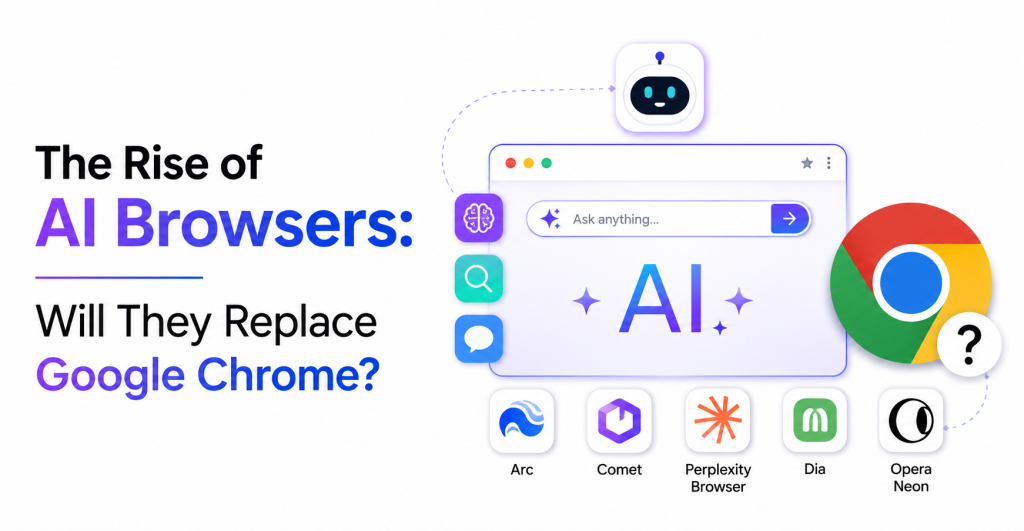

Artificial intelligence is rapidly transforming how people interact with the internet, and web browsers are becoming the next major frontier. Rather than serving as simple tools for opening websites, a new generation of AI-powered browsers is introducing intelligent assistants capable of summarizing web pages, answering questions, automating repetitive tasks, organizing research, and even completing workflows directly within the browser. As technology companies continue investing heavily in AI-first experiences, industry experts are increasingly asking whether traditional browsers like Google Chrome will remain dominant or whether AI browsers will redefine the future of web browsing.
Key Insights
- AI browsers are evolving beyond traditional web navigation by integrating intelligent assistants that help users search, summarize, automate tasks, and improve productivity without switching between multiple applications.
- While Google Chrome continues to lead the global browser market, AI-powered browsers are creating a new competitive landscape by focusing on personalized experiences, workflow automation, and contextual intelligence.
The web browser has remained one of the most important digital tools for over three decades, acting as the primary gateway to information, communication, shopping, entertainment, and business operations. However, the rapid advancement of artificial intelligence is beginning to reshape what users expect from their browsing experience.
AI Browsers Are Redefining the Modern Web Experience
Industry analysts believe that AI-powered browsers represent one of the biggest shifts in internet technology since the introduction of tabbed browsing and mobile-first web experiences. Instead of merely displaying websites, these next-generation browsers are designed to understand user intent, provide intelligent recommendations, automate repetitive actions, and assist with research in real time.
Unlike conventional browsers that rely primarily on search engines to deliver information, AI browsers aim to become active digital assistants. Users can ask complex questions, summarize lengthy articles, compare products, organize research notes, draft emails, analyze documents, and perform multiple tasks without leaving the browser window.
Why AI Browsers Are Gaining Momentum in 2026
This evolution reflects the growing demand for faster access to information and more efficient digital workflows. Businesses, students, researchers, marketers, and software developers are increasingly seeking tools that reduce manual effort while improving productivity.
One of the defining characteristics of AI browsers is contextual understanding. Instead of treating every webpage as an isolated destination, these browsers analyze content across multiple sources, allowing users to receive concise summaries, key insights, and actionable recommendations. This capability significantly reduces the time spent reading multiple articles or comparing information manually.
Key Features That Set AI Browsers Apart
Intelligent Search and Context Awareness
AI browsers understand the context behind user queries rather than relying solely on keyword-based searches. This enables faster, more accurate answers and a more conversational browsing experience.
AI-Powered Workflow Automation
Another important innovation is workflow automation. AI browsers can assist users by filling forms, organizing tabs, generating reports, scheduling meetings, translating content, and even interacting with web applications through intelligent automation. These features have the potential to save hours of repetitive work each week.
Built-in Writing and Research Assistance
Integrated AI assistants can summarize articles, generate content ideas, explain technical topics, rewrite emails, and organize research materials, making them valuable tools for professionals and students alike.
Enhanced Privacy and Security Features
Privacy and security are also becoming central areas of innovation. Many developers are investing in AI systems capable of detecting phishing attempts, identifying suspicious websites, warning users about malicious downloads, and protecting sensitive personal information. As cyber threats become increasingly sophisticated, AI-driven security features may become standard components of future browsers.
Can AI Browsers Replace Google Chrome?
The growing popularity of generative AI has further accelerated interest in intelligent browsing experiences. Instead of opening multiple tabs to answer a single question, users increasingly expect conversational interfaces capable of delivering comprehensive responses while providing links to relevant sources.
Technology companies are responding by integrating AI directly into their browser ecosystems. Some platforms emphasize productivity features for enterprise users, while others focus on consumer experiences such as intelligent shopping assistance, travel planning, coding support, content creation, and personalized recommendations.
Despite the excitement surrounding AI browsers, Google Chrome continues to maintain significant competitive advantages. Chrome benefits from years of ecosystem development, extensive extension support, cross-device synchronization, strong developer adoption, and deep integration with Google services.
Experts suggest that replacing Chrome entirely will not happen overnight. Instead, the market is expected to experience gradual diversification, with AI browsers attracting users who prioritize automation, research, productivity, and personalized assistance.
What This Means for Businesses, SEO, and Digital Marketing
For businesses, the emergence of AI browsers presents both opportunities and challenges. Digital marketers may need to rethink traditional SEO strategies as AI assistants increasingly summarize content before users visit individual websites. Publishers will likely focus more on creating authoritative, trustworthy, and well-structured content that AI systems can accurately interpret and reference.
E-commerce companies may also experience changes in customer behavior. AI-powered shopping assistants can compare prices, analyze reviews, recommend products based on user preferences, and simplify purchasing decisions. As a result, brands may place greater emphasis on structured product data, customer trust, and transparent information.
Industries That Could Benefit Most
Education
Educational institutions may see increased adoption of AI browsers. Students can summarize academic papers, organize research materials, translate technical content, generate study notes, and receive contextual explanations without switching between multiple applications.
Enterprise Productivity
Businesses can streamline operations through AI-assisted scheduling, document management, customer support, and workflow automation, helping employees work more efficiently.
Software Development
Software developers are expected to benefit from integrated coding assistants that provide real-time debugging, code explanations, documentation summaries, and workflow automation directly within the browser environment.
E-commerce
Online retailers can leverage AI browsers to improve personalized shopping experiences, product recommendations, and customer engagement while simplifying purchase decisions.
Challenges Facing AI Browser Adoption
However, the transition toward AI-first browsing also raises important questions regarding privacy, transparency, copyright, information accuracy, and AI hallucinations. Technology companies continue working to improve citation practices, user controls, and safeguards designed to reduce misinformation while maintaining user trust.
The Future of AI Browsers
Industry observers believe the browser of the future will function less like a passive window to the internet and more like an intelligent operating system for online activity. Rather than simply helping users find information, AI browsers are expected to assist with understanding, organizing, creating, and acting on that information.
As artificial intelligence continues advancing, competition within the browser market is likely to intensify. Innovation will increasingly focus on productivity, personalization, security, and seamless integration with everyday digital workflows.
Conclusion
Whether AI browsers ultimately replace Google Chrome remains uncertain. What is clear, however, is that artificial intelligence is fundamentally changing how people browse the internet. The coming years are expected to determine whether users continue relying on traditional browsers or embrace AI-powered platforms that transform browsing into a more intelligent, interactive, and productive experience.