
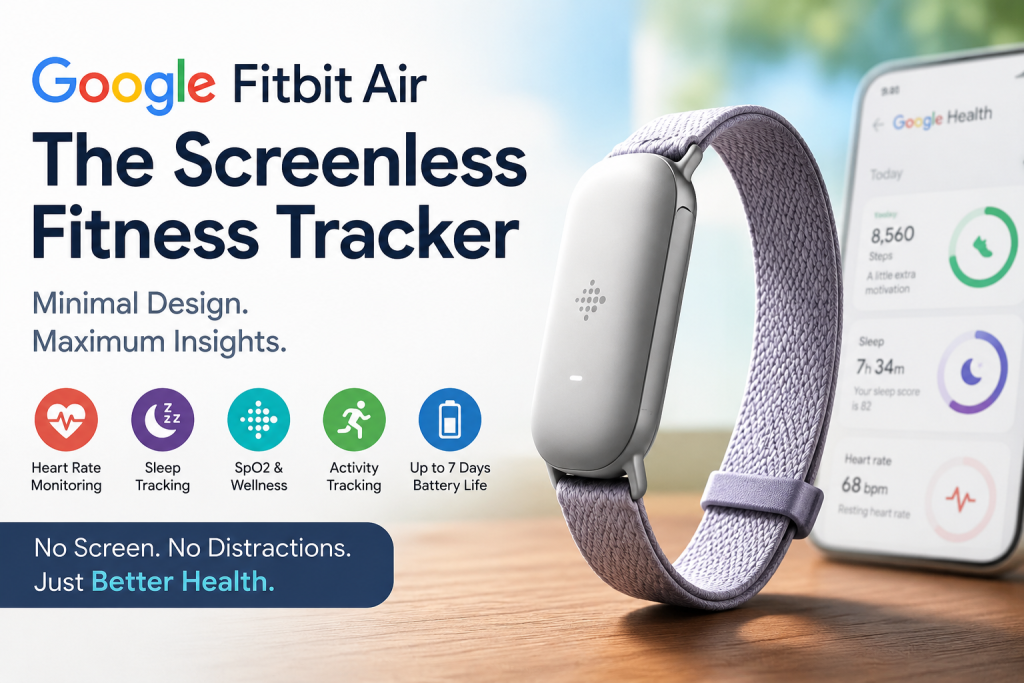

For years, fitness trackers have followed a familiar formula: bigger screens, more notifications, and increasingly smartwatch-like experiences. But Google appears to be taking a completely different approach with the launch of Fitbit Air, a screenless fitness tracker designed to help users focus on their health rather than their devices.
At first glance, the idea sounds unusual. Why would anyone buy a fitness tracker without a display in an era dominated by smartwatches? Yet this minimalist approach could be exactly what millions of users have been waiting for.
With growing concerns about screen addiction, digital distractions, and notification fatigue, Fitbit Air is positioning itself as a wellness-first wearable that quietly tracks health metrics in the background while keeping users focused on real life.
What Exactly Is the Fitbit Air?
Fitbit Air is Google’s newest health-focused wearable and its first major screenless fitness tracker. Instead of providing information directly on the wrist, the device syncs with the Google Health app, where users can access all their fitness and wellness data.
The device is designed to be lightweight, comfortable, and easy to wear 24/7. Google describes it as its smallest tracker yet, focusing on continuous health monitoring rather than constant user interaction.
Fitbit Air Key Features
| Feature | Details |
|---|---|
| Display | Screenless Design |
| Battery Life | Up to 7 Days |
| Heart Rate Monitoring | Yes |
| Sleep Tracking | Yes |
| SpO2 Monitoring | Yes |
| AFib Alerts | Yes |
| Workout Detection | Automatic |
| Companion App | Google Health App |
Source: Google Fitbit Air Announcement
Why a Screenless Fitness Tracker Makes Sense
The wearable industry has spent years adding more screens to our lives. Smartwatches now display emails, messages, social media alerts, news updates, and even video content.
Google is betting that many consumers no longer want that experience.
Instead of becoming another device competing for attention, Fitbit Air aims to become almost invisible. Users wear it, collect health data throughout the day, and review insights only when they choose to. This approach could appeal to people who want health tracking benefits without the distractions of a traditional smartwatch.
The concept is similar to the growing popularity of devices like Whoop and smart rings, which prioritize passive monitoring over screen interaction.
The Rise of “Invisible Technology”
One of the biggest technology trends in 2026 is the movement toward invisible computing.
Rather than constantly interacting with screens, users increasingly prefer technology that operates quietly in the background. Fitness tracking is a perfect example of this shift.
Instead of checking step counts every few minutes, users want actionable insights delivered when they matter most.
Google appears to be embracing this philosophy with Fitbit Air’s minimalist design, which eliminates on-device notifications and places greater emphasis on long-term health trends.
How AI Could Become Fitbit Air’s Secret Weapon
Perhaps the most interesting aspect of Fitbit Air isn’t the hardware—it’s the software behind it.
The device is closely integrated with Google’s new health ecosystem and AI-powered health tools. Rather than simply displaying raw numbers, the platform aims to provide personalized health recommendations and wellness insights.
This means users may receive guidance on:
- Sleep quality improvements
- Recovery optimization
- Activity recommendations
- Heart health monitoring
- Long-term wellness trends
As artificial intelligence becomes more deeply integrated into healthcare, devices like Fitbit Air could evolve from simple trackers into personalized health companions.
Fitbit Air vs Traditional Fitness Trackers
| Category | Fitbit Air | Traditional Smartwatch |
| Screen | No | Yes |
| Notifications | No | Yes |
| Focus | Health & Wellness | Health + Productivity |
| Battery Life | Up to 7 Days | Typically 1–3 Days |
| Distraction Level | Low | High |
| User Experience | Passive Tracking | Active Interaction |
The biggest advantage may not be technological at all—it could be psychological.
By removing constant notifications and screen interactions, Fitbit Air encourages users to focus on health goals rather than device engagement.
Could Fitbit Air Succeed in India?
India represents one of the world’s fastest-growing wearable markets. Consumers are increasingly interested in affordable health-focused technology, particularly devices that offer strong value without unnecessary complexity.
Recent reports suggest that Fitbit Air could launch in India soon following regulatory certifications, generating significant interest among fitness enthusiasts and tech consumers.
If priced competitively, Fitbit Air could appeal to:
- First-time fitness tracker users
- Professionals seeking fewer distractions
- Health-conscious consumers
- Users looking for smartwatch alternatives
- People focused on sleep and recovery tracking
The Bigger Picture
Fitbit Air may represent more than just another wearable launch.
It signals a potential shift in how technology companies think about health tracking. Rather than demanding more attention from users, future devices may focus on requiring less attention while delivering more meaningful insights.
In a world overwhelmed by notifications, endless scrolling, and digital overload, Google’s screenless approach feels surprisingly refreshing.
Whether Fitbit Air becomes a mainstream success remains to be seen. However, one thing is clear: the future of wearable technology may not involve bigger screens—it may involve removing them altogether.