
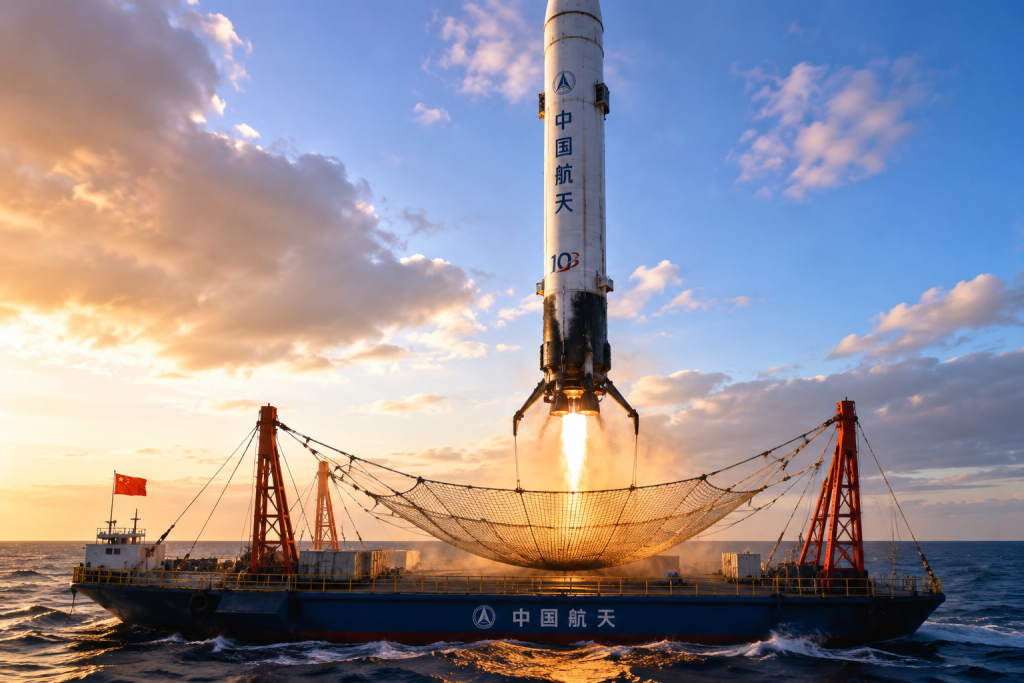

China has achieved another milestone in its rapidly evolving space program by successfully testing a sea-based rocket booster recovery system, marking a significant step toward reusable launch technology. The achievement highlights the country’s commitment to lowering launch costs, improving mission efficiency, and strengthening its position in the increasingly competitive global space industry.
As nations and private aerospace companies race to make space transportation more affordable, reusable rockets have become one of the industry’s most important innovations. Recovering and reusing first-stage boosters can dramatically reduce manufacturing costs while enabling more frequent launches. China’s latest demonstration reflects its determination to join the world’s leading space powers in developing next-generation reusable launch systems.
The successful test involved the Long March 10B rocket, whose first-stage booster executed a controlled return and was recovered using an innovative offshore net-based system instead of conventional landing legs. The approach represents a unique engineering solution that could improve payload efficiency while simplifying future recovery operations.
China Unveils an Innovative Sea-Based Rocket Recovery System
Unlike traditional reusable rockets that perform vertical landings on fixed platforms, China’s newly tested recovery system utilizes a specially designed floating platform equipped with a suspended capture net. During descent, the returning booster engages the recovery structure using landing hooks integrated into its design.
This concept eliminates the need for heavy deployable landing legs, reducing overall booster weight and potentially increasing the amount of payload that can be carried into orbit. Engineers believe the simplified structure could also reduce maintenance requirements while improving long-term operational efficiency.
The successful demonstration showcases China’s willingness to explore alternative engineering approaches as it develops its own reusable launch ecosystem.
Long March 10B Demonstrates China’s Reusable Rocket Ambitions
The recovery mission was conducted during the inaugural orbital flight of the Long March 10B launch vehicle from the Wenchang Commercial Space Launch Site on Hainan Island. After successfully delivering its payload into orbit, the rocket’s first-stage booster separated from the upper stage before initiating an autonomous return sequence.
Guided by onboard navigation systems, the booster descended toward the offshore recovery platform where it was successfully captured, marking one of China’s most important achievements in reusable launch technology.
The Long March 10B has been designed to support commercial launch services while delivering heavy payloads into low-Earth orbit. Engineers are expected to inspect the recovered booster to evaluate its structural integrity and determine its readiness for future missions, an essential step toward routine rocket reusability.
Why Reusable Rocket Technology Is Transforming the Space Industry
Reusable rockets have fundamentally changed the economics of space exploration. Traditionally, launch vehicles were discarded after a single mission, making every launch an expensive undertaking. By recovering and refurbishing first-stage boosters, launch providers can significantly reduce production costs while increasing launch frequency.
This capability has become increasingly important as governments, research organizations, and private companies deploy growing numbers of satellites for communications, Earth observation, navigation, climate monitoring, and broadband internet services.
Lower launch costs also make ambitious projects—including lunar exploration, deep-space missions, and large-scale satellite constellations—more financially viable.
China’s Growing Space Capabilities Intensify Global Competition
China’s latest success further strengthens its position within the rapidly expanding commercial space sector. Over the past decade, the country has significantly increased investments in reusable launch technologies, satellite manufacturing, deep-space exploration, and human spaceflight.
The successful booster recovery demonstrates China’s progress toward building launch systems capable of supporting both commercial and national space objectives. As the country’s launch capabilities continue to mature, competition within the global aerospace industry is expected to intensify.
For satellite operators and commercial customers, increased competition among launch providers could ultimately lead to lower costs, greater launch availability, and faster access to space.
Engineering Challenges Still Stand Between Testing and Routine Reuse
Although recovering a rocket booster represents a major technical achievement, transforming that success into an operational launch system requires overcoming several engineering challenges.
Recovered boosters must undergo comprehensive structural inspections to evaluate heat damage, mechanical stress, engine performance, and overall flight readiness. Engineers must also establish efficient refurbishment procedures that minimize turnaround times while maintaining high safety standards.
Autonomous guidance systems, precision landing technologies, propulsion reliability, and long-term component durability will remain critical areas of development as China works toward regular booster reuse.
What China’s Latest Achievement Means for the Future of Spaceflight
The successful sea-based booster recovery represents more than a single technological milestone—it reflects the broader evolution of the global space industry toward reusable launch systems. As demand for satellite deployment, commercial space services, and scientific missions continues to grow, reusable rockets are expected to become the foundation of future space transportation.
China’s innovative net-based recovery concept demonstrates that multiple engineering approaches can achieve the same objective of reducing launch costs and improving operational efficiency. Whether through offshore recovery platforms, vertical landings, or other emerging technologies, the pursuit of rocket reusability is reshaping how humanity accesses space.
With continued investment in advanced propulsion systems, reusable launch vehicles, and commercial aerospace infrastructure, China is positioning itself as one of the leading contributors to the next generation of global space exploration. Its latest achievement underscores how innovation in reusable technology will continue driving the future of affordable, sustainable, and increasingly frequent space missions.