
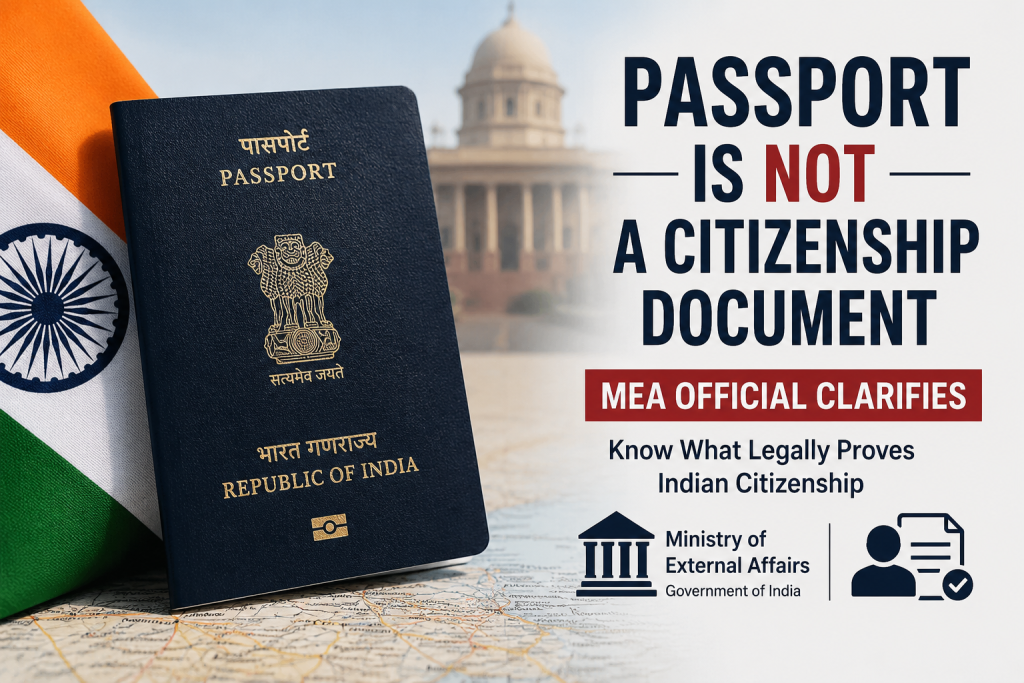

For decades, many Indians have regarded the passport as the ultimate proof of their identity and citizenship. Whether opening a bank account, applying for visas, or completing official documentation, an Indian passport has often been viewed as the most authoritative government-issued document. However, a recent clarification by the Ministry of External Affairs (MEA) has sparked nationwide discussion after a senior official stated that a passport is primarily a travel document and not, in itself, proof of Indian citizenship.
The statement has generated significant public interest, with legal experts, policymakers, and citizens debating what constitutes proof of citizenship in India and why this distinction matters.
Why Did the MEA Make This Clarification?
The clarification was made during the observance of Passport Seva Divas, where the government highlighted the expansion and modernization of passport services across the country. During the event, a senior MEA official explained that while a passport certifies a person’s nationality for international travel, it should not be interpreted as a standalone legal document establishing citizenship in every context.
The clarification gained wider attention because it coincided with ongoing public discussions surrounding citizenship verification and voter documentation, prompting questions about the legal status of commonly used identity documents.
Passport vs. Citizenship: Understanding the Difference
Although these two concepts are closely related, they are not legally identical.
A passport is issued by the Government of India to facilitate international travel and identify the holder as an Indian national while travelling abroad. Citizenship, on the other hand, is determined by the provisions of the Citizenship Act, 1955, and the Constitution of India.
In practical terms, a passport serves as strong evidence that an individual has undergone extensive verification before issuance. However, Indian law does not treat the passport alone as conclusive proof of citizenship in every legal proceeding.
Why the Distinction Matters
The government’s clarification highlights an important legal principle rather than introducing a new policy.
Different government documents serve different purposes:
- Aadhaar establishes identity and residency.
- PAN facilitates taxation.
- Voter ID confirms electoral registration.
- Driving licences authorize individuals to operate vehicles.
- Passports enable international travel.
Each document performs a specific administrative function, and none automatically replaces the legal framework governing citizenship.
Legal experts point out that citizenship may sometimes require examination through multiple records depending on the circumstances, particularly in cases involving registration, naturalization, disputed identity, or immigration matters.
Public Debate Following the Statement
The clarification quickly triggered widespread reactions across political circles and social media.
Several opposition leaders questioned why a passport—issued only after extensive documentation and police verification—would not qualify as definitive proof of citizenship. Others argued that the clarification could create confusion among citizens who have traditionally relied on passports as their most trusted identity document.
Supporters of the clarification, however, noted that the legal distinction has existed for decades and that the MEA was simply reiterating the passport’s intended administrative purpose rather than altering citizenship laws.
The Legal Framework Behind Passport Issuance
India’s passport system operates under the Passports Act, 1967, which governs the issuance, suspension, and revocation of passports.
Applicants undergo multiple stages of verification that may include identity checks, address verification, police verification, and document authentication before a passport is issued.
While these procedures are rigorous, the law distinguishes passport issuance from formal legal determination of citizenship, which continues to be governed by separate legislation under the Citizenship Act, 1955.
Growing Importance of Document Awareness
The discussion has highlighted the need for greater public awareness regarding the purpose of different government documents.
Many citizens understandably assume that possessing a passport automatically settles all questions regarding citizenship because obtaining one involves a comprehensive verification process. However, legal experts emphasize that government-issued documents are designed for specific administrative purposes and should not always be viewed as interchangeable.
Improving public understanding of these distinctions can help reduce confusion while strengthening confidence in administrative processes.
Digital Governance and Documentation
India has made remarkable progress in digitizing citizen services over the past decade. Passport Seva Kendras, online applications, biometric passports, and integrated verification systems have significantly improved efficiency and accessibility for millions of applicants.
The MEA continues expanding passport services while leveraging technology to streamline verification, reduce processing times, and improve citizen convenience.
As digital governance evolves, ensuring that citizens clearly understand the legal purpose of various identity documents will become increasingly important.
Future Outcome
The recent clarification has reopened an important conversation about documentation, identity, and citizenship in India. While the statement has generated debate, legal experts suggest that it primarily reinforces an existing legal distinction rather than introducing any change in citizenship policy.
For most Indian citizens, the clarification is unlikely to affect everyday life or passport usage. Passports will continue to serve as one of the world’s most respected travel documents while enabling international mobility and identity verification across borders.
The broader takeaway is that citizenship remains a legal status defined under constitutional and statutory provisions, whereas passports remain specialized travel documents designed to facilitate international movement. Understanding this distinction can help citizens navigate administrative processes with greater clarity while reducing misconceptions surrounding official documentation.