
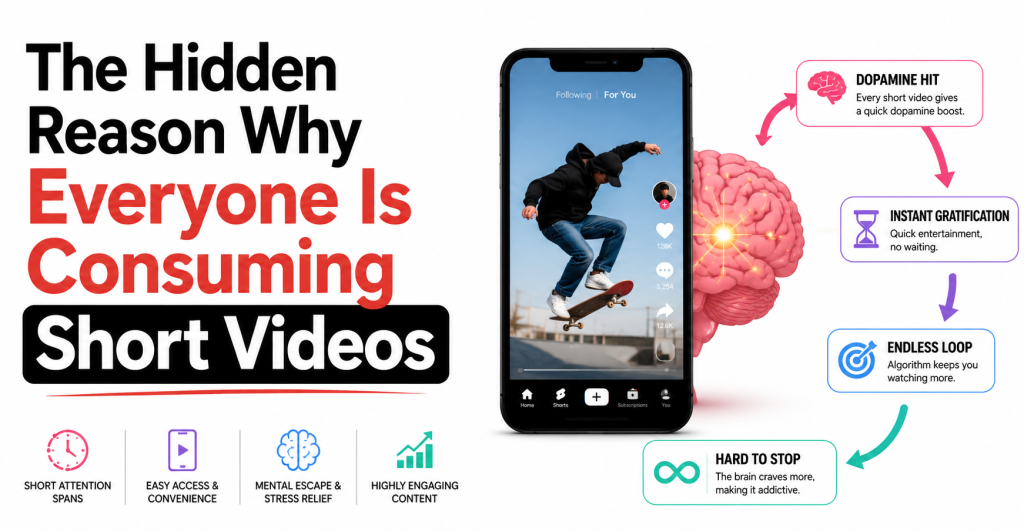

Short videos are not merely winning attention; they are becoming the default language of digital consumption because they compress novelty, emotion, and reward into a format the brain can process instantly. The real reason behind the surge is not just convenience or entertainment, but a structural shift in how audiences discover, evaluate, and repeat content in an always-on mobile environment.
Why The Brain Prefers It
The hidden reason everyone is consuming short videos is that the format aligns almost perfectly with basic cognitive and emotional processing. Short clips reduce mental load, deliver immediate feedback, and keep curiosity unresolved just long enough to trigger another swipe. Public explanations of short-form behavior consistently emphasize instant gratification, dopamine-linked reward loops, and the feeling of effortless consumption. In plain terms, the brain gets a quick reward without having to commit time or concentration, and that makes the next video feel easy to justify.
This matters because digital attention is rarely lost in a single dramatic moment; it erodes through repeated micro-decisions. A short video asks for only a few seconds, which makes the entry cost seem trivial. Once the first clip is watched, the next one carries almost no friction, and the feed becomes self-sustaining. That is why short videos feel less like “content” and more like a behavioral sequence. The format is engineered for low resistance, and low resistance is one of the strongest predictors of scale.
The Algorithmic Advantage
The second hidden reason is algorithmic precision. Short-video feeds are highly personalized, which means every swipe teaches the system more about what the user prefers, ignores, pauses on, or replays. That creates a fast feedback loop between user behavior and content delivery, and the result is a stream that feels unusually relevant almost immediately. When content feels personally selected, engagement rises because the user perceives less noise and more reward.
From a market-research perspective, this is where the format becomes commercially powerful. A highly personalized feed does not just increase watch time; it improves ad targeting, creator distribution, and product testing efficiency. In other words, short videos are successful not only because they are short, but because they are machine-readable at scale. The format generates dense behavioral data, and that data becomes monetizable across advertising, social commerce, subscription upsells, and creator tools. The winner is not just the platform with the most content, but the one with the best learning loop.
Why Brands Keep Following
Brands are leaning into short videos because the economics are difficult to ignore. Longer content still matters for depth and trust, but short-form video is now the fastest route to awareness, repeat exposure, and top-of-funnel interaction. The format works especially well in mobile-first environments where users are already in a scanning mindset and are more likely to respond to quick visual cues than to long explanations. That makes short video particularly attractive in categories where discovery matters more than technical detail.
The commercial logic goes beyond advertising. Short video increasingly functions as a performance asset, a search asset, and a social proof asset at the same time. A single clip can introduce a product, demonstrate use, create community response, and move a viewer toward purchase without requiring a traditional sales journey. That is why short video has become central to growth strategy in consumer brands, digital services, education, gaming, fitness, and impulse-driven retail categories. The format shortens the path from curiosity to conversion, which is exactly what modern marketing teams want.
The Real Growth Engines
Several structural forces are pushing the market higher at once, and together they create a strong secular case for continued expansion. First, smartphone usage and mobile bandwidth improvements have made frictionless video consumption universal rather than premium. Second, creator supply has exploded, which means there is always fresh content to feed fast-moving audiences. Third, recommendation systems have become more efficient at serving the right clip at the right moment, which increases retention and makes the experience feel highly relevant.
There is also a powerful cultural factor: short videos have become the native format of digital literacy for younger audiences and an increasingly large share of older ones. Users now expect information, entertainment, and opinion in compressed form. That expectation changes platform strategy, content planning, and even editorial design. Over time, the market opportunity extends beyond entertainment into education, commerce, customer support, training, and internal communications. The most important growth story is not simply that people like short videos; it is that institutions are beginning to use them as a standard communication layer.
What Happens Next
Looking ahead, the next phase of growth is likely to be defined by monetization depth rather than just user growth. The most valuable opportunities will probably sit in creator monetization, social commerce, AI-assisted editing, and enterprise-grade short video production for training and brand communication. As the format matures, the winners will be the players that can translate attention into repeatable revenue without degrading user experience. That balance will become increasingly important as users become more selective and content saturation rises.
A second opportunity lies in localization and niche specialization. Broad entertainment still drives volume, but the highest-value segments may emerge in vertical short video streams focused on finance, health, skills, product demos, and localized commerce. Those categories are better suited to intent-driven monetization because the viewer is not just passing time; the viewer is often seeking a useful answer, a recommendation, or a purchase cue. In that sense, short video is evolving from a pure engagement model into an intent marketplace.
Risks That Matter
The risks are real, but the most relevant ones are strategic rather than sensational. Oversupply can reduce content quality, weaken trust, and make user fatigue more likely if every feed becomes repetitive. Regulation may also become more important as attention-based business models draw closer scrutiny around data use, youth engagement, and content governance. There is a separate risk on the advertiser side as well: if short video becomes too saturated, performance returns may normalize and force a rethink of media mix strategies.
Still, these risks do not weaken the underlying trend. They mainly suggest that the market is entering a more competitive phase where execution quality matters more than novelty. Platforms, creators, and brands that treat short video as a disciplined growth channel rather than a trendy add-on will be better positioned to capture the next wave. The format is no longer a side effect of social media; it is becoming one of the main organizing principles of digital attention, and that is why its growth story is likely to keep compounding.