
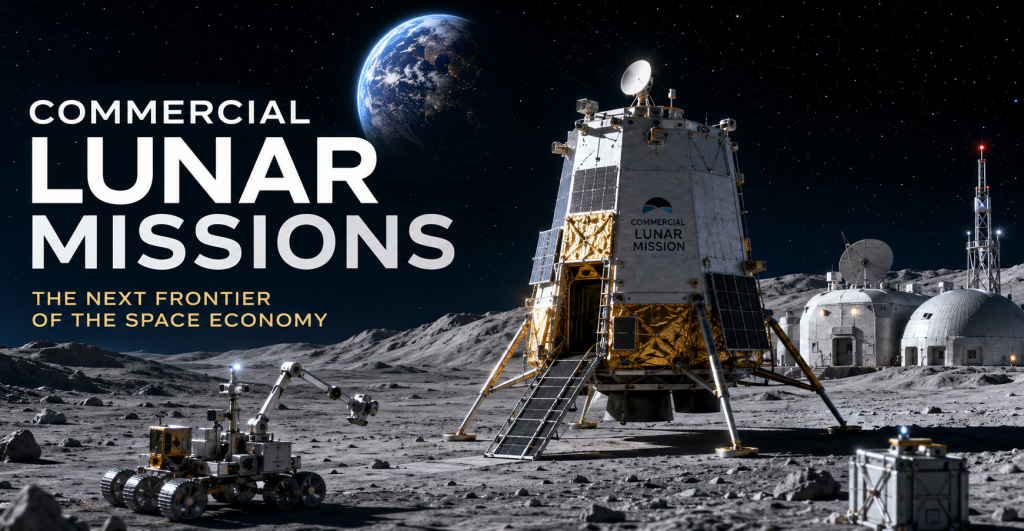

The Moon is no longer just a destination for scientific exploration—it is rapidly becoming the next frontier for commercial business. Governments once dominated lunar exploration, but today private companies are designing landers, delivering payloads, building lunar infrastructure, and preparing for resource utilization. Commercial lunar missions have evolved from ambitious concepts into a fast-growing industry backed by space agencies, venture capital, and global partnerships.
With programs like NASA’s Commercial Lunar Payload Services (CLPS), the Artemis initiative, and increasing participation from private companies across the U.S., Europe, Japan, and India, the lunar economy is gaining momentum. The coming decade could redefine how businesses operate beyond Earth.
Why Commercial Lunar Missions Are Becoming a Major Trend
Historically, lunar missions were funded and operated almost entirely by governments. Today, agencies are increasingly outsourcing transportation, technology development, and scientific payload delivery to commercial companies.
Instead of building every spacecraft themselves, organizations such as NASA purchase transportation services from private firms, creating a business model similar to commercial aviation. This shift significantly reduces mission costs while accelerating innovation and competition. NASA continues expanding commercial partnerships through its lunar delivery programs and Moon Base strategy.
The commercial approach is attracting startups, aerospace giants, robotics companies, AI developers, mining technology firms, and satellite operators into an entirely new economic ecosystem.
What Is Driving the Commercial Lunar Economy?
Several powerful trends are fueling investment in commercial lunar missions.
Government Support Through Public-Private Partnerships
Rather than developing every mission internally, space agencies now collaborate with private companies for lunar transportation, scientific experiments, communications, and surface infrastructure.
These partnerships provide companies with long-term contracts while allowing governments to expand exploration at lower costs. NASA has recently awarded additional commercial lunar missions as part of its long-term Moon Base plans.
Lower Launch Costs
Reusable rockets have dramatically changed the economics of spaceflight.
Companies can now launch heavier payloads more frequently, making lunar transportation increasingly practical for commercial customers. Future heavy-lift systems are expected to reduce the cost per kilogram delivered to the Moon even further.
Growing Demand for Lunar Infrastructure
Future lunar missions will require:
- Cargo transportation
- Navigation systems
- Communications satellites
- Surface power systems
- Lunar rovers
- Construction technologies
- Scientific laboratories
- Resource extraction equipment
Each requirement represents a potential commercial market.
Industries That Will Benefit
Commercial lunar missions are creating opportunities across multiple sectors.
Aerospace Manufacturing
Companies are developing reusable lunar landers, propulsion systems, robotics, navigation software, and advanced spacecraft components.
Artificial Intelligence
AI is expected to play a major role in autonomous landing, robotic exploration, navigation, hazard detection, and equipment maintenance, reducing reliance on human intervention during lunar operations.
Robotics
Since astronauts cannot perform every task, robotic systems will handle construction, exploration, cargo movement, drilling, and maintenance.
Telecommunications
Reliable communication between Earth and the Moon requires dedicated satellite networks, positioning systems, and next-generation deep-space connectivity.
Mining and Resource Utilization
Researchers are studying the possibility of extracting lunar water ice, oxygen, rare minerals, and other resources that could support future missions and reduce dependence on supplies launched from Earth.
Major Companies Shaping Commercial Lunar Missions
Several private companies are already competing to build the future lunar economy.
Some focus on robotic landers, while others develop heavy-lift launch systems, lunar rovers, communications infrastructure, or cargo delivery services. NASA continues awarding missions to commercial providers including Astrobotic, Firefly Aerospace, and Intuitive Machines under its expanding lunar exploration strategy.
International companies are also entering the market. Japan’s ispace, for example, recently announced plans to use SpaceX’s Starship for shared lunar cargo transportation, reflecting a growing commercial ecosystem beyond government missions.
Challenges That Still Exist
Despite rapid progress, commercial lunar exploration faces several obstacles.
High Development Costs
Building reliable lunar spacecraft remains expensive, requiring years of engineering, testing, and regulatory approvals.
Technical Risks
Landing safely on the Moon remains one of the most challenging tasks in spaceflight. Mission failures can significantly impact timelines and investor confidence.
Space Regulations
Questions surrounding lunar resource ownership, environmental protection, and international governance are still evolving as more private organizations prepare for operations beyond Earth.
Sustainable Business Models
Long-term profitability depends on creating repeat demand for lunar transportation, infrastructure, research services, and resource utilization.
Why Investors Are Paying Attention
Commercial lunar missions are no longer viewed solely as scientific endeavors. Investors increasingly see them as part of the emerging “space economy,” with opportunities spanning transportation, robotics, AI, communications, manufacturing, and resource development.
The public-private model reduces barriers for startups while creating recurring revenue opportunities through government contracts and future commercial customers.
As launch costs decline and lunar activity increases, investment is expected to spread across supporting technologies rather than focusing only on spacecraft manufacturers.
What the Future Looks Like
The next decade is expected to bring more frequent robotic missions, expanded commercial cargo deliveries, advanced lunar infrastructure, and greater international collaboration.
Many experts envision the Moon serving as a proving ground for technologies that will later support human missions to Mars. Recent NASA plans emphasize sustained commercial activity, regular lunar deliveries, and long-term infrastructure development rather than isolated exploration missions.
Final Thoughts
Commercial lunar missions represent one of the most exciting transformations in the global space industry. What was once driven almost entirely by national space programs is becoming a collaborative marketplace where governments, startups, and private aerospace companies work together to build the next generation of space infrastructure.
As reusable launch systems mature, autonomous technologies improve, and commercial demand grows, the Moon is poised to become the first major destination of the emerging space economy. For businesses, investors, and technology innovators, commercial lunar missions are no longer a distant vision—they are becoming a defining trend of the future.