

The global transportation industry is undergoing a significant transformation as governments, energy companies, and automotive manufacturers seek cleaner and more sustainable alternatives to conventional fossil fuels. Among the emerging solutions, E85 fuel has gained considerable attention for its ability to reduce greenhouse gas emissions while supporting energy diversification. Recent advancements in ethanol production technologies and fuel formulations have further enhanced the viability of E85, positioning it as a strategic component of the evolving renewable energy landscape.
As environmental regulations become more stringent and consumers increasingly prioritize sustainability, the new generation of E85 fuel offers a practical pathway toward cleaner transportation without requiring a complete overhaul of existing vehicle infrastructure.
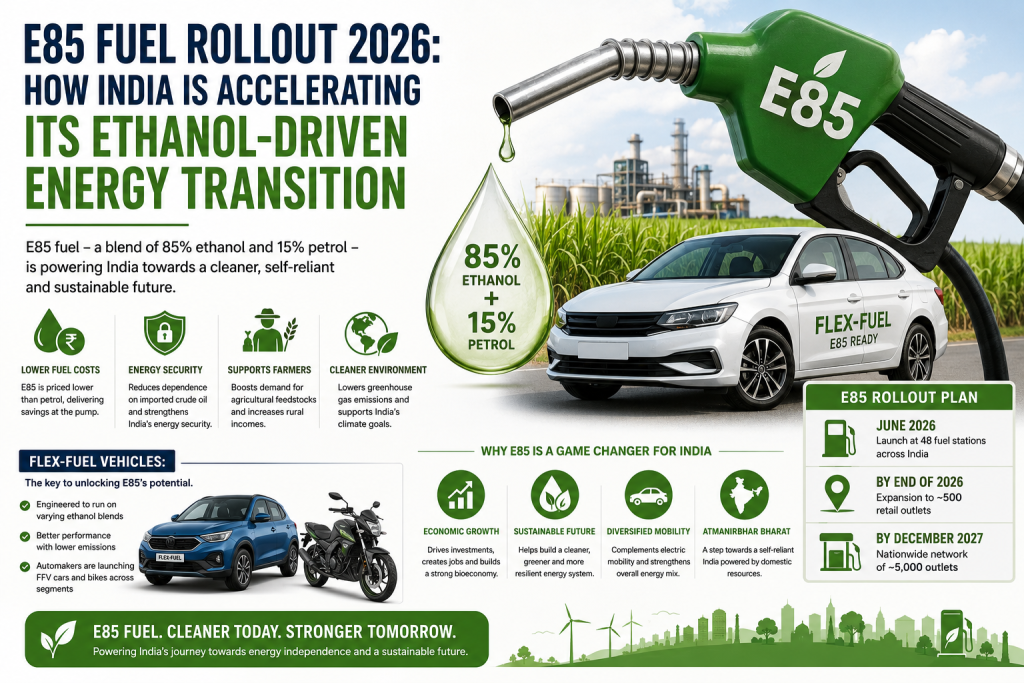
India has taken a decisive step in its energy transition strategy with the official introduction of E85 fuel on June 5, 2026, World Environment Day. Union Minister for Petroleum and Natural Gas, Hardeep Singh Puri, launched the high-ethanol blend at an Indian Oil Corporation retail outlet in New Delhi. Comprising 80-85% ethanol and 15-20% gasoline, E85 is positioned as a strategic extension of the country’s successful Ethanol Blended Petrol (EBP) programme, following the nationwide implementation of E20.
The launch underscores the government’s commitment to reducing reliance on imported crude oil, mitigating greenhouse gas emissions, bolstering agricultural incomes, and fostering a domestic biofuel ecosystem. Initial deployment covers 48 public sector outlets, with priority given to major economic corridors including Delhi-NCR, Mumbai-Pune, and Nagpur. The rollout roadmap targets 500 dispensing stations by the end of 2026 and approximately 5,000 stations by December 2027.
Pricing has been calibrated to encourage adoption. E85 is offered at roughly ₹20 per litre below prevailing E20 petrol prices. In Delhi, for instance, the launch price was set at approximately ₹82 per litre against ₹102 for standard petrol. This differential aims to neutralize the impact of ethanol’s lower energy density on operating costs for end users.
Understanding E85 Fuel
E85 is a high-level ethanol fuel blend that typically contains between 51% and 85% ethanol, with the remaining percentage consisting of conventional gasoline. The exact ethanol concentration varies based on seasonal requirements and regional climate conditions.
The fuel is specifically designed for Flexible Fuel Vehicles (FFVs), which are equipped with advanced engine systems capable of operating on gasoline, E85, or any combination of the two. These vehicles automatically adjust fuel delivery and combustion parameters to optimize performance regardless of the fuel blend being used.
Ethanol itself is a renewable biofuel primarily produced from agricultural feedstocks such as corn, sugarcane, and other biomass materials. Unlike petroleum-based fuels, ethanol can be replenished through ongoing agricultural production, making it a more sustainable energy source.
Evolution of the New E85 Fuel
Recent developments in biofuel technology have significantly improved the performance characteristics of E85 fuel. Modern production processes have increased ethanol purity, improved energy efficiency, and reduced lifecycle emissions associated with fuel manufacturing.
Advanced refining techniques have also enhanced fuel stability, cold-weather performance, and compatibility with modern engine systems. These improvements address several challenges that previously limited the widespread adoption of high-ethanol fuel blends.
In addition, ongoing research into cellulosic ethanol production is enabling manufacturers to utilize agricultural residues, forestry waste, and non-food biomass sources. This next-generation approach reduces reliance on food crops while improving the overall sustainability profile of ethanol production.
Environmental Benefits
One of the most compelling advantages of E85 fuel is its potential to reduce transportation-related emissions.
Compared to conventional gasoline, E85 produces lower levels of carbon monoxide, particulate matter, and harmful hydrocarbons during combustion. Because ethanol contains oxygen within its molecular structure, it burns more completely, resulting in cleaner exhaust emissions.
Furthermore, ethanol is derived from renewable biological sources that absorb carbon dioxide during growth. This creates a more balanced carbon cycle compared to fossil fuels, which release carbon that has been stored underground for millions of years.
Studies indicate that high-ethanol fuel blends can significantly reduce lifecycle greenhouse gas emissions, supporting national and international climate objectives. As organizations pursue net-zero emission targets, E85 provides an immediately deployable solution for reducing the environmental impact of existing vehicle fleets.
Economic and Energy Security Advantages
Beyond its environmental benefits, E85 contributes to economic resilience and energy security.
The production of ethanol supports agricultural industries, creates rural employment opportunities, and stimulates investment in biofuel infrastructure. Farmers, processing facilities, transportation providers, and fuel distributors all benefit from the expansion of the ethanol value chain.
From an energy security perspective, increased ethanol utilization reduces dependence on imported petroleum products. Diversifying fuel sources helps protect economies from oil price volatility and geopolitical supply disruptions.
Many countries view renewable fuels as an essential component of long-term energy strategies, and E85 aligns closely with these objectives by leveraging domestic agricultural resources to meet transportation energy demands.
Technological Advancements Driving Adoption
Several technological innovations are accelerating the adoption of E85 fuel across global markets.
Advanced Flexible Fuel Vehicle Technology
Modern FFVs feature sophisticated engine control systems capable of detecting ethanol concentrations and optimizing combustion in real time. These systems ensure reliable performance, efficient fuel utilization, and compliance with emissions standards.
Improved Biofuel Production
Innovations in enzyme technology, fermentation processes, and biomass conversion methods have increased ethanol production efficiency while lowering manufacturing costs. These advancements continue to improve the competitiveness of ethanol-based fuels.
Expansion of Fueling Infrastructure
Governments and private-sector stakeholders are investing in expanded E85 fueling networks to improve accessibility for consumers. The growing availability of E85 stations is reducing one of the key barriers to widespread adoption.
Challenges Ahead
Despite its promise, E85 adoption faces hurdles. The most significant is fuel economy: ethanol contains less energy per litre, typically resulting in 20-30% lower mileage compared to regular petrol. Early real-world tests in India have shown reductions of around 24% in some vehicles. While the price discount mitigates this, drivers must plan for more frequent refuelling.
Infrastructure remains in the early stages. With only 48 stations operational initially, convenience is limited outside major corridors. Expanding to thousands of outlets will require significant investment and coordination among oil marketing companies.
Vehicle availability is another constraint. The “chicken-and-egg” problem is evident: limited FFVs reduce urgency for infrastructure, while sparse stations discourage automakers and buyers. Government incentives for FFV production and purchase could accelerate progress. Additionally, large-scale ethanol production raises questions about water usage, land allocation, and the food-versus-fuel balance, though proponents argue improved efficiencies and second-generation technologies can address these concerns.
Cold-start performance can be slightly more challenging with high-ethanol blends in cooler weather, though this is minimal in most Indian climates.
Strategic Outlook
The E85 launch aligns with India’s broader energy transition goals. By encouraging flex-fuel technology alongside electric vehicles and other alternatives, the country is pursuing a multi-pronged approach to sustainable mobility. Industry analysts expect the flex-fuel vehicle segment to grow rapidly once more models become available and infrastructure matures. For consumers, E85 makes sense primarily for owners of certified flex-fuel vehicles who live or travel near available stations. Others should continue using E20 or regular petrol to protect their engines. As awareness grows and more manufacturers introduce compatible models, E85 could become a mainstream option for cost-conscious and environmentally aware drivers.
The Future of Renewable Transportation Fuels
The transportation sector is expected to utilize a diverse mix of energy solutions in the coming decades, including electric vehicles, hydrogen technologies, renewable diesel, and advanced biofuels. Within this evolving ecosystem, E85 serves as a valuable transitional and complementary fuel option.
Unlike some alternative energy technologies that require substantial infrastructure investments, E85 can be integrated into existing transportation networks with relatively minimal disruption. This practical advantage positions it as an effective tool for reducing emissions in the near and medium term.
Ongoing advancements in sustainable agriculture, biofuel production, and vehicle technology are expected to further strengthen the role of E85 within global energy markets.