

Artificial Intelligence is no longer confined to research labs or large data centers. Today, AI powers smartphones, autonomous vehicles, smart factories, healthcare devices, financial services, and countless everyday applications. As AI adoption accelerates worldwide, one question is becoming increasingly important: Should AI run on the device itself or in the cloud?
This debate has given rise to two major approaches—Edge AI and Cloud AI. Both technologies are transforming industries, but they serve different purposes and offer unique advantages. While Cloud AI provides enormous computing power and scalability, Edge AI delivers real-time processing, enhanced privacy, and lower latency.
Rather than replacing one another, these two technologies are expected to complement each other. However, with businesses investing billions of dollars in AI infrastructure, understanding which approach will dominate the future has become one of the biggest conversations in the technology industry.
What Is Edge AI?
Edge AI refers to artificial intelligence that runs directly on local devices instead of relying on remote cloud servers.
Examples include:
- Smartphones
- Smart cameras
- Wearable devices
- Autonomous vehicles
- Industrial robots
- Medical equipment
- Smart home devices
- IoT sensors
Instead of sending data to the cloud for analysis, Edge AI processes information immediately on the device.
This enables much faster responses while reducing internet dependency.
What Is Cloud AI?
Cloud AI performs data processing using powerful remote servers hosted by cloud providers such as Microsoft Azure, Google Cloud, Amazon Web Services (AWS), and others.
Cloud AI is commonly used for:
- Large language models
- Chatbots
- Image generation
- Enterprise analytics
- Big data processing
- AI model training
- Recommendation engines
- Business intelligence
Because cloud platforms offer massive computing resources, they remain ideal for handling complex AI workloads.
Why Edge AI Is Growing So Quickly
Several technological trends are accelerating Edge AI adoption.
Faster Decision-Making
Edge AI eliminates the delay associated with transmitting information to cloud servers.
Applications such as:
- Self-driving cars
- Factory automation
- Healthcare monitoring
- Security surveillance
require immediate responses that cloud-based processing cannot always deliver.
Better Privacy
Since sensitive information remains on the device, Edge AI reduces the amount of personal data transmitted across networks.
This makes it particularly attractive for industries such as healthcare, finance, and government.
Offline Functionality
Edge AI continues working even without internet connectivity.
This capability is essential for:
- Remote industrial sites
- Military applications
- Disaster response
- Rural healthcare
- Space exploration
Why Cloud AI Continues to Lead
Despite Edge AI’s growth, Cloud AI remains the backbone of modern artificial intelligence.
Massive Computing Power
Training advanced AI models requires enormous computational resources that only cloud infrastructure can efficiently provide.
Scalability
Cloud platforms allow organizations to process millions of AI requests simultaneously.
Continuous Learning
Cloud AI systems can be updated regularly using massive datasets collected from around the world.
Cost Efficiency
Businesses avoid purchasing expensive hardware by accessing AI services through cloud subscriptions.
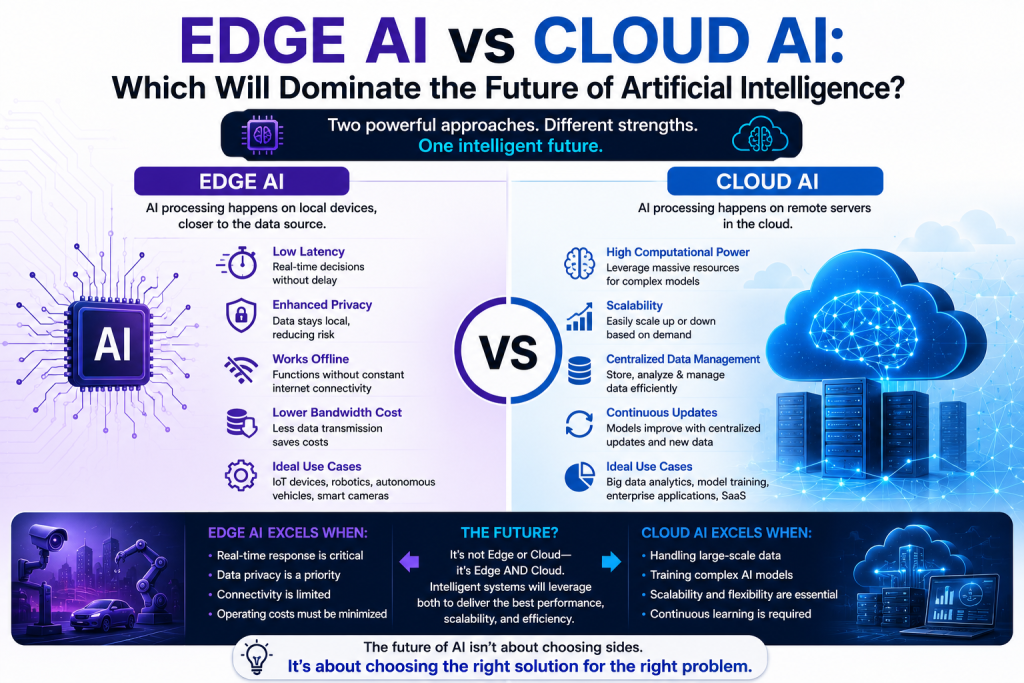
Edge AI vs Cloud AI: Key Differences
Edge AI focuses on speed, local processing, privacy, and real-time intelligence.
Cloud AI emphasizes scalability, model complexity, centralized management, and large-scale analytics.
While Edge AI processes information close to users, Cloud AI leverages distributed data centers capable of handling enormous workloads.
The choice often depends on the specific application rather than one technology being universally better.
Industries Driving Edge AI Adoption
Several industries are rapidly embracing Edge AI.
Healthcare
Medical devices use Edge AI for:
- Patient monitoring
- Disease detection
- Medical imaging
- Emergency alerts
Automotive
Modern vehicles increasingly rely on Edge AI for:
- Driver assistance
- Object recognition
- Collision avoidance
- Navigation
Manufacturing
Factories deploy Edge AI for:
- Predictive maintenance
- Quality inspection
- Robotics
- Equipment monitoring
Retail
Retailers use Edge AI for:
- Smart checkout
- Customer analytics
- Inventory monitoring
- Loss prevention
Industries Relying on Cloud AI
Cloud AI continues dominating enterprise applications.
Financial Services
Banks leverage cloud infrastructure for:
- Fraud detection
- Risk management
- Customer analytics
- Credit scoring
E-commerce
Cloud AI powers:
- Product recommendations
- Customer support
- Dynamic pricing
- Demand forecasting
Enterprise Software
Organizations use Cloud AI for:
- Business intelligence
- Workflow automation
- Data analytics
- Customer relationship management
Can Edge AI Replace Cloud AI?
The short answer is no.
Edge AI excels at processing information locally, while Cloud AI provides the computing power required to build and improve advanced AI models.
Most experts believe the future lies in Hybrid AI, where both technologies work together.
For example:
- Edge AI analyzes data instantly.
- Cloud AI performs deeper analysis.
- Updated AI models are distributed back to edge devices.
This creates an intelligent ecosystem combining speed with scalability.
Challenges Facing Edge AI
Although promising, Edge AI faces several limitations.
Hardware Constraints
Edge devices have limited processing power compared to cloud data centers.
Model Size
Running large AI models locally remains difficult for many consumer devices.
Security Risks
Physical devices require strong protection against tampering and cyberattacks.
Update Management
Keeping millions of edge devices synchronized with the latest AI models presents operational challenges.
Challenges Facing Cloud AI
Cloud AI also faces important challenges.
Latency
Data transmission introduces delays that can affect real-time applications.
Privacy
Sending sensitive information to remote servers raises security concerns.
Internet Dependency
Cloud AI requires stable network connectivity.
Infrastructure Costs
Running large AI models demands significant investment in data centers and energy resources.
The Rise of Hybrid AI
Increasingly, technology companies are combining both approaches.
Hybrid AI enables organizations to:
- Process urgent tasks locally
- Store large datasets in the cloud
- Continuously improve AI models
- Deliver faster user experiences
Major technology companies including Microsoft, Google, Apple, NVIDIA, Qualcomm, Intel, and Amazon are investing heavily in hybrid AI ecosystems.
Future Outlook (2026–2035)
The next decade will likely witness rapid expansion of both Edge AI and Cloud AI.
Expected developments include:
- Smarter smartphones
- AI-powered autonomous vehicles
- Intelligent factories
- Personalized healthcare devices
- Faster AI chips
- More efficient cloud infrastructure
- Advanced hybrid computing platforms
Rather than competing directly, Edge AI and Cloud AI are expected to evolve together, creating seamless intelligent experiences across industries.
Conclusion
The question is no longer whether Edge AI or Cloud AI will dominate—it is how both technologies will work together to power the next generation of artificial intelligence.
Edge AI delivers speed, privacy, and real-time intelligence where immediate decisions are essential. Cloud AI provides the computational scale, learning capabilities, and infrastructure required to build increasingly powerful AI systems.
As businesses continue accelerating digital transformation, the future belongs to organizations capable of integrating both technologies effectively. The AI revolution is unlikely to be powered by Edge AI or Cloud AI alone—it will be driven by the intelligent combination of both.