
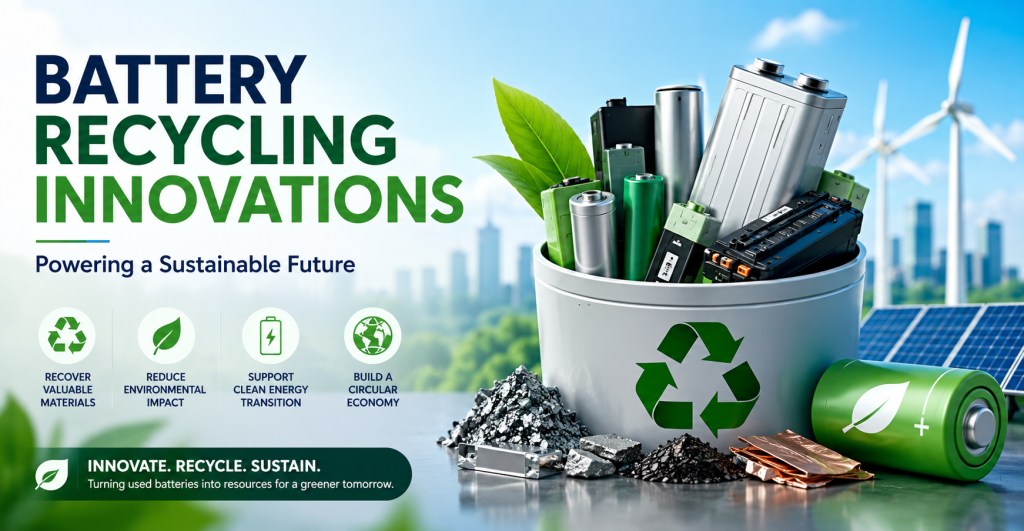

As electric vehicles, renewable energy storage systems, and portable electronics become increasingly common, battery recycling innovations are emerging as one of the most significant sustainability trends of 2026. Governments, manufacturers, and technology companies are investing heavily in advanced recycling methods to recover valuable materials while reducing environmental impact. Rather than treating used batteries as waste, industries are beginning to view them as valuable resources capable of supporting a circular economy.
The rapid expansion of lithium-ion battery usage has created a pressing need for efficient recycling infrastructure. Millions of batteries will reach the end of their useful lives over the coming decade, making advanced recovery technologies essential for securing supplies of critical minerals such as lithium, nickel, cobalt, and manganese. Recent industry developments indicate that recycling capacity is expanding rapidly alongside electric vehicle adoption and renewable energy deployment.
Smarter Recycling Technologies Are Replacing Traditional Methods
Traditional battery recycling often relies on energy-intensive smelting processes that consume large amounts of electricity while recovering only a portion of valuable materials. Today’s innovations are focused on cleaner, more efficient alternatives that maximize material recovery while lowering carbon emissions.
Hydrometallurgical recycling has become one of the fastest-growing approaches because it uses chemical solutions to extract battery metals with higher purity and improved recovery rates. At the same time, direct recycling techniques aim to preserve battery cathode materials instead of breaking them down completely, significantly reducing processing costs and energy consumption.
Researchers are also exploring electrochemical regeneration methods that restore battery components without destroying them. New approaches have demonstrated the potential to extend battery life while reducing recycling expenses, offering an alternative to conventional dismantling processes.
Artificial Intelligence Is Improving Battery Sorting
Artificial intelligence is becoming an essential tool in battery recycling facilities. AI-powered inspection systems can identify battery chemistry, detect damaged cells, and automatically sort batteries before processing begins.
Machine learning algorithms analyze battery health and estimate remaining life, allowing suitable batteries to be reused in secondary energy storage applications instead of being immediately recycled. This “second-life” strategy extends battery usability while reducing overall waste.
Advanced robotics are also entering recycling plants. Automated disassembly systems equipped with computer vision can safely dismantle complex battery packs, reducing workplace risks while increasing operational efficiency. Recent research demonstrates how robotic systems can improve precision during battery pack disassembly for recycling operations.
Circular Economy Gains Momentum
Battery recycling is becoming a central pillar of the global circular economy. Instead of relying solely on newly mined raw materials, manufacturers are increasingly incorporating recycled metals into new battery production.
This closed-loop manufacturing model offers several advantages:
- Reduced dependence on mining operations
- Lower greenhouse gas emissions
- Improved supply chain resilience
- Reduced waste generation
- Greater resource efficiency
Many battery manufacturers are forming long-term partnerships with recycling companies to ensure a steady supply of recovered materials. These collaborations help stabilize production costs while supporting sustainability goals.
Governments Introduce Stronger Recycling Policies
Policy support continues to accelerate battery recycling worldwide. Many countries are introducing stricter collection targets, producer responsibility regulations, and mandatory recycling requirements for electric vehicle batteries.
Manufacturers are increasingly required to track battery lifecycles, improve product traceability, and ensure responsible disposal once batteries reach end-of-life. Such regulations encourage companies to design batteries that are easier to dismantle and recycle.
India is also strengthening its battery recycling framework to support the country’s growing electric mobility ecosystem, although industry participants continue to discuss implementation challenges associated with new compliance requirements.
Second-Life Batteries Create New Opportunities
Not every battery reaching retirement from an electric vehicle is ready for recycling. Many still retain sufficient capacity for less demanding applications.
These second-life batteries are increasingly being deployed for:
| Application | Benefit |
|---|---|
| Residential energy storage | Stores solar power for home use |
| Commercial backup systems | Provides emergency electricity |
| Renewable energy projects | Stabilizes solar and wind generation |
| Telecom infrastructure | Ensures uninterrupted communication services |
| Industrial energy storage | Reduces electricity costs during peak demand |
This trend extends battery lifespan while delaying recycling until the battery has delivered its maximum value.
Battery Design Is Becoming More Recycling-Friendly
Manufacturers are beginning to consider recyclability during the design phase rather than after production.
New battery architectures emphasize:
- Modular construction
- Easier cell removal
- Standardized components
- Reduced adhesive usage
- Improved material labeling
These improvements simplify automated disassembly while lowering recycling costs.
Emerging battery chemistries, including lithium iron phosphate (LFP) and sodium-ion batteries, are also influencing recycling strategies. Recycling facilities are adapting their technologies to efficiently recover materials from these next-generation energy storage systems.
Innovation Continues Across the Industry
Beyond recycling itself, researchers continue exploring methods that reduce waste before batteries even reach end-of-life.
Innovations include:
- Battery health prediction software
- Smart battery passports
- Digital material tracking
- AI-powered quality inspection
- Automated logistics systems
- Advanced battery regeneration technologies
These developments improve transparency across the battery lifecycle while helping manufacturers recover valuable resources more efficiently.
Industry experts believe digital technologies will become increasingly important as battery volumes continue growing throughout the decade.
Looking Ahead
Battery recycling innovations are reshaping how the world manages one of the fastest-growing waste streams generated by modern technology. Cleaner recycling processes, artificial intelligence, robotics, second-life battery applications, and stronger environmental policies are creating a more sustainable energy ecosystem.
As electric mobility and renewable energy continue expanding, efficient battery recycling will play a crucial role in securing critical mineral supplies while reducing environmental impact. Rather than viewing used batteries as disposable products, industries increasingly recognize them as valuable assets that can power the next generation of clean technologies.
The momentum behind battery recycling demonstrates how technological innovation and sustainability can work together, supporting both economic growth and environmental responsibility. With continued investment and policy support, battery recycling is set to become one of the defining clean technology trends of the decade.