
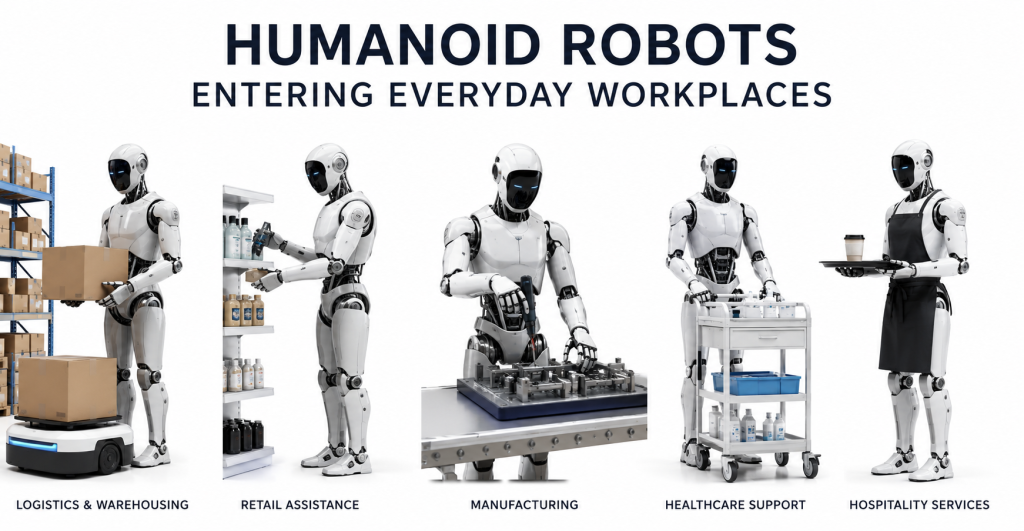

The global shift toward humanoid robots entering everyday workplaces is moving beyond experimentation into early-stage operational reality. What was once framed as a distant automation vision is now increasingly tied to labor economics, productivity constraints, and enterprise efficiency strategies. The defining change is not just the introduction of machines that resemble human form, but the emergence of adaptable physical AI systems designed to operate in environments originally built for people. This creates a fundamentally new layer in the global labor structure, where physical work can be partially digitized through embodied intelligence.
This transition is being shaped by a tightening global labor market, rising wage pressures in developed and emerging economies, and sustained demand for operational efficiency across industries. Businesses are no longer viewing automation purely as a cost-reduction tool but as a workforce stabilization mechanism. Humanoid robots, in this context, are positioned as flexible labor assets capable of performing repetitive, physically demanding, or structurally predictable tasks without requiring extensive infrastructure redesign. This compatibility with human-centric environments is one of the strongest accelerators of adoption, as it avoids the high capital burden associated with traditional fixed automation systems.
Workplace Integration and Operational Redesign
Workplace environments are expected to evolve into hybrid systems where human workers and humanoid robots operate in shared physical spaces. This does not necessarily imply replacement but rather redistribution of task categories. Routine, repetitive, and physically intensive tasks are increasingly likely to be assigned to robotic systems, while humans focus on supervision, exception handling, and decision-making responsibilities.
This transition will also require new operational frameworks to manage human-robot interaction safely and efficiently. Workflow orchestration systems will become essential, enabling real-time coordination between multiple robotic units and human teams. Over time, organizations may treat robotic systems as part of their core workforce infrastructure, requiring dedicated management, maintenance, and optimization strategies similar to human resource planning.
Key Market Signals Driving Adoption
- Rapid increase in demand for scalable physical labor solutions in logistics and warehousing networks
- Structural labor shortages in aging economies, particularly in entry-level and repetitive roles
- Strong capital inflows into robotics and physical AI development ecosystems
- Growing need for operational flexibility in manufacturing and service delivery models
- Rising enterprise interest in hybrid human-robot workforce structures for long-term efficiency gains
Market Forces Reshaping Demand for Humanoid Robotics
The demand for humanoid robotics is being shaped by a combination of demographic stress, industrial scaling pressure, and technological convergence. Aging populations in major economies are reducing the availability of entry-level workers, particularly in logistics, retail support, and light manufacturing roles. At the same time, global supply chains are becoming more complex and time-sensitive, requiring higher throughput and operational consistency. These structural conditions are pushing enterprises to reconsider how physical labor is sourced and sustained.
Another key factor is the evolution of physical AI systems, which combine machine learning, robotics engineering, and real-time environmental sensing. This convergence is enabling robots to function in unstructured environments with increasing autonomy. Unlike traditional automation systems that require fixed pathways and controlled conditions, humanoid robots are being engineered to interpret dynamic environments and adjust their actions accordingly. This flexibility significantly expands their potential use cases across industries that were previously resistant to automation.
Economic and Industry-Level Transformation
The integration of humanoid robots into workplaces is expected to alter productivity structures across multiple sectors. In manufacturing, they can support flexible production models where product variations and short production cycles make traditional automation inefficient. In logistics, they can reduce bottlenecks between automated systems and manual handling points, improving flow continuity in high-volume environments. In service industries, they can absorb operational tasks that do not require human judgment but demand physical presence.
The broader economic implication is a shift in how productivity growth is generated. Instead of relying solely on digital efficiency gains or industrial mechanization, economies may enter a phase where physical labor itself becomes dynamically programmable. This introduces a new productivity model characterized by elastic labor capacity, where output can scale without proportional increases in human workforce size.
Technology Foundations Supporting Market Expansion
The rapid advancement of humanoid robotics is underpinned by simultaneous progress across multiple technology domains. Machine learning systems are now capable of interpreting complex visual and spatial data in real time, enabling robots to identify objects, navigate obstacles, and adjust to environmental variability. At the same time, improvements in actuator design and materials engineering have enhanced mobility efficiency, allowing robots to perform sustained physical tasks with greater endurance and precision.
Sensor fusion technologies are also playing a critical role in bridging the gap between perception and action. By integrating visual, tactile, and spatial data, humanoid systems can build a more complete understanding of their environment, which is essential for operating in unpredictable workplace conditions. This is further enhanced by advancements in edge computing, which allow robots to process data locally and respond with minimal latency, increasing operational independence.