
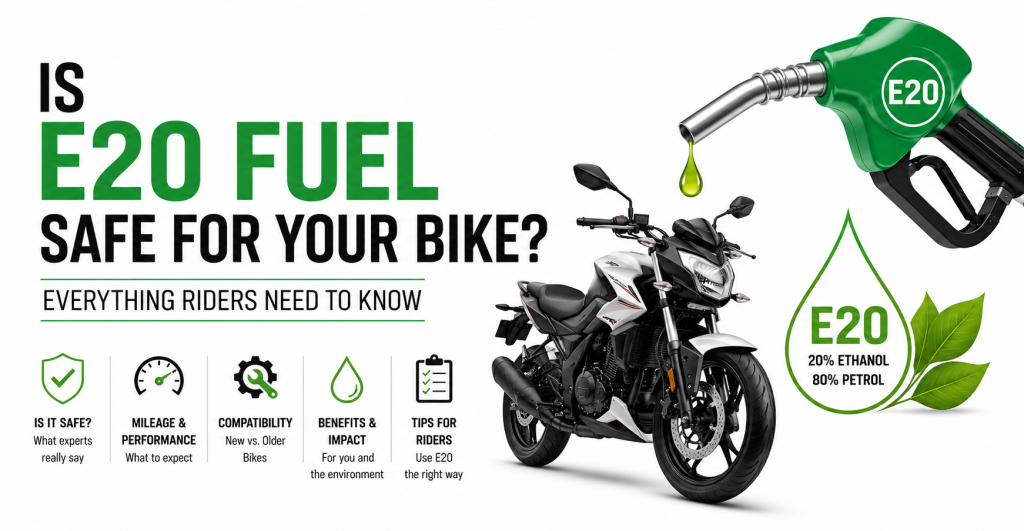

One fuel. Endless debates.
Walk into any petrol station today, and chances are you’ll notice a small label that wasn’t there a few years ago E20 Petrol. For some riders, it’s just another type of fuel. For others, it’s become a source of endless questions.
“Will it reduce my bike’s mileage?”
“Can it damage my engine?”
“Do I need to upgrade my motorcycle?”
If you’ve found yourself asking these questions, you’re not alone. Across India, E20 fuel has become one of the hottest topics among bike owners, mechanics, and automobile enthusiasts. Social media is filled with mixed opinions, while manufacturers are launching new motorcycles proudly labeled as E20-compatible.
So, is E20 fuel really something to worry about?
The short answer is not necessarily. The real story isn’t about fear it’s about understanding how this new fuel fits into the future of mobility and what it means for your motorcycle.
Why Everyone Is Talking About E20
For decades, petrol remained largely unchanged for everyday riders. Refueling was simple you stopped at a petrol pump, filled your tank, and continued your journey without giving much thought to what was inside the fuel.
Today, that is changing.
India is steadily moving towards cleaner fuels to reduce pollution and decrease dependence on imported crude oil. E20 fuel, which contains 20% ethanol blended with 80% petrol, is one of the country’s biggest steps in that direction.
It’s not just an environmental initiative. It also supports farmers by increasing demand for ethanol produced from crops such as sugarcane and maize, while helping strengthen India’s energy security.
But every major change brings uncertainty, especially when it involves something as important as your motorcycle.
So, Is E20 Safe?
The answer depends on one important factor your bike.
If you own a recently launched motorcycle, there’s a good chance it’s already designed to run on E20 fuel. Manufacturers have spent years updating engines, fuel systems, and components to handle higher ethanol blends without affecting reliability.
For these motorcycles, E20 is simply part of the next generation of cleaner transportation.
However, older motorcycles tell a different story.
Many bikes manufactured before E20 standards became common were designed for lower ethanol blends. While using E20 once or occasionally isn’t likely to cause immediate damage, continuous use in motorcycles that aren’t officially compatible may gradually affect certain rubber seals, plastic fuel lines, or metal components over time.
That’s why checking your owner’s manual remains one of the smartest things you can do before making the switch.
Why Older Bikes Raise More Questions
Imagine wearing shoes designed for walking and suddenly deciding to run a marathon.
Will they survive?
Probably.
Will they perform at their best?
Not necessarily.
The same idea applies to motorcycles.
Older engines weren’t developed with E20 in mind. Ethanol behaves differently from conventional petrol. It attracts moisture more easily and interacts differently with certain materials found in older fuel systems.
This doesn’t mean every older bike will suddenly develop problems.
It simply means manufacturers designed those motorcycles for different fuel standards.
Understanding that difference helps riders make informed decisions rather than relying on internet rumors.
Will Your Bike Lose Mileage?
Perhaps no question worries riders more than fuel efficiency.
After all, even a small drop in mileage can make a noticeable difference for daily commuters.
Since ethanol contains slightly less energy than petrol, E20 may deliver marginally lower fuel economy under certain conditions. However, the difference is generally small and varies depending on your motorcycle, riding habits, road conditions, and engine tuning.
Many riders may never notice a meaningful change during everyday commuting.
Maintaining proper tyre pressure, servicing your motorcycle regularly, and riding smoothly often have a greater impact on fuel efficiency than switching to E20 alone.
More Than Just Cleaner Fuel
It’s easy to view E20 as another government initiative.
In reality, it’s part of a much larger transformation taking place across the automobile industry.
Motorcycle manufacturers are redesigning engines.
Fuel stations are upgrading infrastructure.
Engineers are developing technologies capable of handling higher ethanol blends.
Researchers continue improving fuel efficiency and reducing emissions.
Every major transition in transportation from leaded petrol to unleaded fuel, from carburetors to fuel injection initially raised concerns.
Eventually, those technologies became the new normal.
E20 appears to be following a similar path.
The Real Opportunity Behind E20
While riders focus on engines and mileage, businesses are looking at something much bigger.
The shift towards ethanol is creating opportunities across multiple industries.
Farmers benefit from increased demand for ethanol-producing crops.
Automobile manufacturers are investing in new engine technologies.
Fuel companies continue expanding blending infrastructure.
Engineering firms are developing compatible components.
Even startups working in renewable energy and green mobility are finding new opportunities as India’s transportation sector evolves.
In many ways, E20 represents more than a fuel it signals the beginning of a broader clean mobility ecosystem.
Myths That Refuse to Disappear
Whenever new technology enters the market, misinformation usually arrives first.
Some people believe E20 instantly damages every motorcycle engine.
Others claim it dramatically reduces mileage or voids warranties.
Neither statement tells the complete story.
The reality is much simpler.
If your motorcycle is designed for E20, you can use it confidently.
If your motorcycle is older, follow your manufacturer’s recommendations instead of relying on social media opinions.
Facts will always outperform rumors.
What Should Riders Do Now?
There’s no need to panic every time you stop at a petrol station.
Instead, take a practical approach.
Find out whether your motorcycle is E20-compatible. Read your owner’s manual, ask an authorized service center, and continue following regular maintenance schedules.
Being informed is far more valuable than believing every headline or viral post.
As India’s fuel landscape evolves, riders who understand these changes will adapt far more easily than those who rely on assumptions.
Final Thoughts
E20 fuel isn’t here to make riding more difficult it represents India’s effort to build a cleaner, more sustainable transportation future. Like every major change in the automotive industry, it has sparked questions, debates, and a fair share of misconceptions.
For riders with newer E20-compatible motorcycles, the transition is likely to be straightforward. Owners of older bikes simply need to confirm compatibility and follow manufacturer guidance before making the switch.
The road ahead isn’t about choosing between old fuel and new fuel. It’s about understanding how technology is evolving and ensuring your motorcycle is ready for that journey.
After all, every great ride begins with confidence and that confidence comes from knowing the facts, not the rumors.