
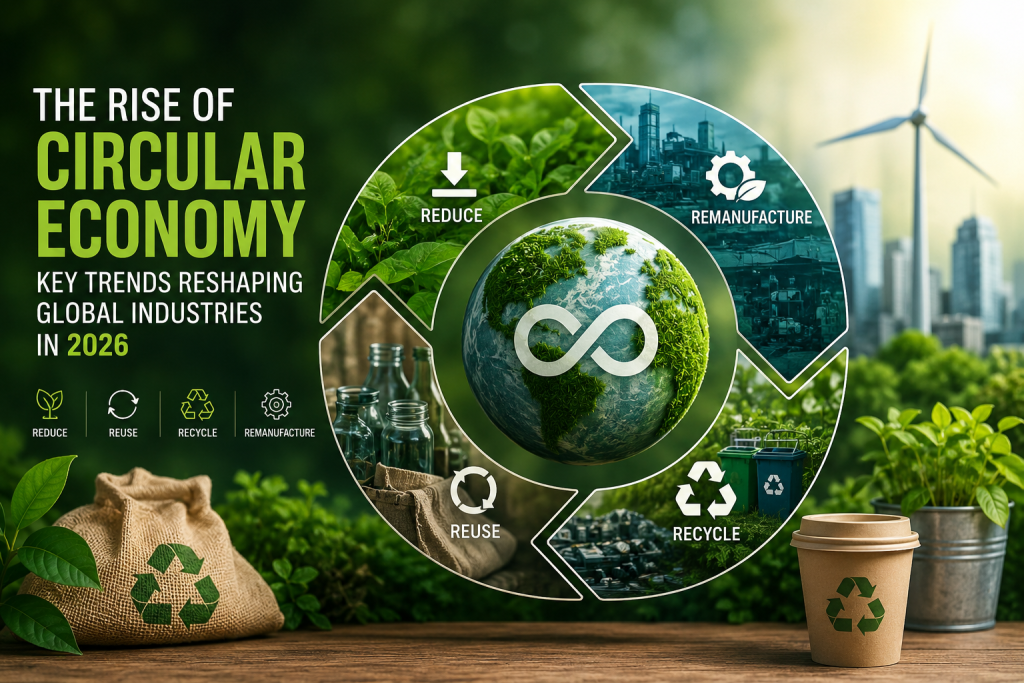

The global business landscape is undergoing a major transformation as companies increasingly embrace circular economy principles. In 2026, the circular economy is no longer viewed solely as a sustainability initiative—it is becoming a core business strategy across industries. Rising environmental concerns, stricter regulations, and shifting consumer preferences are encouraging organizations worldwide to move away from the traditional “take-make-dispose” model.
Businesses are now focusing on reducing waste, extending product lifecycles, improving resource efficiency, and creating sustainable value chains. From manufacturing and packaging to electronics and fashion, circular economy practices are reshaping how products are designed, produced, used, and recycled.
Industry experts believe that circular business models will play a critical role in driving sustainable economic growth over the coming decade.
Understanding the Circular Economy
A circular economy is an economic system designed to minimize waste and maximize resource utilization. Unlike the traditional linear economy, which relies heavily on extracting raw materials and disposing of products after use, the circular model emphasizes reuse, refurbishment, remanufacturing, and recycling.
The objective is to keep materials and products in circulation for as long as possible while reducing environmental impact.
Advancements in recycling technologies, material innovation, and digital tracking systems are making circular business models increasingly practical and scalable.
Why Circular Economy Adoption Is Accelerating
Several factors are driving the rapid adoption of circular economy strategies across industries.
One major factor is the growing global focus on sustainability and climate action. Governments worldwide are implementing stricter regulations related to waste reduction, carbon emissions, and resource management.
Consumers are also becoming more environmentally conscious and increasingly prefer brands that demonstrate strong sustainability commitments.
Additionally, businesses are recognizing that circular practices can improve operational efficiency, reduce costs, strengthen supply chain resilience, and create new revenue opportunities.
As sustainability becomes a competitive differentiator, organizations are integrating circular principles into long-term business strategies.
Key Circular Economy Trends Reshaping Industries
Multiple trends are accelerating the transition toward circular business models.
Product-as-a-Service (PaaS) models are gaining momentum as companies shift from selling products to offering subscription-based services, enabling greater product reuse and lifecycle management.
Sustainable packaging solutions are becoming increasingly important, with businesses investing in recyclable, compostable, and reusable packaging materials.
Advanced recycling technologies, including chemical recycling and AI-enabled waste sorting systems, are improving material recovery rates and reducing landfill dependence.
Additionally, digital product passports are emerging as valuable tools for tracking product materials, repair history, and recycling information throughout the product lifecycle.
These innovations are helping organizations improve transparency and optimize resource utilization.
Industries Leading the Circular Economy Transition
Several industries are at the forefront of circular economy adoption.
The manufacturing sector is increasingly implementing remanufacturing and industrial recycling programs to minimize material waste and improve resource efficiency.
The fashion industry is embracing resale platforms, clothing rental services, and textile recycling initiatives to address sustainability challenges.
Consumer electronics companies are expanding device refurbishment, repair programs, and e-waste recovery efforts to extend product lifespans.
Meanwhile, the packaging industry continues to innovate through reusable packaging systems and biodegradable material development.
Collaboration across supply chains is further accelerating the adoption of circular practices across these sectors.
Technology Is Enabling Circular Business Models
Technology is playing a vital role in advancing the circular economy.
Internet of Things (IoT) sensors, blockchain, and digital tracking platforms are helping companies monitor product usage, improve asset management, and enhance supply chain transparency.
Data analytics solutions are enabling businesses to optimize material flows, identify waste reduction opportunities, and improve resource efficiency.
Automation and smart manufacturing technologies are also supporting sustainable production processes while reducing environmental footprints.
As digital transformation continues, technology-driven circular ecosystems are expected to expand significantly.
Challenges Still Need to Be Overcome
Despite growing momentum, several challenges continue to hinder large-scale circular economy adoption.
High implementation costs, inadequate recycling infrastructure, and complex supply chains remain significant barriers for many organizations.
Standardization issues, limited consumer participation, and inconsistent regulatory frameworks can also slow progress.
Additionally, redesigning products for durability, repairability, and recyclability often requires substantial investment and operational changes.
Addressing these challenges will be essential for accelerating the global transition toward circular economic systems.
What the Future Holds
Industry analysts expect circular economy practices to become increasingly mainstream across global industries.
Future developments may include greater adoption of closed-loop manufacturing systems, expansion of secondary material markets, increased investment in sustainable innovation, and stronger collaboration among businesses, governments, and consumers.
As environmental pressures continue to intensify, circular economy principles are likely to become a fundamental component of corporate growth strategies.
A New Era of Sustainable Business
The rise of the circular economy marks a significant shift in how businesses create value and manage resources.
Organizations that successfully embrace circular principles can enhance sustainability, strengthen resilience, and unlock long-term competitive advantages.
In 2026, the circular economy is no longer an emerging concept—it is rapidly becoming a defining trend shaping the future of global industries.