

Artificial intelligence is no longer a technology that belongs only in research labs or tech companies. It is already changing how people work, learn, communicate, receive healthcare, and run businesses. As AI becomes more powerful and accessible, one important question continues to grow louder: Who should guide its future?
That question is now at the center of a major global initiative.
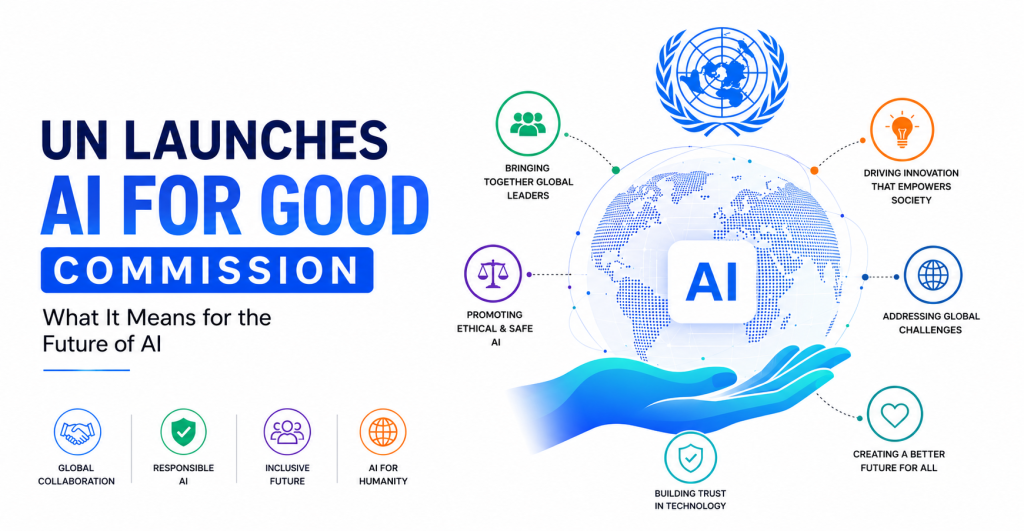
The United Nations has announced the launch of the AI for Good Commission, bringing together policymakers, technology leaders, researchers, and international organizations to encourage the responsible development and use of artificial intelligence. Rather than focusing only on innovation, the commission aims to ensure that AI benefits society while addressing concerns such as safety, transparency, ethics, and inclusion.
The announcement reflects a growing global belief that AI should not simply become more powerful it should also become more trustworthy.
Why the Commission Matters
Artificial intelligence is advancing at an extraordinary pace. Businesses are using AI to automate tasks, hospitals are applying it to improve diagnoses, schools are introducing AI-powered learning tools, and governments are exploring new ways to improve public services.
While these developments create exciting opportunities, they also raise important concerns. Questions around misinformation, bias, privacy, cybersecurity, intellectual property, and job displacement have become part of everyday discussions.
The AI for Good Commission has been created to encourage international cooperation on these challenges. Instead of allowing countries or companies to work independently, the initiative promotes dialogue and shared responsibility for AI’s future.
Although different nations may adopt different policies, the commission provides a platform where global perspectives can come together.
A Shift From Competition to Collaboration
Over the past few years, much of the AI conversation has focused on competition.
Technology companies have raced to release more capable AI models. Countries have invested heavily in AI research, semiconductor manufacturing, cloud infrastructure, and digital innovation. The rapid pace of development has often been described as a global AI race.
The UN initiative introduces a different perspective.
Rather than asking who can build the fastest or most powerful AI systems, it encourages a broader conversation about how these technologies can improve healthcare, education, environmental protection, disaster response, economic development, and public services.
This shift highlights an important idea: success in artificial intelligence should not be measured only by technological progress but also by its positive impact on society.
What “AI for Good” Really Means
The phrase “AI for Good” goes beyond developing smarter software.
It focuses on using artificial intelligence to solve meaningful real-world problems.
For example, AI can help doctors detect diseases earlier, assist farmers in improving crop yields, support teachers with personalized learning, optimize energy consumption, strengthen disaster preparedness, and improve accessibility for people with disabilities.
These practical applications demonstrate that AI is not just about automation it can also become a tool for improving quality of life.
The commission aims to encourage innovation that serves people while reducing potential risks.
Why Businesses Should Pay Attention
Although the initiative is led by international organizations, its impact could extend far beyond governments.
Businesses are increasingly integrating AI into customer service, software development, marketing, manufacturing, finance, and logistics. As AI adoption grows, expectations around responsible use are also increasing.
Consumers want transparency about how AI systems make decisions. Investors are paying closer attention to ethical technology practices. Regulators around the world are introducing new AI-related policies.
Companies that build trustworthy AI solutions may gain stronger customer confidence and long-term competitive advantages.
Responsible AI is gradually becoming both an ethical responsibility and a business opportunity.
Challenges That Cannot Be Ignored
Despite AI’s enormous potential, important challenges remain.
Bias in algorithms can produce unfair outcomes. AI-generated misinformation can spread rapidly online. Privacy concerns continue to grow as intelligent systems process increasing amounts of personal data. Cybersecurity risks are becoming more sophisticated as AI tools evolve.
Another concern is workforce transformation. While AI is expected to create new opportunities, it may also change existing jobs, requiring employees to develop new skills.
These issues cannot be solved by technology companies alone. They require collaboration between governments, businesses, researchers, educators, and civil society.
That is one of the reasons why international cooperation is becoming increasingly important.
The Growing Importance of AI Governance
The discussion around AI governance has accelerated over the past two years.
Several countries and regional organizations have introduced policies aimed at improving AI transparency, accountability, and user protection. The UN’s initiative adds another important voice to this global conversation by encouraging cooperation rather than isolated decision-making.
Effective governance does not necessarily mean slowing innovation.
Instead, it seeks to create clear frameworks that allow innovation to continue while protecting public interests.
Finding that balance may become one of the defining technology challenges of this decade.
What This Means for Everyday Users
For most people, AI governance may sound like a distant policy discussion, but its impact is likely to be felt in everyday life.
Future AI systems could become more transparent about how they generate responses, stronger safeguards may reduce harmful content, and users could gain greater control over how their data is collected and used.
In education, healthcare, banking, and digital communication, responsible AI practices have the potential to improve trust while making technology safer and more reliable.
Ultimately, these discussions influence how people experience AI every day not just how governments regulate it.
Looking Ahead
Artificial intelligence will continue evolving rapidly. New models, applications, and breakthroughs will emerge at a remarkable pace.
The challenge is ensuring that innovation remains aligned with human values.
The launch of the AI for Good Commission signals that the global conversation is moving beyond simply asking what AI can do. It is increasingly focused on what AI should do and how its benefits can be shared more broadly.
No single organization or country will determine AI’s future alone. Collaboration will play an increasingly important role as the technology becomes woven into every aspect of society.
Final Thoughts
The UN’s AI for Good Commission represents more than a new international initiative it reflects a growing recognition that artificial intelligence should advance with responsibility as well as innovation.
As AI continues transforming industries and everyday life, conversations around ethics, transparency, safety, and inclusion will become just as important as technical breakthroughs.
Whether you are a business leader, developer, policymaker, student, or everyday technology user, the future of AI will affect you in some way.
The real opportunity is not simply to build more intelligent machines. It is to build an AI ecosystem that earns public trust, supports sustainable progress, and delivers meaningful benefits for people around the world.
If that vision succeeds, the future of artificial intelligence will be defined not only by what it can achieve, but by how responsibly it achieves it.