
The global economy is experiencing one of its most significant technological transformations, yet much of the public conversation remains focused on highly visible innovations such as artificial intelligence chatbots, electric vehicles, and consumer electronics. Beneath these headline-grabbing developments, a far more profound digital shift is quietly redefining how industries operate, compete, and create value. Organizations across manufacturing, healthcare, finance, logistics, retail, education, and public services are moving beyond simple digitization toward deeply interconnected, intelligent, and data-driven operating models. This evolution is not merely about adopting new software or automating repetitive tasks; it represents a structural change in how decisions are made, resources are allocated, and customer experiences are delivered.
What makes this transition particularly remarkable is its gradual nature. Unlike disruptive consumer technologies that generate immediate public attention, enterprise-wide digital transformation often occurs behind the scenes. Businesses are redesigning supply chains, modernizing legacy infrastructure, integrating cloud-native platforms, deploying advanced analytics, and building digital ecosystems that continuously learn and improve. These investments rarely attract widespread discussion despite their enormous economic implications. As a result, one of the largest shifts in modern business is unfolding with relatively little mainstream attention.
Why This Digital Shift Matters More Than Ever
The growing complexity of global markets has fundamentally changed the way organizations approach growth and resilience. Companies are increasingly expected to respond instantly to changing customer behavior, supply disruptions, regulatory changes, and evolving competitive landscapes. Traditional operating models built around periodic reporting and manual decision-making are no longer sufficient in an environment where information moves in real time. This has accelerated investment in connected technologies capable of providing continuous operational intelligence across every business function.
Digital infrastructure has therefore become a strategic asset rather than simply an IT investment. Businesses are embedding data collection, predictive analytics, automation, and intelligent decision support directly into everyday operations. These capabilities allow organizations to anticipate market demand, optimize resource utilization, reduce operational inefficiencies, and strengthen risk management. The shift also enables faster innovation cycles, allowing companies to launch products, adjust pricing strategies, and improve customer engagement with greater speed than conventional business models ever allowed.
The Rise of Invisible Digital Infrastructure
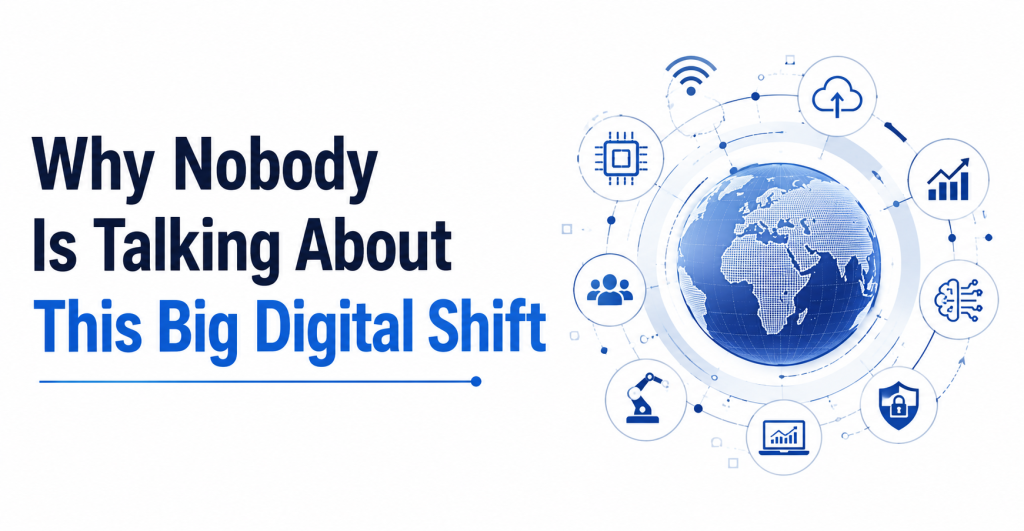
Much of today’s digital transformation is taking place through technologies that remain largely invisible to consumers. Connected sensors, edge computing, cloud architecture, digital twins, cybersecurity frameworks, application programming interfaces, and intelligent automation platforms are becoming foundational components of modern enterprises. Rather than functioning as isolated technologies, these systems increasingly work together to create adaptive digital environments capable of responding dynamically to changing business conditions.
This integrated infrastructure is becoming the backbone of future economic growth because it improves efficiency across nearly every industry. Manufacturers can optimize production in real time, healthcare providers can deliver more personalized care, retailers can forecast demand with greater accuracy, and financial institutions can strengthen fraud detection while improving customer experiences. The competitive advantage no longer comes solely from owning digital tools but from effectively connecting them into intelligent operational ecosystems.
Investment Momentum Signals Long-Term Growth
Capital investment patterns clearly demonstrate that organizations view this digital shift as a long-term strategic priority rather than a temporary technology cycle. Spending is increasingly directed toward scalable digital platforms that support automation, advanced analytics, cybersecurity, cloud migration, and integrated enterprise operations. Instead of replacing individual processes, businesses are redesigning entire value chains around digital capabilities that improve productivity and organizational agility.
This investment trend extends well beyond large multinational corporations. Mid-sized enterprises, startups, public institutions, and industrial operators are also accelerating modernization efforts to remain competitive in increasingly digital marketplaces. Governments are simultaneously supporting digital infrastructure development through modernization initiatives, smart city programs, digital public services, and technology-focused economic policies. Collectively, these investments are creating a multiplier effect that strengthens demand across numerous technology segments while encouraging continuous innovation throughout the global economy.
Emerging Opportunities Across Industries
The next phase of this digital shift will likely be defined by convergence rather than isolated innovation. Artificial intelligence, automation, cloud computing, cybersecurity, advanced connectivity, digital identity, and predictive analytics are increasingly being combined into unified business ecosystems that continuously improve through real-time learning. Organizations capable of integrating these technologies effectively will likely achieve higher operational efficiency, stronger customer engagement, and greater resilience during periods of economic uncertainty.
New business models are also emerging around digital services instead of traditional product ownership. Subscription platforms, predictive maintenance solutions, data-driven consulting, intelligent logistics, personalized healthcare, and autonomous industrial operations illustrate how digital capabilities are reshaping value creation. As industries continue generating larger volumes of operational data, the ability to transform that information into strategic insights will become one of the defining competitive advantages of the coming decade.
Rather than representing another technology trend, this transformation reflects a fundamental restructuring of the global business landscape. Companies that recognize the importance of this quiet but powerful digital shift are positioning themselves for sustained growth, stronger innovation capacity, and greater adaptability in an increasingly interconnected economy. Those that delay modernization may find it progressively more difficult to compete as digital ecosystems become the standard foundation for future industrial and commercial success.