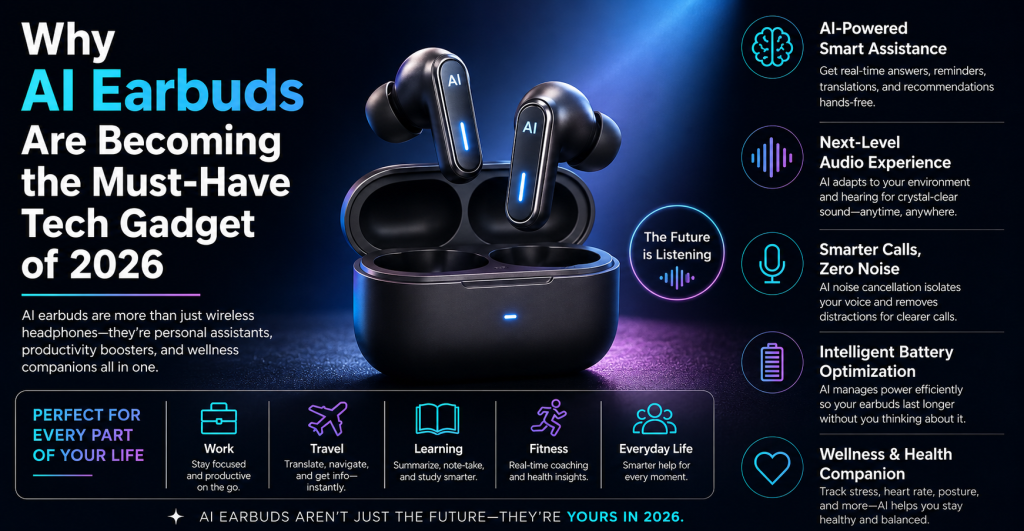

Artificial Intelligence (AI) is rapidly transforming the consumer electronics industry, and AI earbuds have emerged as one of the most promising categories within the wearable technology landscape. By combining premium wireless audio with advanced AI capabilities such as voice assistance, real-time translation, adaptive noise cancellation, and health monitoring, AI earbuds are evolving from simple listening devices into intelligent personal companions.
The growing popularity of smart wearables, increasing adoption of voice-enabled technologies, and advancements in generative AI are creating strong demand for AI-powered earbuds across both consumer and professional applications.
Understanding AI Earbuds
AI earbuds are wireless earphones equipped with artificial intelligence technologies that enhance functionality beyond traditional music playback and phone calls. These devices utilize embedded processors, cloud-based AI models, and advanced sensors to understand user behavior, interpret voice commands, and deliver contextual assistance.
Unlike conventional earbuds, AI-powered models can perform tasks such as scheduling appointments, answering questions, translating languages, monitoring health metrics, controlling smart home devices, and providing personalized recommendations. Their ability to function as always-available digital assistants makes them a valuable tool for both personal and professional users.
The integration of AI enables earbuds to continuously learn from user interactions, improving accuracy and customization over time. This creates a more intuitive and seamless experience compared to traditional wearable audio devices.
AI Wearables Market Expansion Supports AI Earbud Growth
The broader wearable technology market has experienced substantial expansion over the past decade. Industry estimates indicate that global wearable device shipments surpassed 600 million units annually, driven by strong demand for smartwatches, fitness trackers, smart glasses, and wireless audio devices.
Wireless earbuds represent one of the fastest-growing segments within the wearable ecosystem. Market analysts estimate that annual shipments of true wireless stereo (TWS) earbuds have exceeded 350 million units worldwide, highlighting strong consumer preference for compact and wireless audio solutions.
As AI capabilities become integrated into consumer devices, a growing share of these shipments is expected to include advanced intelligent features such as contextual voice assistance, adaptive audio optimization, and real-time language processing.
Growing Adoption of Voice-Based AI Assistants
Voice interaction has become a key driver behind AI earbud adoption. Research suggests that more than 8 billion digital voice assistants are currently in use globally across smartphones, smart speakers, vehicles, and wearable devices.
Consumer demand for hands-free experiences continues to increase. Surveys indicate that nearly 60% of smartphone users regularly use voice commands for tasks such as messaging, navigation, information searches, and device control.
AI earbuds extend these capabilities by enabling users to access virtual assistants instantly without removing their smartphones from pockets or bags. This convenience is making AI earbuds increasingly attractive for commuters, professionals, travelers, and fitness enthusiasts.
Real-Time Translation Becomes a Key Growth Driver
One of the most innovative features of AI earbuds is real-time language translation. The global language services industry has grown significantly, reflecting rising international business activity and global travel demand.
Modern AI-powered translation systems can support more than 40 languages, enabling near-instant communication between speakers of different languages. Advanced machine learning algorithms continue to improve translation accuracy, contextual understanding, and speech recognition performance.
As international collaboration increases across industries, AI translation earbuds are expected to become valuable tools for business meetings, tourism, education, and customer service applications.
Adaptive Noise Cancellation Enhances User Experience
Noise cancellation technology has become a standard feature in premium earbuds, but AI is significantly improving its effectiveness.
Traditional noise-canceling systems rely on predefined audio processing algorithms. AI-powered earbuds continuously analyze environmental sounds and automatically adjust noise reduction levels based on changing surroundings.
Studies indicate that advanced active noise cancellation systems can reduce ambient sound levels by up to 30–40 decibels, improving listening quality in airports, offices, public transportation systems, and crowded urban environments.
This intelligent adaptation helps deliver a more comfortable and immersive audio experience while preserving awareness of important environmental sounds when needed.
Health Monitoring Opens New Opportunities
The integration of biometric sensors is expanding the role of AI earbuds beyond communication and entertainment.
According to health technology research, more than 30% of wearable device users now actively monitor health-related metrics through connected devices. Manufacturers are increasingly incorporating sensors capable of tracking heart rate, movement patterns, exercise performance, and wellness indicators.
Future AI earbuds are expected to support advanced capabilities such as:
- Heart rate monitoring
- Stress detection
- Sleep tracking
- Activity analysis
- Posture assessment
- Fatigue monitoring
The convergence of artificial intelligence and health analytics could position AI earbuds as an important component of preventive healthcare ecosystems.
Growing Role in Productivity and Communication
AI earbuds are becoming valuable productivity tools for professionals. Integrated digital assistants can manage schedules, set reminders, read notifications, summarize messages, and facilitate hands-free communication.
For remote workers and business travelers, AI-powered features provide greater efficiency by reducing dependence on smartphones and laptops for routine tasks. Voice-driven interactions allow users to stay connected while focusing on other activities.
In business environments, AI earbuds can support meeting transcription, note-taking assistance, and multilingual communication. These capabilities are increasingly relevant as organizations embrace hybrid work models and global collaboration.
Enterprise Applications Continue to Expand
AI earbuds are also gaining traction in enterprise environments. Businesses increasingly rely on digital collaboration tools, hybrid work models, and multilingual communication platforms.
Recent workplace technology surveys indicate that over 70% of organizations have adopted hybrid or flexible work arrangements. This shift is creating demand for intelligent communication tools that improve productivity and collaboration.
AI-powered earbuds can support:
- Meeting transcription
- Voice note generation
- Instant translation
- Smart scheduling
- Notification management
- Hands-free communication
These capabilities allow professionals to remain productive while minimizing distractions and reducing dependence on multiple devices.
Integration with Smart Ecosystems
The rapid expansion of connected devices is another factor supporting AI earbud adoption. Industry estimates suggest that the number of connected Internet of Things (IoT) devices worldwide could exceed 30 billion devices during the coming years.
AI earbuds increasingly serve as a natural interface for interacting with connected ecosystems. Users can control smart lighting, thermostats, security systems, entertainment devices, and productivity applications through simple voice commands.
As smart homes and connected workplaces become more common, AI earbuds are expected to function as a central hub for seamless digital interactions.
Challenges and Considerations
Despite their growing popularity, AI earbuds face several challenges. Privacy and data security remain among the most significant concerns. Since these devices continuously process voice commands and personal information, manufacturers must implement robust security measures to protect user data.
Battery performance is another important consideration. AI processing requires substantial computing power, which can impact battery life. Manufacturers are actively developing more energy-efficient chips and software solutions to address this challenge.
Additionally, ensuring accurate voice recognition across different accents, languages, and noisy environments remains a complex technical task. Continued improvements in AI models will be necessary to deliver consistent user experiences.
Final Thoughts
The future of AI earbuds appears exceptionally promising. Advances in generative AI, edge computing, 5G connectivity, and miniaturized sensors are expected to unlock new capabilities over the next decade.
Industry experts anticipate that future AI earbuds will deliver:
- More natural conversations with AI assistants
- Enhanced real-time translation accuracy
- Advanced biometric monitoring
- Personalized wellness coaching
- Context-aware digital assistance
- Integration with augmented reality experiences
As intelligent wearables become increasingly embedded in everyday life, AI earbuds are positioned to become one of the most influential consumer technologies of the next generation.