
Artificial intelligence is advancing at an unprecedented pace, but the race is no longer defined solely by better models or smarter algorithms. Behind every breakthrough lies an enormous amount of computing power, and that resource is becoming increasingly scarce. As technology companies compete to build the next generation of AI systems, access to high-performance computing infrastructure is emerging as one of the industry’s biggest competitive challenges.
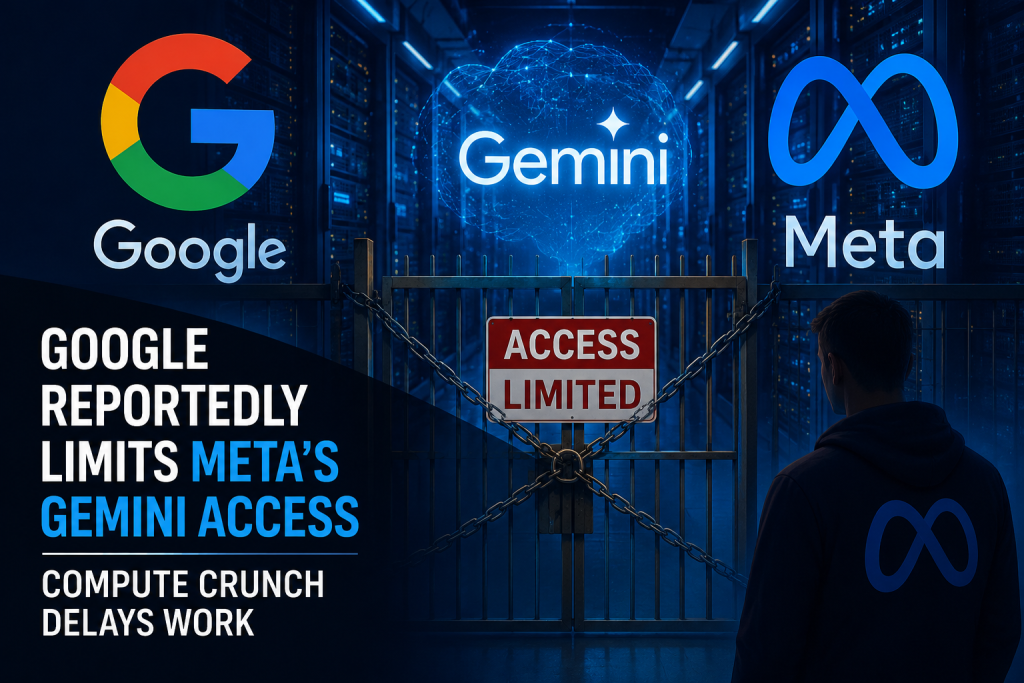
Recent reports suggest that Google has restricted Meta’s access to its Gemini AI models after the social media giant requested more computing capacity than Google could provide. The reported limitations have delayed portions of Meta’s internal AI initiatives, highlighting a broader issue facing the entire AI ecosystem—there simply isn’t enough compute capacity to satisfy today’s explosive demand.
Key Takeaways
| Topic | Details |
|---|---|
| Industry | Artificial Intelligence |
| Companies Involved | Google & Meta |
| Main Issue | AI compute capacity constraints |
| Reported Impact | Delays to some internal Meta AI projects |
| Industry Trend | Increasing demand for GPUs, cloud infrastructure, and AI processing power |
Why AI Computing Power Has Become a Critical Resource
Building modern AI models requires enormous computational resources. Training and deploying large language models involve thousands of GPUs, specialized AI chips, high-speed networking, massive storage systems, and data centers capable of handling complex workloads.
Over the past year, enterprises across industries have accelerated AI adoption, creating unprecedented demand for cloud computing services. As organizations develop generative AI applications, virtual assistants, autonomous systems, and enterprise AI solutions, infrastructure providers are struggling to keep pace.
According to recent reports, Google informed Meta around March that it could not meet the full amount of Gemini AI compute capacity Meta requested. While other Google Cloud customers reportedly experienced similar capacity limitations, Meta was particularly affected because of its exceptionally large demand.
How the Compute Shortage Affected Meta
Meta has invested aggressively in artificial intelligence, expanding its work across large language models, AI assistants, content moderation, developer tools, and enterprise AI technologies.
Reports indicate that Google’s limited capacity disrupted some of Meta’s internal AI development efforts. To adapt, Meta reportedly encouraged employees to reduce AI token consumption and optimize resource usage while continuing development activities.
Although Meta continues investing heavily in its own AI infrastructure, the reported situation illustrates how even the world’s largest technology companies can face infrastructure constraints during periods of rapid AI expansion.
The AI Race Is Becoming an Infrastructure Race
The conversation around artificial intelligence often focuses on model performance, benchmarks, and new features. However, infrastructure is rapidly becoming just as important.
Today’s AI leaders compete across several critical areas:
| Traditional AI Competition | Next Generation AI Competition |
| Model accuracy | Compute availability |
| Training datasets | GPU access |
| AI capabilities | Data center capacity |
| Product innovation | Cloud infrastructure scalability |
| Software performance | Energy efficiency and compute optimization |
This shift means that companies investing billions in AI must also secure sufficient computing resources to support long-term innovation.
Growing Demand Is Testing Cloud Providers
The reported restrictions do not necessarily indicate a lack of investment by Google. Instead, they reflect how rapidly AI demand has expanded.
Google Cloud has experienced strong growth as organizations increasingly adopt AI services. However, company executives have previously acknowledged that computing capacity constraints have limited the cloud division’s ability to meet customer demand fully. This reflects a broader industry trend, with major cloud providers continuing to invest in new AI chips, larger data centers, and expanded infrastructure to address rising workloads.
The situation also underscores how cloud infrastructure has become one of the most valuable assets in the AI economy.
What This Means for Businesses
The reported Google–Meta development carries implications far beyond the two companies involved.
Businesses building AI-powered applications may increasingly encounter:
- Higher cloud computing costs
- Longer deployment timelines
- Limited access to premium AI infrastructure
- Greater competition for GPU resources
- Increased emphasis on efficient AI model design
These factors are likely to encourage organizations to optimize AI workloads, improve infrastructure planning, and diversify cloud partnerships.
For startups and enterprises alike, AI strategy is becoming inseparable from infrastructure strategy.
The Future of AI Depends on More Than Better Models
As generative AI adoption continues accelerating, infrastructure investments will play an increasingly central role in determining which companies lead the next phase of innovation.
Technology firms are investing billions of dollars in advanced semiconductors, AI accelerators, renewable energy, and hyperscale data centers to overcome current limitations. At the same time, developers are exploring smaller, more efficient models that require less computational power without compromising performance.
The reported limitations placed on Meta’s access to Gemini illustrate a broader reality: the future of artificial intelligence will depend as much on scalable infrastructure as it does on groundbreaking software.
Frequently Asked Questions
Why did Google reportedly limit Meta’s access to Gemini?
According to reports, Meta requested more Gemini AI computing capacity than Google could provide. Google reportedly restricted access because available infrastructure could not meet Meta’s exceptionally high demand.
What is AI compute capacity?
AI compute capacity refers to the hardware and infrastructure—including GPUs, AI accelerators, networking equipment, and cloud resources—needed to train and operate advanced artificial intelligence models.
Is this a problem affecting only Google and Meta?
No. Reports indicate that other Google Cloud customers also experienced capacity constraints, although Meta was reportedly the most affected because of its scale. Industry-wide demand for AI infrastructure continues to exceed available supply.
Final Thoughts
The reported restrictions on Meta’s access to Google’s Gemini AI models highlight one of the defining challenges of the modern AI era. While innovation continues at an extraordinary pace, computing infrastructure has become a decisive factor in determining how quickly companies can build, deploy, and scale new AI capabilities. As the demand for generative AI continues to grow, the organizations that invest successfully in both intelligent software and resilient infrastructure are likely to shape the future of artificial intelligence.