
Artificial Intelligence (AI) is reshaping the software industry at an unprecedented pace. Businesses across healthcare, finance, manufacturing, retail, education, and customer service are rapidly adopting AI-powered applications to improve efficiency, reduce costs, and deliver better user experiences. While traditional software has been the backbone of digital transformation for decades, AI introduces an entirely new approach by enabling systems to learn, adapt, and make intelligent decisions.
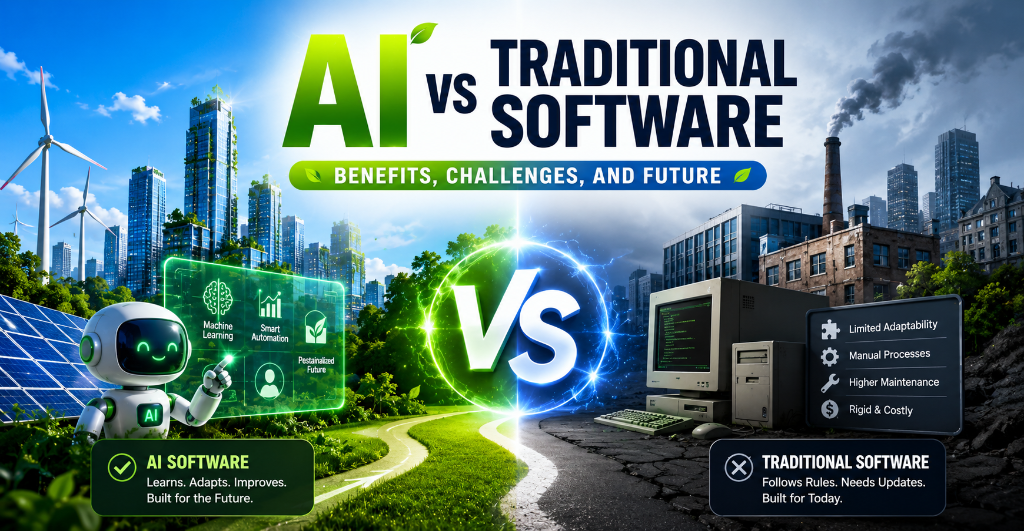
Traditional software follows predefined rules written by developers, whereas AI software continuously improves through data and machine learning algorithms. This shift is changing how software is developed, maintained, and used across industries. As organizations embrace automation and intelligent technologies, understanding the difference between AI and traditional software has become more important than ever.
What Is Traditional Software?
Traditional software is developed using fixed programming logic. Developers write specific instructions, and the application performs only the tasks defined within its code. If business requirements change, the software must be manually updated by developers.
Examples of traditional software include:
- Microsoft Excel
- Accounting software
- Payroll management systems
- ERP software
- CRM platforms
- Banking applications
Traditional software is highly reliable for structured, repetitive, and rule-based processes where outcomes remain predictable.
What Is AI Software?
AI software goes beyond predefined programming by learning from data. Using technologies such as machine learning, deep learning, natural language processing (NLP), and computer vision, AI systems recognize patterns, make predictions, and continuously improve their performance.
Examples include:
- ChatGPT
- Google Gemini
- AI-powered chatbots
- Fraud detection systems
- Recommendation engines like Netflix and Amazon
- AI medical diagnosis tools
Unlike traditional software, AI adapts as it receives new information, making it suitable for complex and changing environments.
AI vs Traditional Software: Major Differences
Learning Capability
Traditional software never learns on its own. Every improvement requires developers to modify the source code.
AI software continuously learns from historical and real-time data, improving its accuracy and performance over time.
Decision Making
Traditional applications follow predefined rules to produce predictable outcomes.
AI systems analyze data patterns and generate intelligent predictions or recommendations even when situations are unfamiliar.
Data Processing
Traditional software works best with structured databases and organized information.
AI can process structured, semi-structured, and unstructured data including images, videos, documents, emails, and voice recordings.
Automation
Traditional software automates repetitive tasks with fixed workflows.
AI automates decision-making, customer interactions, document analysis, predictive maintenance, and business intelligence.
Adaptability
Traditional software requires manual updates whenever business rules change.
AI models automatically improve by learning from new datasets, making them highly adaptable to changing business conditions.
Why Businesses Are Moving Toward AI
Organizations are increasingly investing in AI because it delivers measurable business value.
Better Customer Experience
AI-powered virtual assistants provide instant customer support around the clock, improving satisfaction while reducing operational costs.
Faster Decision Making
AI analyzes millions of data points in seconds, helping businesses make smarter and faster decisions.
Increased Productivity
Routine tasks such as invoice processing, document classification, scheduling, and customer support can be automated, allowing employees to focus on strategic work.
Predictive Analytics
AI identifies trends before they occur, enabling businesses to forecast sales, detect equipment failures, and anticipate customer behavior.
Personalization
Streaming services, e-commerce platforms, and digital marketing campaigns use AI to recommend products and content based on user preferences.
Industries Being Transformed by AI
Healthcare
AI assists doctors with medical imaging, disease diagnosis, drug discovery, and patient monitoring.
Banking and Finance
Banks use AI for fraud detection, credit scoring, risk assessment, and algorithmic trading.
Retail
Retailers use AI for personalized recommendations, inventory optimization, pricing strategies, and customer analytics.
Manufacturing
Manufacturers implement AI for predictive maintenance, quality control, robotics, and production planning.
Education
Educational platforms use AI to personalize learning experiences, automate grading, and provide intelligent tutoring systems.
Is Traditional Software Becoming Obsolete?
Not entirely.
Traditional software remains essential for applications requiring stability, compliance, and predefined workflows. Accounting systems, payroll software, enterprise databases, and regulatory applications continue to rely heavily on traditional programming.
However, many modern software solutions now combine traditional programming with AI capabilities. For example, a CRM platform may use traditional software for managing customer records while integrating AI for lead scoring, sales forecasting, and customer support automation.
This hybrid approach provides the reliability of conventional software alongside the intelligence and adaptability of AI.
Challenges of AI Software
Despite its advantages, AI implementation comes with several challenges:
- High development and infrastructure costs
- Large volumes of quality data required for training
- Privacy and security concerns
- Ethical issues related to bias and transparency
- Continuous monitoring and model updates
Organizations should carefully evaluate these factors before adopting AI solutions.
The Future of Software Development
The future lies in intelligent software rather than purely traditional applications. Developers are increasingly integrating AI into existing software products instead of replacing them entirely.
Low-code AI platforms, generative AI assistants, intelligent automation, and AI-powered coding tools are accelerating software development while improving business efficiency.
As AI technology matures, businesses that successfully combine traditional software with intelligent automation will gain a significant competitive advantage.
Conclusion
AI is transforming the software landscape by introducing learning, adaptability, and intelligent decision-making capabilities that traditional software cannot provide on its own. While conventional software remains valuable for structured business operations, AI enables organizations to automate complex tasks, analyze massive datasets, and deliver personalized user experiences.
Rather than replacing traditional software completely, AI is enhancing it. Businesses that embrace this combination will be better equipped to innovate, improve operational efficiency, and stay competitive in an increasingly digital world.