
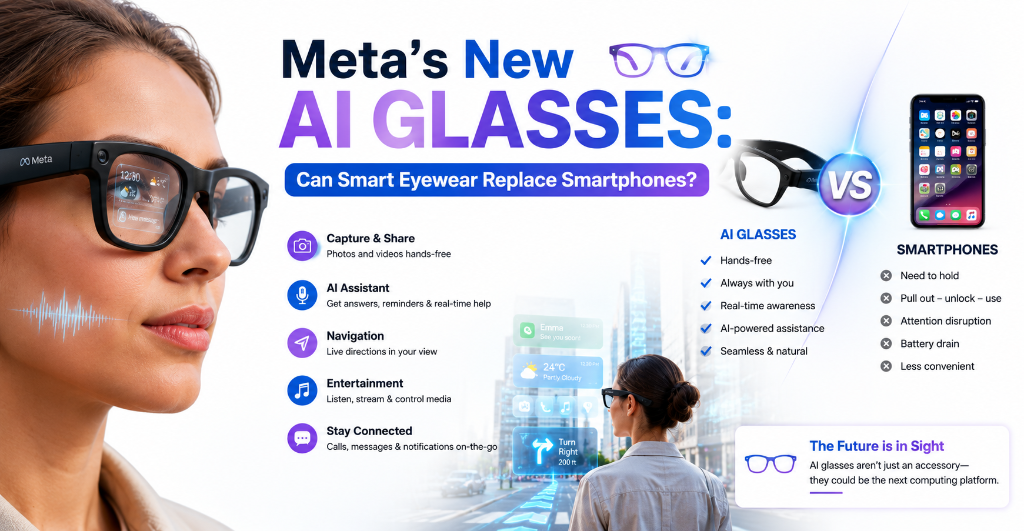

Artificial intelligence is reshaping consumer technology, and wearable devices are becoming the next major innovation. While smartphones have dominated digital communication for nearly two decades, companies are now investing heavily in AI-powered wearables that promise more natural and hands-free interactions. Among the biggest players, Meta has positioned itself at the forefront with its latest generation of AI glasses.
Meta’s new AI glasses combine voice assistants, cameras, speakers, and real-time AI capabilities into a lightweight wearable designed for everyday use. Rather than pulling a smartphone out of your pocket, users can ask questions, capture photos, translate languages, receive navigation assistance, and interact with AI simply by speaking.
The growing popularity of AI wearables raises an important question: Can Meta’s new AI glasses eventually replace smartphones?
The Evolution of Smart Eyewear
Smart glasses have existed for years, but earlier products struggled due to bulky designs, limited battery life, and lack of practical applications. Today’s AI-powered devices represent a significant leap forward because they integrate cloud computing, large language models, and advanced computer vision.
Meta has partnered with leading technology companies to create smart eyewear that looks like traditional glasses while offering intelligent digital assistance. Instead of acting as a replacement display, these glasses focus on making AI available instantly throughout the day.
This shift represents a broader industry movement toward ambient computing, where technology becomes less intrusive and more seamlessly integrated into daily life.
What Makes Meta’s New AI Glasses Different?
Unlike earlier wearable devices, Meta’s AI glasses emphasize practical everyday features rather than experimental technology.
Key capabilities include:
- Voice-controlled AI assistant
- Hands-free photo and video capture
- Real-time object recognition
- Instant language translation
- Music playback through open-ear speakers
- Phone call support
- Navigation assistance
- AI-powered information retrieval
- Social media integration
- Smart notifications
Instead of opening multiple smartphone apps, users simply ask the AI assistant to perform tasks naturally through voice commands.
AI Is the Biggest Game Changer
Artificial intelligence is what truly differentiates Meta’s smart glasses from previous wearable devices.
Using advanced AI models, the glasses can understand conversations, answer questions, describe surroundings, recognize landmarks, identify objects, summarize information, and even assist with everyday decision-making.
For example, users can ask:
- “What building am I looking at?”
- “Translate this menu.”
- “Read this sign.”
- “Take a picture.”
- “Where did I park my car?”
- “What recipe can I make with these ingredients?”
Instead of manually searching through a smartphone, AI provides immediate contextual answers.
This hands-free experience significantly reduces friction and makes digital interactions feel more conversational.
Why Tech Companies Believe Wearables Are the Future
The wearable AI market is expanding rapidly as consumers increasingly demand convenience, personalization, and always-available digital assistance.
Several trends are driving this growth:
Natural Human-Computer Interaction
People prefer speaking naturally rather than typing lengthy search queries. Voice AI makes technology faster and more intuitive.
Advances in Generative AI
Large language models have made conversational assistants dramatically more useful, allowing wearables to become practical productivity tools.
Improved Hardware
Miniaturized cameras, processors, microphones, batteries, and speakers now fit inside lightweight frames without sacrificing comfort.
Connected Ecosystems
Smart glasses integrate with smartphones, cloud services, messaging platforms, and smart home devices, creating a seamless user experience.
Can Smart Glasses Really Replace Smartphones?
Although Meta’s AI glasses are impressive, replacing smartphones entirely remains unlikely in the near future.
Smartphones continue to offer advantages such as:
- Large touchscreens
- Mobile gaming
- Video editing
- Banking applications
- Document management
- Productivity software
- Long-form content creation
- Shopping experiences
- Professional photography
Many activities still require larger displays and direct touch interaction.
Instead, Meta’s glasses are currently positioned as a companion device that complements smartphones rather than replacing them.
However, this relationship could gradually change as wearable technology continues to improve.
Industries That Could Benefit Most
Meta’s AI glasses have applications beyond personal entertainment.
Healthcare
Doctors can access patient information hands-free while examining patients.
Manufacturing
Workers receive real-time instructions without stopping production.
Retail
Employees can instantly check inventory and product information.
Tourism
Travelers receive translations, navigation, and historical information while exploring new destinations.
Education
Students can interact with AI tutors during learning activities.
Logistics
Warehouse staff can receive picking instructions while keeping both hands available.
These professional use cases may drive widespread adoption even before consumers fully embrace AI eyewear.
Challenges That Still Need to Be Solved
Despite rapid progress, several challenges remain.
Battery Life
Continuous AI processing requires significant power, making battery optimization essential.
Privacy Concerns
Built-in cameras raise questions about recording people without consent.
Data Security
Voice interactions and visual information must be securely processed and protected.
Social Acceptance
Many people remain cautious about wearing always-connected devices in public settings.
Pricing
Premium AI wearables are still relatively expensive for mass-market adoption.
Addressing these concerns will be crucial for widespread acceptance.
The Future of AI Wearables
Industry experts believe AI glasses represent the beginning of a much larger shift toward ambient computing.
Future generations may include:
- Augmented reality displays
- Longer battery life
- Better visual recognition
- Personalized AI assistants
- Health monitoring
- Gesture controls
- Eye tracking
- Offline AI processing
- Improved privacy protections
As hardware becomes smaller and AI models become more powerful, smart eyewear could eventually handle many tasks currently performed by smartphones.
Rather than replacing phones overnight, wearable AI will likely evolve alongside them, gradually changing how people access information and communicate.
Conclusion
Meta’s new AI glasses demonstrate how artificial intelligence is transforming wearable technology from a niche product into a practical everyday assistant. By combining voice AI, computer vision, hands-free photography, and contextual information, Meta is redefining how users interact with digital devices.
While smartphones remain indispensable for many tasks, AI glasses are steadily reducing our dependence on screens for everyday activities. As battery life improves, AI capabilities expand, and consumer acceptance grows, smart eyewear could become one of the most influential technology categories of the next decade.
The future may not belong exclusively to smartphones or smart glasses—but to an ecosystem where both work together to deliver faster, smarter, and more natural digital experiences.