
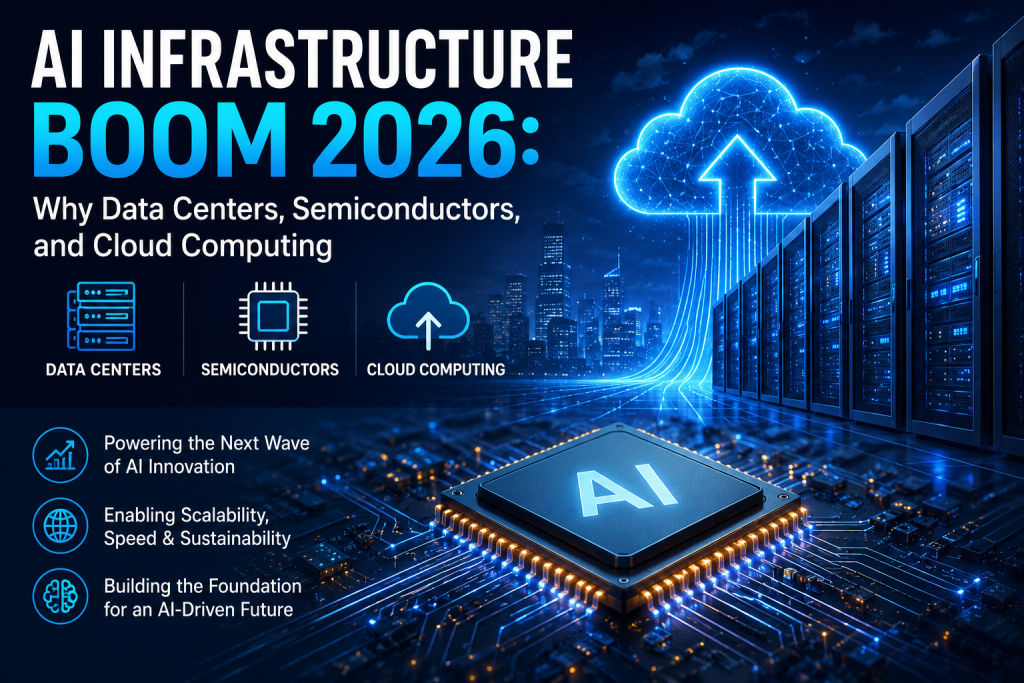

Artificial intelligence is transforming industries at an unprecedented pace, and 2026 has become a defining year for the technology’s supporting infrastructure. While AI applications such as intelligent assistants, automation platforms, and predictive analytics receive most of the attention, the foundation that powers these innovations is experiencing its own remarkable growth. Data centers, semiconductor manufacturing, and cloud computing have emerged as the backbone of the AI revolution, creating a robust ecosystem capable of supporting increasingly complex workloads.
As organizations across industries adopt AI solutions, demand for computing power continues to surge. Businesses are investing heavily in infrastructure that can process massive datasets, train sophisticated AI models, and deliver intelligent services with minimal latency. This shift is creating new opportunities for technology providers, investors, enterprises, and governments worldwide.
The Growing Importance of AI Infrastructure
Artificial intelligence requires enormous computational resources. Training advanced machine learning models involves processing billions of data points, requiring specialized hardware and high-performance computing environments. Traditional IT infrastructure is no longer sufficient for many AI workloads, prompting companies to modernize their technology stacks.
AI infrastructure includes powerful servers, graphics processing units (GPUs), advanced networking equipment, storage systems, cloud platforms, and energy-efficient cooling technologies. Together, these components create the foundation necessary for developing and deploying intelligent applications.
The rapid increase in AI adoption across healthcare, finance, manufacturing, retail, education, logistics, and entertainment continues to fuel infrastructure investments around the globe.
Data Centers Become AI Powerhouses
Modern data centers have evolved far beyond traditional server facilities. Today’s AI-ready data centers are designed specifically to support high-density computing environments capable of running demanding AI workloads continuously.
These facilities feature advanced cooling systems, high-speed networking, redundant power supplies, and specialized AI hardware that maximize computational performance while maintaining operational reliability.
Many organizations are expanding hyperscale data centers to accommodate growing AI demand. These large-scale facilities offer greater efficiency, scalability, and processing capabilities than conventional server rooms.
Sustainability has also become a major priority. Operators are increasingly investing in renewable energy, liquid cooling technologies, and energy-efficient equipment to reduce environmental impact while supporting higher computing densities.
Semiconductors Power the AI Revolution
Semiconductors remain one of the most critical components of AI infrastructure. Every AI application relies on chips capable of performing millions of calculations every second.
The increasing complexity of AI models has driven demand for specialized processors such as AI accelerators, GPUs, tensor processing units (TPUs), and custom-designed chips optimized for machine learning workloads.
Chip manufacturers continue to innovate by producing processors with higher efficiency, greater memory bandwidth, and lower power consumption. These improvements enable faster AI training, improved inference performance, and reduced operating costs.
Beyond large AI servers, semiconductors are also enabling intelligent edge devices including autonomous vehicles, industrial robots, medical equipment, smartphones, and smart home systems.
Cloud Computing Enables AI at Scale
Cloud computing has become one of the biggest enablers of AI adoption. Instead of investing in expensive on-premise infrastructure, organizations can access AI-ready computing resources on demand through cloud platforms.
Cloud services provide businesses with flexible computing power, scalable storage, AI development tools, and managed machine learning services that significantly reduce deployment complexity.
Small businesses and startups particularly benefit from cloud-based AI because they can access enterprise-grade infrastructure without substantial upfront investments.
Hybrid cloud and multi-cloud strategies are also gaining popularity, allowing organizations to optimize performance, improve security, and ensure business continuity while deploying AI applications across multiple environments.
Enterprise Demand Continues to Rise
Businesses across every major industry are integrating AI into daily operations. Customer service automation, fraud detection, predictive maintenance, supply chain optimization, medical diagnostics, and personalized marketing all require reliable AI infrastructure.
As digital transformation accelerates, enterprises are expanding investments in networking equipment, storage capacity, cybersecurity, cloud services, and specialized AI hardware.
Organizations are also prioritizing infrastructure that supports real-time analytics and low-latency AI applications, enabling faster decision-making and improved customer experiences.
Investment Opportunities in AI Infrastructure
The AI infrastructure boom is creating opportunities across multiple sectors. Technology companies, semiconductor manufacturers, cloud providers, construction firms, renewable energy suppliers, networking companies, and cybersecurity vendors all stand to benefit from growing demand.
Governments are also encouraging domestic semiconductor manufacturing, expanding digital infrastructure, and supporting AI research initiatives to strengthen national competitiveness.
Private investment continues to flow into AI-focused startups developing innovative hardware, software platforms, cooling technologies, and data center solutions.
Challenges Ahead
Despite impressive growth, AI infrastructure faces several challenges. Rising electricity consumption, supply chain constraints, semiconductor shortages, cybersecurity risks, and the need for skilled professionals remain ongoing concerns.
Organizations must also balance rapid AI deployment with sustainability goals, regulatory compliance, and responsible technology governance.
Continuous innovation will be essential to address these challenges while supporting future generations of AI applications.
Looking Ahead
The AI infrastructure boom in 2026 represents much more than technological advancement—it reflects a fundamental transformation in how computing resources are built and utilized. Data centers are becoming smarter and more energy efficient, semiconductor technologies continue to evolve rapidly, and cloud computing is making advanced AI capabilities accessible to organizations of every size.
As AI adoption expands across industries, investment in infrastructure will remain a critical driver of innovation, economic growth, and digital transformation. Companies that build scalable, secure, and sustainable AI infrastructure today will be well positioned to support the intelligent technologies that shape the future.