
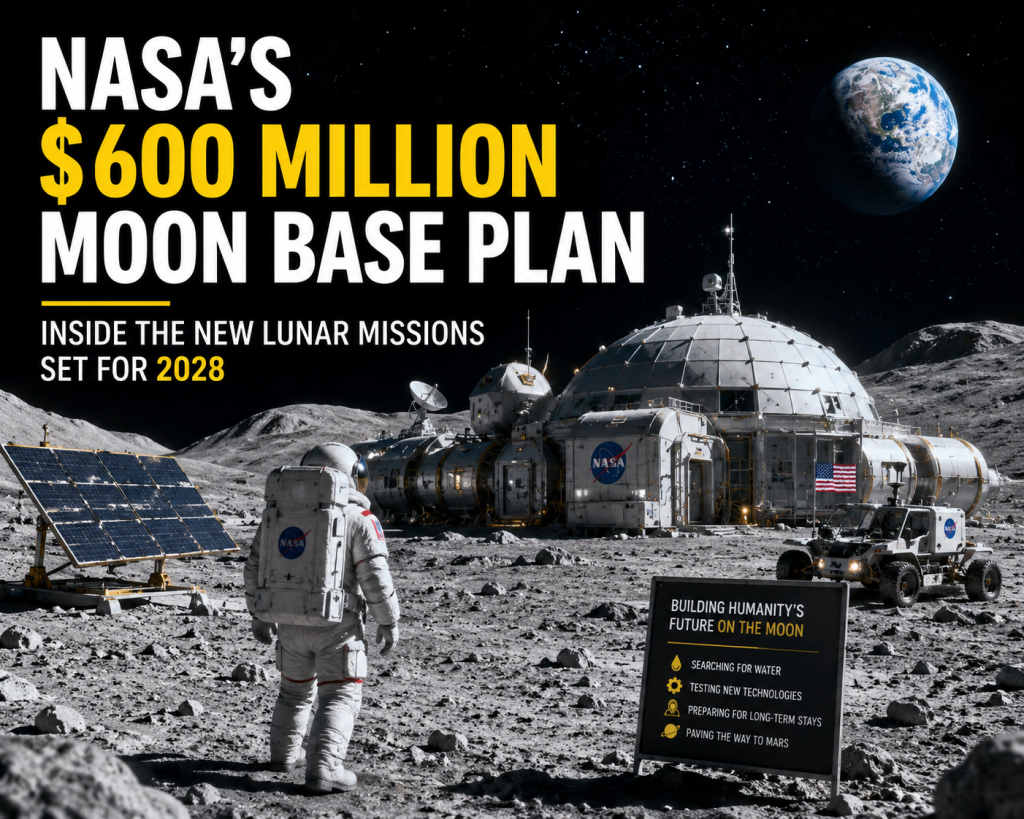

For decades, the Moon represented humanity’s greatest achievement in space exploration—a place we visited briefly before turning our attention elsewhere. Today, that narrative is changing.
NASA has unveiled a new initiative worth nearly $600 million to fund a series of robotic lunar missions scheduled for 2028, marking another significant step toward establishing a long-term human presence on the Moon. Unlike the Apollo era, where astronauts visited the lunar surface for only a few days, the new strategy focuses on building the infrastructure, technology, and scientific knowledge needed for sustainable lunar exploration.
A New Vision: Living on the Moon Instead of Visiting It
Returning to the Moon isn’t simply about planting another flag.
NASA’s latest initiative is designed to answer a much bigger question:
Can humans actually live and work on the Moon for extended periods?
Before astronauts can establish a permanent presence, scientists must solve several complex challenges, including:
- Managing abrasive lunar dust that can damage equipment
- Protecting astronauts from intense radiation
- Improving navigation in the Moon’s harsh environment
- Testing technologies that can survive extreme temperature fluctuations
- Developing systems capable of supporting long-duration missions
Each robotic mission launched over the next few years will help gather critical data needed to answer these questions before humans return.
Why NASA Is Partnering With Private Companies
One of the biggest differences between today’s lunar program and the Apollo missions is NASA’s growing reliance on commercial space companies.
Instead of designing and operating every spacecraft itself, NASA has awarded nearly $600 million in contracts to three commercial partners:
- Astrobotic
- Firefly Aerospace
- Intuitive Machines
Together, these companies will conduct four robotic missions that transport scientific instruments and technology demonstrations to the Moon’s surface. This commercial partnership allows NASA to reduce costs, accelerate innovation, and increase the number of lunar missions while encouraging the growth of a broader space economy.
Why the Moon’s South Pole Matters
One of NASA’s primary destinations is the Moon’s south polar region.
Unlike the dusty plains explored during the Apollo missions, the lunar south pole is believed to contain permanently shadowed craters that may hold significant quantities of frozen water.
Water on the Moon is far more valuable than it sounds.
It can potentially be used to:
- Produce drinking water for astronauts
- Generate breathable oxygen
- Manufacture rocket fuel using hydrogen and oxygen
- Support future lunar habitats
If these resources can be utilized effectively, they could dramatically reduce the cost of deep-space exploration by allowing spacecraft to refuel beyond Earth.
Every Mission Builds Toward Something Bigger
Rather than attempting to build a lunar settlement immediately, NASA is taking an incremental approach.
The upcoming robotic missions will carry scientific payloads that study:
- Lunar surface composition
- Dust movement
- Radiation levels
- Navigation systems
- Environmental conditions
Some missions will also test technologies that future astronauts may depend upon during long-term lunar operations.
The knowledge gained from each landing will gradually reduce uncertainty and improve mission reliability before larger human expeditions begin.
More Than Exploration—A Future Lunar Economy?
The implications extend well beyond scientific discovery.
A permanent lunar presence could create entirely new industries over the coming decades, including:
- Lunar construction
- Space mining
- In-space manufacturing
- Deep-space logistics
- Commercial transportation
- Advanced robotics
- Space tourism
Private investment in space infrastructure has accelerated rapidly over the past decade, and many experts believe the Moon could become the first stepping stone toward a sustainable space economy.
The companies participating in today’s robotic missions may eventually become the builders of tomorrow’s lunar infrastructure.
Looking Beyond 2028
NASA’s long-term objective is far more ambitious than a handful of robotic landings.
The agency envisions a phased approach that ultimately leads to continuous scientific operations and a lasting human presence on the lunar surface. The experience gained on the Moon is also expected to play a crucial role in preparing future crewed missions to Mars, where astronauts will face many of the same engineering and survival challenges—but on an even greater scale.
Final Thoughts
Humanity’s return to the Moon represents more than another chapter in space exploration—it signals the beginning of a new era where space may become an extension of human civilization rather than a destination for short-term missions.
The nearly $600 million investment announced by NASA demonstrates a shift from exploration to preparation. Every robotic mission, every scientific experiment, and every technological breakthrough brings us one step closer to living and working beyond Earth.
Whether the first permanent lunar settlement arrives in the next decade or later, one thing is becoming increasingly clear: the race to build humanity’s future in space has already begun.