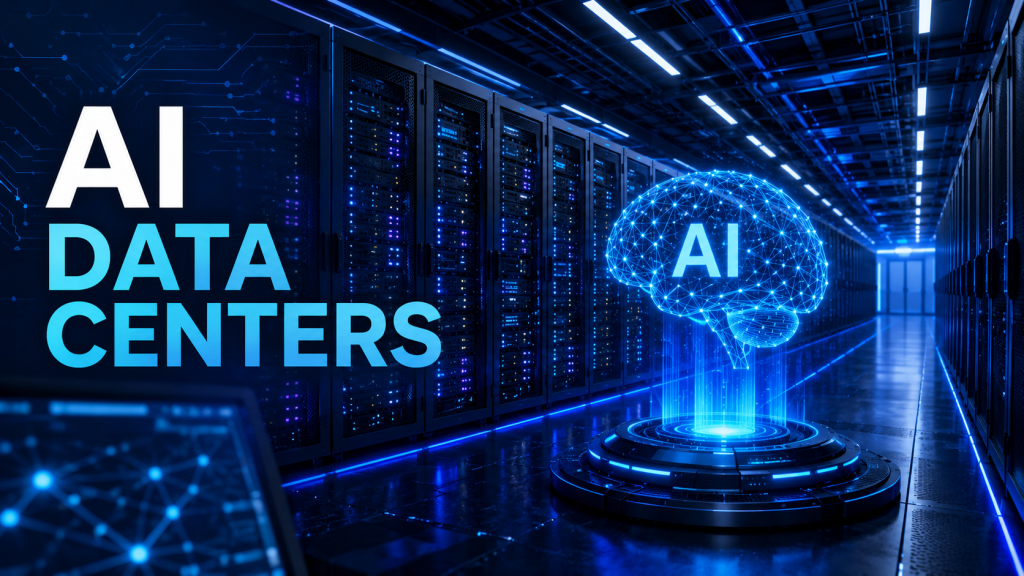

Artificial Intelligence (AI) is reshaping the global technology landscape, and at the heart of this transformation lies a new generation of AI data centers. As enterprises deploy generative AI, large language models (LLMs), and advanced analytics across industries, the demand for high-performance computing infrastructure is rising at an unprecedented pace. AI data centers are becoming mission-critical assets, enabling organizations to process massive datasets, train sophisticated AI models, and deliver real-time intelligent applications.
Unlike conventional facilities, AI data centers are purpose-built with GPU-accelerated servers, high-speed networking, intelligent storage systems, and advanced cooling technologies to handle compute-intensive workloads. Technology companies, cloud service providers, financial institutions, healthcare organizations, and manufacturers are investing billions of dollars to expand AI-ready infrastructure, reflecting the growing importance of digital transformation.
Industry analysts estimate that the global AI data center market was valued at USD 147.3 billion in 2025 and is projected to reach USD 810.6 billion by 2033, expanding at a CAGR of 23.9%. This remarkable growth is fueled by enterprise AI adoption, hyperscale cloud expansion, and continuous innovation in AI hardware and infrastructure.
Key Highlights
- Growing enterprise adoption of generative AI is accelerating investments in AI-ready data centers.
- GPU-powered computing infrastructure is becoming the foundation of modern AI workloads.
- Hyperscale cloud providers continue expanding AI infrastructure across North America, Europe, and Asia-Pacific.
- Liquid cooling, energy-efficient power systems, and AI-driven infrastructure management are emerging as major technology trends.
- Sustainability initiatives are driving innovation in renewable energy integration and efficient cooling architectures.
- Edge AI data centers are gaining traction to support low-latency applications across smart cities, healthcare, and industrial automation.
Rising Demand for AI Infrastructure Drives Market Expansion
Organizations are rapidly integrating AI into customer service, cybersecurity, financial analytics, manufacturing automation, software development, and healthcare diagnostics. These applications require enormous computing power that traditional enterprise infrastructure cannot efficiently provide.
As a result, AI data centers equipped with GPU clusters, AI accelerators, and high-bandwidth networking have become essential for training and deploying modern AI models. Cloud providers are significantly increasing investments in hyperscale AI facilities to meet the surging demand for AI-as-a-Service (AIaaS), machine learning platforms, and enterprise AI solutions. Recent market activity also reflects strong investor confidence in AI infrastructure businesses as demand for digital infrastructure continues to accelerate.
Advanced Cooling Technologies Transform AI Data Centers
One of the biggest challenges facing AI infrastructure is thermal management. AI servers generate significantly more heat than conventional computing systems due to dense GPU deployments and continuous high-performance workloads.
To improve operational efficiency, operators are increasingly adopting liquid cooling technologies, immersion cooling, and intelligent thermal management systems. These innovations reduce energy consumption, improve hardware performance, and enable higher rack densities while supporting sustainability goals.
Recent innovations in liquid cooling architecture demonstrate the industry’s focus on reducing both energy usage and water consumption as next-generation AI facilities continue to scale.
Energy Efficiency and Sustainability Become Strategic Priorities
Although AI is driving technological innovation, it also presents significant energy challenges. Large AI data centers consume enormous amounts of electricity, placing pressure on regional power grids and increasing operational costs.
To address these concerns, infrastructure providers are investing in renewable energy sourcing, battery storage, intelligent workload optimization, and energy-efficient facility designs. Many organizations are integrating solar and wind power into their operations while deploying AI-based energy management systems to improve sustainability.
Balancing rapid AI expansion with environmental responsibility is expected to remain one of the industry’s defining priorities throughout the coming decade.
Edge AI Infrastructure Gains Momentum
While hyperscale facilities dominate AI training, edge AI data centers are emerging as an important growth segment. Processing AI workloads closer to users enables faster response times and reduces latency for applications such as autonomous vehicles, smart manufacturing, video analytics, and connected healthcare.
The growing adoption of IoT devices, 5G networks, and real-time analytics is encouraging enterprises to deploy distributed AI infrastructure across multiple geographic locations, creating new opportunities for regional data center operators.
North America Leads While Asia-Pacific Emerges as a High-Growth Region
North America currently represents the largest AI data center market, supported by strong investments from leading cloud providers, semiconductor companies, and technology innovators. The region benefits from advanced digital infrastructure and widespread enterprise AI adoption.
Meanwhile, Asia-Pacific is expected to experience the fastest growth over the coming years as governments and private enterprises accelerate investments in cloud computing, semiconductor manufacturing, digital transformation, and AI innovation.
Competitive Landscape
The AI data center ecosystem continues to evolve as cloud providers, semiconductor manufacturers, networking companies, and colocation operators expand their capabilities. Key participants are investing in next-generation processors, high-speed networking, AI accelerators, modular data center designs, and sustainable infrastructure to strengthen their competitive positions.
Strategic collaborations between hardware vendors, cloud platforms, and enterprise software providers are expected to accelerate AI infrastructure deployment worldwide.
Future Outlook
The future of AI data centers extends beyond simply increasing computing capacity. Industry leaders are focusing on intelligent infrastructure capable of automatically optimizing power consumption, cooling efficiency, workload distribution, and predictive maintenance.
Emerging technologies including advanced AI accelerators, silicon photonics, liquid cooling, software-defined infrastructure, and autonomous data center operations are expected to redefine the next generation of digital infrastructure.
As organizations continue expanding AI adoption across every major industry, AI data centers will remain the backbone of innovation, enabling faster model development, scalable cloud services, and next-generation intelligent applications.
Conclusion
AI data centers have become one of the fastest-growing segments of the global digital infrastructure market. Rising enterprise AI adoption, expanding hyperscale cloud investments, and continuous advances in computing hardware are transforming how organizations build and operate modern infrastructure.
Although challenges related to energy consumption, sustainability, and infrastructure costs remain, ongoing innovation in cooling technologies, renewable energy integration, and intelligent facility management is positioning AI data centers for sustained long-term growth. As AI becomes deeply integrated into business operations worldwide, demand for resilient, scalable, and energy-efficient AI infrastructure is expected to continue accelerating over the next decade.