
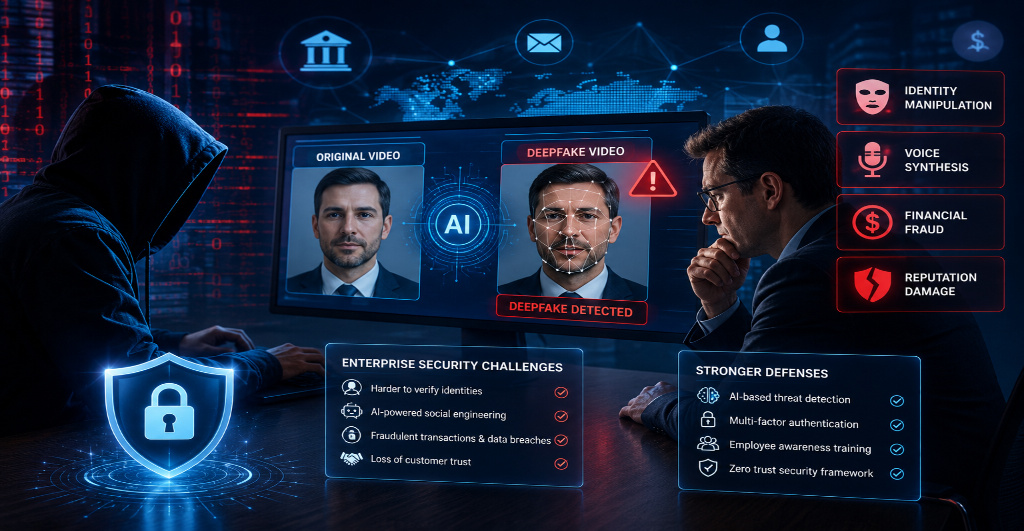

Artificial intelligence has transformed business operations, making organizations more productive and efficient. However, the same technology is also empowering cybercriminals. One of the fastest-growing threats today is deepfake fraud, where AI-generated audio, video, and images are used to impersonate executives, employees, or trusted individuals.
As deepfake technology becomes more realistic and accessible, enterprises across finance, healthcare, manufacturing, government, and technology sectors are facing unprecedented security risks. From fraudulent financial transfers to identity theft and corporate espionage, deepfake attacks are evolving rapidly.
Organizations are now investing heavily in AI-powered cybersecurity solutions, identity verification systems, employee awareness programs, and digital authentication technologies to combat these emerging threats. Enterprise security strategies are increasingly shifting from traditional cyber defenses toward AI-driven threat detection capable of identifying manipulated media in real time.
Key Highlights
- Deepfake fraud is becoming one of the fastest-growing AI-powered cyber threats.
- Businesses are increasingly targeted through fake executive voice and video impersonation.
- Financial institutions remain among the primary targets for deepfake-enabled fraud.
- AI-based identity verification is becoming a critical component of enterprise security.
- Employee cybersecurity awareness plays a vital role in preventing social engineering attacks.
- Governments worldwide are introducing regulations addressing AI-generated content.
- Advanced detection tools can identify manipulated audio and video using machine learning.
- Zero Trust security models are gaining popularity to reduce identity-related risks.
What Is Deepfake Fraud?
Deepfake fraud refers to the use of artificial intelligence—primarily deep learning and generative AI—to create highly realistic fake videos, voice recordings, or images that imitate real people.
Unlike traditional phishing scams, deepfake attacks exploit visual and audio trust. Criminals can mimic a CEO’s voice, create fake video meetings, or generate convincing identity documents to deceive employees, customers, or business partners.
These attacks are becoming increasingly difficult to detect as generative AI models continue to improve in quality and realism.
Why Enterprises Are Becoming Prime Targets
Large organizations manage sensitive financial transactions, confidential customer information, and valuable intellectual property. This makes them attractive targets for cybercriminals using deepfake technology.
Modern enterprises rely heavily on digital communication platforms such as Microsoft Teams, Zoom, Slack, and email. AI-generated voices or videos can convincingly imitate executives during virtual meetings, instructing employees to transfer funds or disclose confidential information.
As remote and hybrid work environments continue to expand, verifying digital identities has become significantly more challenging.
Common Enterprise Security Challenges
Executive Impersonation
Cybercriminals use cloned voices and AI-generated videos to impersonate CEOs or senior executives. Employees may receive urgent requests to approve payments, share confidential files, or bypass internal security procedures.
Financial Fraud
Deepfake audio attacks have already been used to trick finance teams into authorizing fraudulent bank transfers worth millions of dollars.
Identity Verification Risks
Many organizations now use facial recognition or voice authentication for secure access. Sophisticated deepfakes can potentially bypass weaker biometric verification systems if additional security layers are not implemented.
Social Engineering Attacks
AI-generated content makes phishing campaigns significantly more convincing by personalizing messages with realistic voices and videos.
Brand Reputation Damage
Fake executive announcements, fabricated interviews, or manipulated corporate videos can spread rapidly across social media, damaging brand credibility and investor confidence.
Industries Most Vulnerable
Several sectors face higher exposure to deepfake fraud due to the sensitive nature of their operations.
Banking and Financial Services
Banks process high-value transactions daily, making them prime targets for AI-powered payment fraud and identity theft.
Healthcare
Medical institutions must protect patient records while preventing fraudulent identity verification during telemedicine consultations.
Government
Public agencies face risks from fake political communications, misinformation campaigns, and identity impersonation.
Technology
Technology companies possess valuable intellectual property, making executive impersonation and insider attacks particularly dangerous.
Manufacturing
Global manufacturers increasingly rely on digital collaboration, making supplier fraud and procurement scams more sophisticated.
Technologies Fighting Deepfake Fraud
Organizations are adopting advanced cybersecurity technologies designed specifically to detect AI-generated media.
AI-Based Deepfake Detection
Machine learning algorithms analyze facial movements, voice inconsistencies, lighting artifacts, blinking patterns, and digital fingerprints to identify manipulated content.
Multi-Factor Authentication (MFA)
Combining passwords with biometric verification, authentication apps, or hardware security keys significantly reduces identity-based attacks.
Behavioral Analytics
Modern security platforms monitor user behavior and flag unusual login locations, communication patterns, or transaction requests.
Zero Trust Security
Zero Trust assumes that no user or device should automatically be trusted. Every request must be continuously verified before granting access.
Digital Watermarking
Some AI companies are embedding invisible digital signatures into AI-generated content to improve authenticity verification.
Best Practices for Enterprises
Organizations can reduce deepfake-related risks by implementing proactive cybersecurity strategies.
- Train employees to recognize AI-generated scams.
- Verify sensitive requests using independent communication channels.
- Require multiple approvals for financial transactions.
- Deploy AI-powered deepfake detection software.
- Strengthen identity verification systems.
- Regularly update cybersecurity policies.
- Conduct simulated phishing and social engineering exercises.
- Establish incident response plans for AI-related attacks.
Combining technology with employee awareness creates a stronger defense against increasingly sophisticated cyber threats.
Future Outlook
Deepfake technology will continue advancing as generative AI becomes more powerful and widely available. At the same time, cybersecurity vendors are developing increasingly accurate detection tools capable of identifying manipulated media within seconds.
Governments are expected to introduce stricter regulations governing AI-generated content, digital identity verification, and synthetic media disclosure. Organizations will likely invest more in AI-driven security platforms that automatically detect fraudulent communications before they reach employees.
In the coming years, enterprise cybersecurity strategies will increasingly focus on verifying identities rather than simply protecting devices or networks. Businesses that proactively strengthen digital trust frameworks, implement Zero Trust architectures, and educate employees will be better prepared to manage evolving AI-powered threats.
Conclusion
Deepfake fraud is no longer a futuristic concern—it has become a real and rapidly evolving enterprise security challenge. As AI-generated audio, video, and images become more convincing, organizations must adapt their cybersecurity strategies to defend against identity-based attacks and sophisticated social engineering campaigns.
By combining advanced AI detection technologies, strong authentication methods, employee training, and robust governance policies, businesses can significantly reduce their exposure to deepfake fraud. In an era where digital trust is becoming one of the most valuable business assets, investing in enterprise security is essential for protecting financial resources, reputation, and customer confidence.