
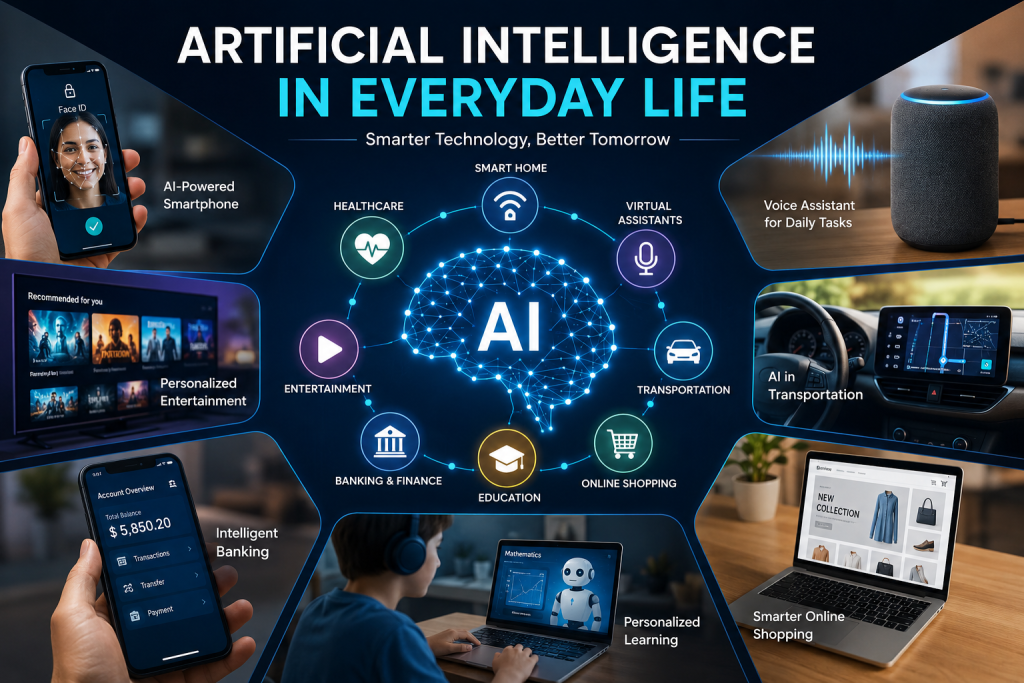

Artificial Intelligence (AI) has rapidly evolved from a futuristic innovation into an essential part of everyday life. Once limited to research laboratories and science fiction, AI now powers countless technologies that people interact with daily. From unlocking smartphones using facial recognition and receiving personalized recommendations on streaming platforms to navigating traffic through GPS applications and managing finances using intelligent banking systems, AI has become deeply integrated into modern living.
Advancements in machine learning, natural language processing, computer vision, cloud computing, and big data analytics have accelerated AI adoption across industries. Businesses are leveraging AI to automate repetitive tasks, improve customer experiences, optimize operations, and make data-driven decisions. Consumers, meanwhile, benefit from smarter digital assistants, intelligent home devices, personalized healthcare solutions, and seamless online shopping experiences.
Governments and organizations worldwide are investing heavily in AI research and infrastructure as the technology continues to drive innovation and economic growth. Whether in healthcare, education, transportation, manufacturing, finance, or entertainment, AI is reshaping how people work, communicate, learn, and solve problems.
As AI capabilities continue to expand, intelligent technologies are expected to become even more personalized, efficient, and accessible. The future of everyday life will increasingly revolve around AI-powered solutions that simplify complex tasks, improve productivity, and enhance overall quality of life.
What Is Artificial Intelligence (AI) in Everyday Life?
Artificial Intelligence in everyday life refers to the use of intelligent software and computer systems capable of performing tasks that normally require human intelligence. These tasks include learning from experience, recognizing speech and images, understanding natural language, making predictions, solving problems, and automating decision-making.
Unlike traditional software that follows fixed instructions, AI systems continuously improve by analyzing large volumes of data and identifying patterns. This enables them to provide more accurate recommendations, automate repetitive processes, and deliver personalized user experiences.
Today, AI is embedded in numerous devices and services that people use every day. Smartphones utilize AI for facial recognition, camera optimization, predictive text, and voice assistants. Navigation applications analyze real-time traffic conditions to recommend the fastest routes. Online retailers use AI algorithms to suggest products based on browsing history and purchase behavior. Streaming platforms recommend movies, music, and television shows tailored to individual preferences.
AI is also transforming workplaces by automating routine administrative tasks, analyzing business data, improving customer support through intelligent chatbots, and assisting professionals with faster decision-making. As the technology becomes more advanced, AI is evolving from a helpful digital assistant into an essential component of everyday activities.
Why Artificial Intelligence Is Growing Rapidly
Several technological and economic factors have contributed to the rapid growth of artificial intelligence across industries and consumer applications.
One of the primary drivers is the increasing availability of data. Every online interaction, digital transaction, and connected device generates valuable information that AI systems use to learn and improve their performance. Combined with powerful cloud computing infrastructure, organizations can now process enormous amounts of data quickly and efficiently.
Machine learning algorithms have become significantly more accurate, enabling AI systems to recognize images, understand conversations, translate languages, and generate human-like content. The emergence of generative AI has further accelerated adoption by allowing businesses and individuals to create text, images, videos, software code, and marketing content with unprecedented speed.
The widespread adoption of smartphones, smart home devices, wearable technology, and Internet of Things (IoT) devices has also expanded AI’s presence in everyday life. Intelligent devices continuously collect and analyze information to deliver personalized experiences while automating routine activities.
Businesses increasingly rely on AI to improve operational efficiency, reduce costs, strengthen cybersecurity, enhance customer engagement, optimize supply chains, and make better strategic decisions. Governments are similarly investing in AI to modernize public services, healthcare systems, transportation networks, and urban infrastructure.
Growing demand for digital transformation across virtually every industry ensures that AI will remain one of the fastest-growing technologies over the coming decade.
Key Trends Shaping Artificial Intelligence in Everyday Life
Several emerging trends are driving the next generation of AI-powered experiences.
Generative AI is transforming content creation by enabling users to generate high-quality text, images, presentations, videos, and software code within seconds. Businesses increasingly use generative AI for marketing, customer support, product design, and software development.
AI-powered virtual assistants have become smarter and more conversational, helping users manage schedules, answer questions, control smart home devices, perform online searches, and automate everyday tasks.
Personalized recommendations continue improving across streaming platforms, online shopping websites, social media applications, and digital advertising by analyzing user preferences and behavioral patterns.
Smart home automation is becoming more intelligent through AI-powered security systems, smart thermostats, lighting controls, voice assistants, and connected appliances that improve convenience while reducing energy consumption.
Healthcare AI is enabling earlier disease detection, personalized treatment recommendations, medical image analysis, remote patient monitoring, and virtual health assistants that improve patient outcomes.
AI-powered cybersecurity solutions are helping organizations detect cyber threats, identify unusual network activity, and respond to attacks more quickly than traditional security systems.
Autonomous technologies, including self-driving vehicles, delivery robots, and intelligent drones, continue advancing through AI-powered computer vision and real-time decision-making systems.
Learning analytics and adaptive AI are transforming education by creating personalized learning experiences that adapt to each student’s pace, strengths, and areas requiring improvement.
Applications Across Industries
Artificial Intelligence is transforming nearly every major industry by improving efficiency, reducing costs, enhancing customer experiences, and enabling smarter decision-making. As AI technologies continue to mature, organizations are finding new ways to integrate intelligent systems into their daily operations.
Healthcare has become one of the biggest beneficiaries of AI innovation. Hospitals and healthcare providers use AI to analyze medical images, assist in disease diagnosis, monitor patients remotely, predict potential health risks, and accelerate drug discovery. AI-powered virtual health assistants also help patients schedule appointments, receive medication reminders, and access medical information more efficiently.
In education, AI is making learning more personalized and accessible. Intelligent tutoring systems provide customized study plans, adaptive assessments, automated grading, and real-time feedback. Educational institutions are also using AI to improve administrative processes while helping students develop skills through interactive learning platforms.
The banking and financial services industry relies heavily on AI for fraud detection, risk assessment, automated customer service, investment analysis, and personalized financial recommendations. AI-powered chatbots assist customers around the clock, while predictive analytics help financial institutions identify suspicious activities before fraud occurs.
The retail and e-commerce sector uses AI to recommend products, forecast customer demand, optimize inventory management, and personalize shopping experiences. Intelligent pricing systems and AI-driven marketing campaigns enable businesses to improve customer engagement while increasing sales.
In manufacturing, AI supports predictive maintenance, quality control, robotics, and production planning. Smart factories equipped with AI-powered sensors can detect equipment failures before they occur, reducing downtime and improving operational efficiency.
The transportation and logistics industry benefits from AI through route optimization, traffic prediction, fleet management, warehouse automation, and autonomous vehicle development. Delivery companies increasingly use AI to improve shipping accuracy and reduce transportation costs.
AI is also revolutionizing agriculture through precision farming techniques. Farmers use AI-powered drones, sensors, and satellite imagery to monitor crop health, optimize irrigation, predict weather conditions, and improve agricultural productivity while reducing environmental impact.
Even the entertainment industry relies on AI to recommend movies, music, games, and digital content based on user preferences. Streaming platforms continuously analyze viewing habits to deliver personalized experiences that keep users engaged.
Major Technologies Driving Artificial Intelligence
Several advanced technologies work together to make modern AI systems more powerful, accurate, and accessible.
Machine Learning (ML) is the foundation of most AI applications. It enables computer systems to learn from historical data, identify patterns, and improve their performance without requiring explicit programming for every task.
Deep Learning, a specialized branch of machine learning, uses artificial neural networks to solve highly complex problems such as speech recognition, image classification, language translation, and autonomous driving. Deep learning has significantly improved the accuracy of AI systems across multiple industries.
Natural Language Processing (NLP) allows computers to understand, interpret, and generate human language. This technology powers AI chatbots, virtual assistants, language translation tools, voice recognition systems, and content generation platforms.
Computer Vision enables AI systems to analyze and understand images and videos. It is widely used in facial recognition, medical imaging, autonomous vehicles, quality inspection, and security surveillance.
Cloud Computing provides scalable infrastructure that allows organizations to train, deploy, and manage AI applications without investing heavily in physical hardware. Cloud-based AI services have made advanced AI capabilities accessible to businesses of all sizes.
Edge Computing brings AI processing closer to connected devices, reducing response times and improving real-time decision-making. This technology is particularly valuable for autonomous vehicles, smart factories, wearable devices, and industrial automation.
The Internet of Things (IoT) generates massive volumes of real-time data from connected devices. AI analyzes this data to optimize operations, automate decision-making, improve predictive maintenance, and enhance user experiences across smart homes, healthcare systems, and industrial environments.
Big Data Analytics plays a critical role in AI development by enabling organizations to process enormous datasets, identify trends, predict future outcomes, and make data-driven decisions with greater confidence.
Challenges Facing Artificial Intelligence
Despite its rapid growth and significant benefits, Artificial Intelligence continues to face several important challenges.
Data privacy and security remain major concerns as AI systems collect and process large amounts of personal and business information. Organizations must ensure that sensitive data is protected against cyber threats while complying with increasingly strict privacy regulations.
Algorithmic bias is another challenge affecting AI adoption. If training data contains biases, AI systems may produce unfair or inaccurate results that impact hiring decisions, financial approvals, healthcare recommendations, and law enforcement applications. Developing transparent and ethical AI models has therefore become a priority for researchers and technology companies.
The growing use of AI has also raised concerns about workforce transformation. While AI automates repetitive and time-consuming tasks, it also changes job requirements across many industries. Employees increasingly need digital skills, critical thinking abilities, and AI literacy to remain competitive in the evolving job market.
Another challenge is the lack of transparency in certain AI systems. Complex deep learning models often operate as “black boxes,” making it difficult for users to understand how decisions are made. Improving explainable AI is becoming essential for building public trust.
Cybersecurity threats continue to evolve as malicious actors also use AI to launch sophisticated cyberattacks, phishing campaigns, and automated malware. Organizations must therefore invest in AI-powered cybersecurity solutions capable of detecting and responding to threats in real time.
Additionally, governments worldwide are working to establish AI regulations and ethical guidelines that promote innovation while ensuring responsible development and protecting public interests.
Future Outlook
The future of Artificial Intelligence is expected to become even more intelligent, personalized, and deeply integrated into everyday life. As computing power increases and AI models become more advanced, intelligent systems will deliver faster, more accurate, and more human-like interactions across nearly every industry.
Generative AI will continue transforming content creation, software development, scientific research, product design, and business operations. AI assistants will become more capable of understanding user intent, managing complex tasks, and collaborating with humans in both personal and professional environments.
Healthcare will benefit from increasingly accurate diagnostic systems, personalized treatment plans, AI-assisted surgeries, and predictive healthcare solutions that improve patient outcomes while reducing medical costs.
Smart cities will use AI to optimize traffic management, energy consumption, waste management, public safety, and environmental monitoring, creating more sustainable and efficient urban environments.
Autonomous transportation technologies, including self-driving vehicles, delivery drones, and intelligent logistics systems, are expected to become more widely adopted as AI continues to improve safety and operational reliability.
Education will become increasingly personalized through adaptive learning platforms capable of understanding individual learning styles and recommending customized educational pathways that improve student success.
Businesses across industries will continue investing in AI to automate operations, improve productivity, strengthen cybersecurity, enhance customer experiences, and accelerate innovation. Human-AI collaboration will become the standard workplace model, allowing professionals to focus on creativity, strategic thinking, and complex decision-making while AI handles routine tasks.
As responsible AI practices continue to evolve, artificial intelligence will play a central role in building smarter economies, improving public services, and enhancing quality of life around the world.
Conclusion
Artificial Intelligence has become one of the most transformative technologies of the modern era, fundamentally changing how people live, work, communicate, and make decisions. From smartphones and smart homes to healthcare, education, banking, transportation, manufacturing, and entertainment, AI is creating more efficient, personalized, and intelligent experiences across every aspect of daily life.
Continuous advancements in machine learning, natural language processing, computer vision, cloud computing, and generative AI are accelerating innovation while opening new opportunities for businesses, governments, and consumers alike. Although challenges such as privacy, cybersecurity, ethical AI development, and workforce transformation remain important, ongoing research and responsible governance will help address these concerns.
As Artificial Intelligence continues to evolve, it will become even more deeply embedded in everyday activities, enabling smarter technologies that improve productivity, support better decision-making, and enhance overall quality of life. Organizations and individuals that embrace AI responsibly will be well-positioned to succeed in an increasingly digital and intelligent future.