
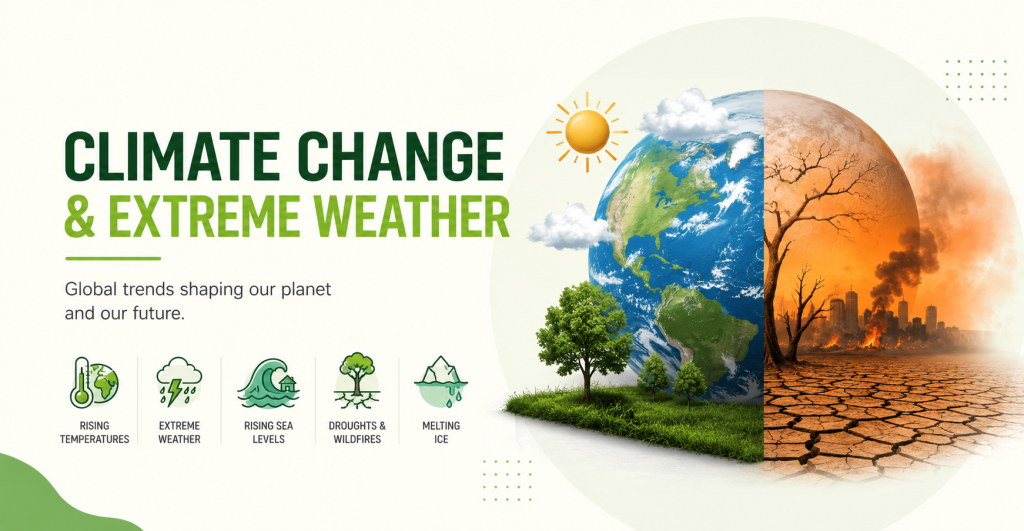

Climate Change and Extreme Weather remain among the most significant global issues in 2026 as countries face more frequent and severe weather events. Record-breaking heat, devastating floods, prolonged droughts, powerful storms, and widespread wildfires are affecting millions of people across the world. Scientists continue to report that rising greenhouse gas emissions and warming oceans are increasing the intensity of many weather events, prompting governments to strengthen climate policies, invest in resilient infrastructure, and improve disaster preparedness. Recent developments have reinforced the urgency of coordinated global action to protect communities, economies, and ecosystems from escalating climate risks.
Recent months have seen several regions experience unusually high temperatures, heavy rainfall, and severe flooding, disrupting transportation, agriculture, and energy infrastructure. These developments have once again highlighted the growing need for sustainable development, improved climate resilience, and international cooperation.
Heatwaves Continue to Challenge Cities
Extreme heat has become a recurring concern across multiple continents. Urban centers are particularly vulnerable due to dense infrastructure that absorbs and retains heat, increasing daytime and nighttime temperatures.
Health authorities have expanded public awareness campaigns, cooling centers, and emergency response systems to protect vulnerable populations. Businesses are also adapting work schedules and investing in cooling technologies to reduce risks associated with prolonged heat exposure.
Agricultural regions have reported declining crop productivity in areas experiencing persistent high temperatures, placing additional pressure on food production and water resources.
Flooding and Heavy Rainfall Disrupt Communities
Intense rainfall events have become more common, leading to flash floods in cities and river basins. Aging drainage systems and rapid urbanization have increased flood risks in many metropolitan areas.
Governments are investing in improved stormwater management systems, flood barriers, and early warning technologies to reduce damage and improve public safety. Satellite monitoring and advanced weather forecasting are helping emergency agencies prepare for severe weather more effectively.
Climate Indicators
| Indicator | Current Situation | Impact |
|---|---|---|
| Global Temperature | Continues to rise | More frequent heatwaves |
| Sea Levels | Gradually increasing | Coastal flooding |
| Glacier Ice | Continuing to decline | Reduced freshwater reserves |
| Ocean Temperature | Higher than historical averages | Stronger tropical storms |
| Wildfire Activity | Elevated in several regions | Forest and biodiversity loss |
Wildfires Affect Forests and Air Quality
Dry conditions and prolonged heat have increased wildfire activity in several parts of the world. Fires are damaging forests, wildlife habitats, and nearby communities while reducing air quality over large geographic areas.
Emergency services are expanding aerial firefighting capabilities, while governments are investing in forest management programs and wildfire detection systems that use artificial intelligence and satellite imagery.
Renewable Energy Expansion Gains Momentum
The transition toward renewable energy continues as countries invest heavily in solar, wind, hydroelectric, and battery storage projects. Clean energy is helping reduce dependence on fossil fuels while supporting long-term environmental goals.
Large-scale renewable energy installations are being paired with modern electricity grids capable of balancing variable power generation. Energy storage technologies are also improving grid reliability during periods of high electricity demand.
Electric vehicles continue gaining popularity, supported by expanding charging infrastructure and government incentives aimed at reducing transportation emissions.
Technology Supports Climate Action
Digital technologies are playing an increasingly important role in environmental monitoring and disaster management.
Key innovations include:
- Artificial intelligence for weather forecasting
- Satellite-based environmental monitoring
- Smart irrigation systems
- Flood prediction platforms
- Climate risk analytics
- Carbon capture technologies
- Drone-assisted forest monitoring
These technologies enable governments and businesses to respond more quickly to emerging climate risks while improving long-term planning.
Climate Impact Across Major Industries
| Industry | Primary Challenge | Response |
|---|---|---|
| Agriculture | Heat stress and drought | Climate-smart farming |
| Energy | Higher electricity demand | Renewable power expansion |
| Transportation | Flood and storm disruption | Resilient infrastructure |
| Insurance | Rising disaster claims | Advanced risk assessment |
| Healthcare | Heat-related illnesses | Emergency preparedness |
Businesses Prioritize Sustainability
Companies are integrating sustainability into long-term business strategies through cleaner manufacturing processes, energy-efficient operations, and environmentally responsible supply chains.
Investments in green buildings, circular economy initiatives, and carbon reduction programs continue to grow as organizations respond to evolving environmental expectations from consumers, investors, and regulators.
Many multinational companies are also enhancing climate-related disclosures to improve transparency and demonstrate progress toward emission reduction goals.
Governments Strengthen Climate Policies
Countries continue introducing new environmental regulations, renewable energy incentives, and infrastructure investment programs designed to improve resilience against severe weather.
Policy priorities include expanding clean energy capacity, protecting forests, improving water management, modernizing transportation infrastructure, and supporting climate adaptation projects in vulnerable communities.
International collaboration remains essential as climate-related challenges increasingly cross national boundaries.
Outlook
Climate change continues to influence weather patterns, infrastructure planning, energy systems, and economic development worldwide. While environmental challenges remain significant, advances in renewable energy, digital technology, and sustainable infrastructure provide opportunities to strengthen resilience and reduce long-term risks.
Continued investment in innovation, international cooperation, and environmental stewardship will play a crucial role in supporting communities and economies as they adapt to a changing climate.
Conclusion
Climate change and extreme weather remain at the forefront of global news in 2026. Rising temperatures, floods, wildfires, and severe storms continue to reshape societies while accelerating investment in renewable energy, climate technology, and sustainable development. As governments, industries, and communities work together to address these challenges, resilience and innovation will remain central to building a safer and more sustainable future.