
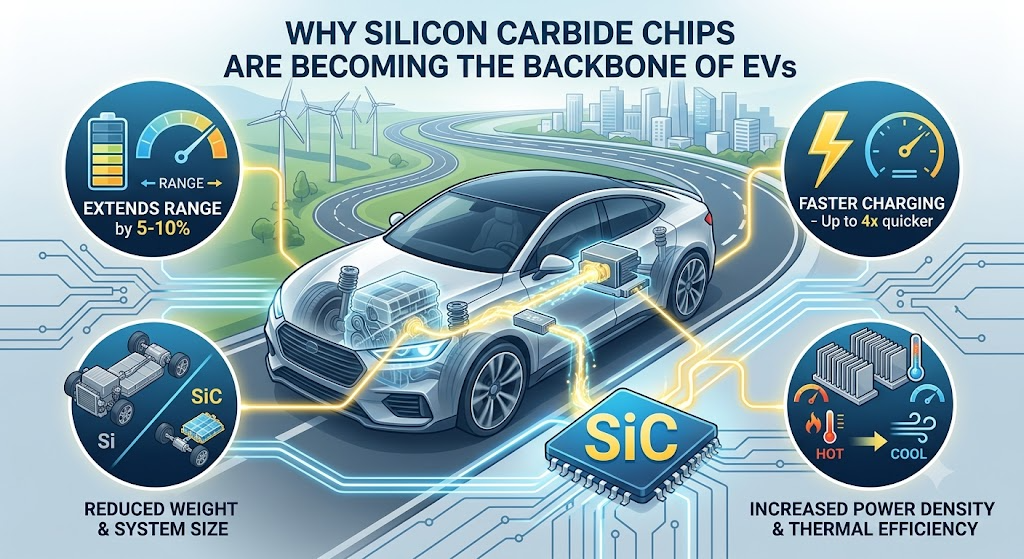

The electric vehicle (EV) revolution is transforming the global automotive industry, and one technology is quietly powering this transition: Silicon Carbide (SiC) chips. As automakers race to build vehicles with longer driving ranges, faster charging capabilities, and improved energy efficiency, Silicon Carbide semiconductors have emerged as a critical innovation.
Unlike traditional silicon-based power chips, Silicon Carbide devices can handle higher voltages, operate at higher temperatures, and significantly reduce energy losses. These advantages make them ideal for modern electric vehicles, where every percentage point of efficiency translates into more miles of driving range and lower operating costs.
What Are Silicon Carbide Chips?
Silicon Carbide is a compound semiconductor made from silicon and carbon. It belongs to a class of materials known as wide-bandgap semiconductors, which outperform conventional silicon in high-power and high-temperature applications.
In electric vehicles, SiC chips are commonly used in:
- Power inverters
- On-board chargers
- DC-DC converters
- Fast-charging infrastructure
- Battery management systems
- Electric drivetrains
These components control the flow of electricity between the battery and the electric motor, making them essential for overall vehicle performance.
Why EV Manufacturers Are Choosing Silicon Carbide
One of the biggest reasons for adopting SiC technology is higher energy efficiency.
Traditional silicon power devices lose more energy as heat during power conversion. Silicon Carbide chips dramatically reduce these losses, allowing more electrical energy to reach the motor.
This leads to several important benefits:
- Increased driving range
- Reduced battery size requirements
- Lower cooling system costs
- Better overall vehicle efficiency
- Improved acceleration and performance
For automakers competing in the rapidly growing EV market, these advantages are becoming increasingly valuable.
Faster Charging Is a Major Advantage
Charging speed remains one of the biggest concerns for EV buyers.
Silicon Carbide chips enable higher-voltage systems—such as the increasingly popular 800V architecture—that support ultra-fast charging.
With SiC-based power electronics, many modern EVs can recharge from around 10% to 80% in approximately 20 minutes under suitable fast-charging conditions.
As charging infrastructure continues to expand worldwide, Silicon Carbide technology will play an important role in reducing charging times and improving convenience for drivers.
Better Performance Under Extreme Conditions
Electric vehicles operate under demanding environments that generate significant heat.
Unlike conventional silicon chips, Silicon Carbide semiconductors maintain stable performance even at much higher operating temperatures.
This offers several benefits:
- Improved reliability
- Longer component lifespan
- Smaller cooling systems
- Lower maintenance requirements
- Higher power density
These characteristics are especially valuable for performance EVs, commercial vehicles, buses, and heavy-duty electric trucks.
Supporting Longer Driving Range
Range anxiety remains one of the largest barriers to EV adoption.
Every improvement in power efficiency helps manufacturers maximize the energy available from each battery charge.
Silicon Carbide chips minimize electrical losses throughout the powertrain, allowing vehicles to travel farther without increasing battery size.
For consumers, this means:
- Fewer charging stops
- Better highway performance
- Lower electricity consumption
- Improved overall driving experience
Even a modest efficiency improvement can translate into several additional kilometers of driving range, making SiC technology highly attractive for manufacturers.
Driving Innovation Across the EV Industry
Leading automotive companies are rapidly integrating Silicon Carbide into their newest electric platforms.
Luxury EV brands, mass-market manufacturers, and commercial vehicle producers are all investing in SiC-based power electronics to improve vehicle performance while reducing total system costs over time.
The technology is also becoming increasingly important in:
- Electric buses
- Electric trucks
- Autonomous vehicles
- High-performance sports EVs
- Renewable energy charging systems
As production scales up, manufacturing costs are expected to decline, making Silicon Carbide accessible across a wider range of vehicle segments.
Challenges Still Remain
Despite its advantages, Silicon Carbide technology faces several challenges.
Manufacturing SiC wafers is more complex and expensive than producing traditional silicon chips. The supply chain is still developing, and global demand has occasionally exceeded production capacity.
Key challenges include:
- Higher production costs
- Limited wafer manufacturing capacity
- Complex fabrication processes
- Supply chain constraints
- Specialized manufacturing equipment
However, semiconductor companies worldwide are investing billions of dollars in expanding production facilities, improving yields, and reducing manufacturing costs.
The Future of Silicon Carbide in Electric Mobility
The future of electric vehicles will depend heavily on advances in semiconductor technology.
As battery capacities increase, charging speeds improve, and power demands continue to grow, Silicon Carbide is expected to become a standard component in next-generation EV architectures.
Beyond passenger vehicles, SiC chips are also enabling innovation in renewable energy systems, industrial automation, aerospace, and high-speed charging infrastructure.
With governments promoting cleaner transportation and automakers investing heavily in electrification, Silicon Carbide is positioned to become one of the foundational technologies supporting the future of sustainable mobility.
Conclusion
Silicon Carbide chips are reshaping the electric vehicle industry by delivering greater efficiency, faster charging, improved reliability, and longer driving ranges. While manufacturing challenges remain, ongoing investments and technological advancements are rapidly making SiC more affordable and widely available.
As the world accelerates toward an electric future, Silicon Carbide is no longer just an advanced semiconductor—it is becoming the backbone of modern EV technology. Its ability to unlock higher performance while reducing energy losses makes it a key enabler of the next generation of cleaner, smarter, and more efficient transportation.