
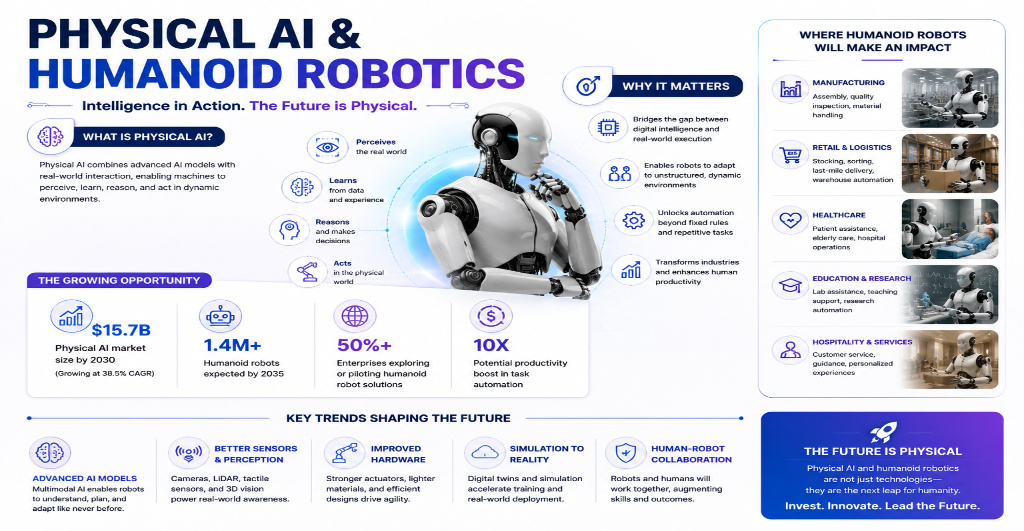

Artificial intelligence is no longer limited to software, chatbots, or virtual assistants. Today, AI is entering the physical world through intelligent machines capable of seeing, understanding, moving, and interacting with their surroundings. This emerging field, known as Physical AI & Humanoid Robotics, is transforming industries by combining advanced AI models with robotics, computer vision, sensors, and autonomous decision-making. As businesses seek greater efficiency and governments invest heavily in automation, Physical AI is becoming one of the most significant technology trends of the decade.
Humanoid robots, once considered futuristic concepts, are rapidly evolving into practical solutions for manufacturing, logistics, healthcare, retail, hospitality, and even household assistance. Powered by generative AI, machine learning, edge computing, and sophisticated sensors, these robots are becoming more capable of performing complex tasks alongside humans. Industry experts predict that Physical AI & Humanoid Robotics will play a central role in addressing global labor shortages while improving productivity, workplace safety, and operational efficiency.
What Is Physical AI?
Physical AI refers to artificial intelligence systems that enable machines to understand and interact with the real world. Unlike traditional AI applications that process only digital information, Physical AI integrates cameras, LiDAR, sensors, robotic actuators, and advanced AI models to perceive environments, analyze situations, and perform physical actions.
These systems continuously collect data from their surroundings, interpret it using AI algorithms, and execute decisions through robotic movements. This allows robots, autonomous vehicles, drones, warehouse systems, and industrial machines to operate independently in dynamic environments with minimal human intervention.
Physical AI combines several cutting-edge technologies, including computer vision, deep learning, reinforcement learning, robotics, sensor fusion, edge AI, and large language models, creating machines capable of adapting to changing real-world conditions.
Understanding Humanoid Robotics
Humanoid robotics focuses on developing robots with human-like bodies, mobility, and communication abilities. Unlike traditional industrial robots that perform repetitive tasks inside fixed environments, humanoid robots are designed to function in spaces built for humans. They can walk, climb stairs, pick up objects, communicate using natural language, and collaborate safely with people.
Modern humanoid robots incorporate AI-powered vision systems, force sensors, dexterous robotic hands, speech recognition, and autonomous navigation. These capabilities allow them to perform tasks ranging from warehouse operations and factory assembly to customer assistance and healthcare support.
The integration of generative AI has significantly enhanced humanoid robots by enabling them to understand conversations, interpret instructions, solve problems, and learn new skills more efficiently than previous robotic generations.
Why Physical AI & Humanoid Robotics Are Growing Rapidly
The rapid growth of Physical AI & Humanoid Robotics is driven by several powerful market forces. One of the biggest factors is the increasing shortage of skilled labor across manufacturing, logistics, healthcare, agriculture, and service industries. Organizations are adopting intelligent robots to fill workforce gaps while maintaining operational efficiency.
Another major growth driver is the advancement of AI hardware. More powerful processors, specialized AI chips, high-performance GPUs, and edge computing platforms now enable robots to process enormous amounts of data in real time without relying entirely on cloud computing.
Declining sensor costs have also accelerated adoption. High-resolution cameras, LiDAR systems, ultrasonic sensors, force sensors, and depth cameras have become significantly more affordable, making advanced robotic systems economically viable for businesses of all sizes.
At the same time, improvements in battery technology, robotic actuators, and lightweight materials have increased the mobility and operational lifespan of humanoid robots, enabling them to work longer hours with greater precision.
Key Applications Across Industries
Physical AI & Humanoid Robotics are expanding into nearly every major industry.
In manufacturing, humanoid robots assist with assembly, quality inspection, welding, packaging, and material handling. Their ability to work continuously while maintaining consistent accuracy improves productivity and reduces production costs.
Warehouse and logistics companies use intelligent robots for inventory management, order picking, package sorting, and autonomous transportation. These systems help businesses meet growing e-commerce demand while minimizing delivery delays.
Healthcare organizations are exploring humanoid robots for patient monitoring, rehabilitation support, medication delivery, hospital logistics, and elderly care. AI-powered assistants can reduce workloads for healthcare professionals while improving patient experiences.
Retailers are deploying robots for inventory tracking, shelf management, customer guidance, and automated checkout assistance. These solutions improve operational efficiency while providing better customer service.
In hospitality, humanoid robots perform concierge services, room deliveries, cleaning, and multilingual customer interactions, helping businesses operate more efficiently during labor shortages.
Agriculture is also benefiting from Physical AI through autonomous harvesting, crop monitoring, precision spraying, and livestock management, enabling farmers to increase productivity while reducing resource consumption.
Major Technology Innovations Driving the Industry
Several technological breakthroughs are accelerating the evolution of Physical AI & Humanoid Robotics.
Generative AI enables robots to understand natural language, generate responses, and learn complex behaviors from human instructions. Computer vision allows robots to recognize objects, detect obstacles, and navigate unfamiliar environments with remarkable accuracy.
Edge AI processes information directly on robotic devices, reducing latency and enabling faster decision-making without constant cloud connectivity. Reinforcement learning allows robots to improve performance through continuous interaction with their environments.
Digital twins are becoming increasingly valuable by creating virtual simulations where robots can be trained, tested, and optimized before deployment in real-world settings. Meanwhile, 5G connectivity supports real-time communication between robots, cloud systems, and industrial infrastructure.
Challenges Facing Physical AI
Despite remarkable progress, several challenges remain.
Developing advanced humanoid robots requires significant investment in hardware, software, AI training, and engineering. High development costs continue to limit widespread adoption for many organizations.
Safety remains another major concern. Robots operating alongside humans must meet strict safety standards to prevent accidents while responding intelligently to unpredictable situations.
Ethical considerations are also growing as AI-powered robots become more autonomous. Questions surrounding accountability, privacy, cybersecurity, workforce displacement, and responsible AI governance require careful regulation and industry collaboration.
Battery limitations, mechanical durability, and real-world adaptability remain ongoing engineering challenges that researchers continue to address.
Future Outlook
The future of Physical AI & Humanoid Robotics appears exceptionally promising. Continuous improvements in AI reasoning, robotics engineering, semiconductor technology, and cloud-edge integration are expected to make intelligent robots more capable and affordable over the coming years.
Humanoid robots will increasingly collaborate with human workers rather than replace them, handling repetitive, hazardous, and physically demanding tasks while allowing employees to focus on creative, strategic, and customer-facing responsibilities. Industries such as manufacturing, healthcare, logistics, construction, defense, and retail are expected to witness the fastest adoption.
As AI models become more sophisticated and robotic hardware continues to improve, Physical AI will expand beyond industrial environments into homes, hospitals, schools, public infrastructure, and everyday life.
Conclusion
Physical AI & Humanoid Robotics represent one of the most transformative technological advancements of the modern era. By combining artificial intelligence with physical machines capable of perception, reasoning, and movement, this emerging industry is redefining automation across virtually every sector.
Businesses investing in intelligent robotics today are positioning themselves for greater efficiency, resilience, and long-term competitiveness. As innovation continues to accelerate, Physical AI & Humanoid Robotics will become a cornerstone of the next generation of smart industries, helping solve labor shortages, improve productivity, and unlock entirely new possibilities for human-machine collaboration.