

The Rapid Evolution of Digital Public Opinion
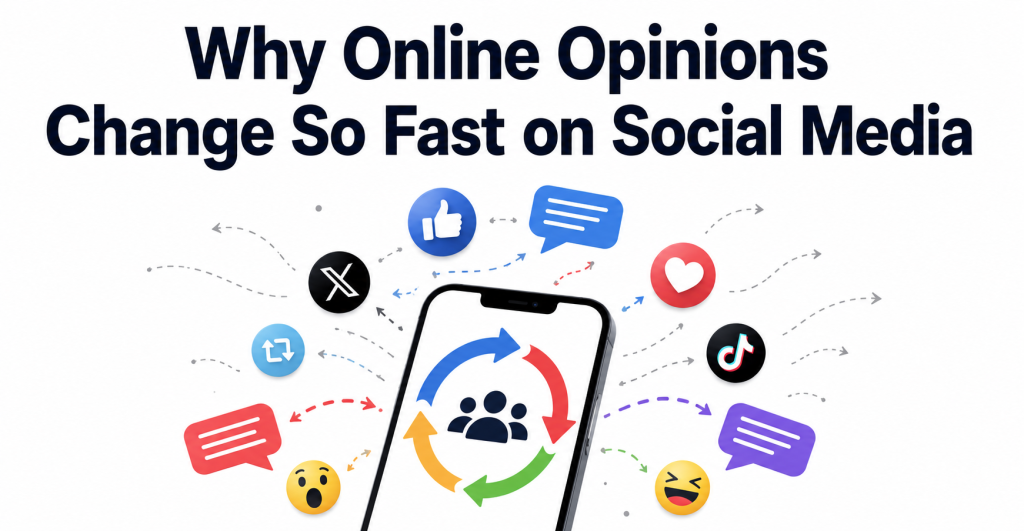
The speed at which public opinion shifts on social media has become one of the defining characteristics of the digital economy. A single post, video, or trending discussion can reshape consumer attitudes, political narratives, entertainment preferences, and brand perception within hours. Unlike traditional media cycles that evolved over days or weeks, today’s information ecosystem operates in real time, driven by continuous user engagement and algorithmic content distribution. This transformation has created an environment where opinions are increasingly dynamic rather than fixed, making adaptability one of the most valuable assets for businesses, creators, policymakers, and marketers. As social platforms continue expanding their influence across commerce, communication, and culture, understanding why online opinions change so quickly has become a strategic necessity rather than a matter of curiosity.
The growing integration of artificial intelligence, personalized content recommendations, and short-form media has further accelerated this phenomenon. Users are constantly exposed to fresh perspectives, viral narratives, and emotionally engaging content that encourages immediate reactions instead of long-term reflection. The result is a marketplace of ideas where attention is highly competitive, trends evolve rapidly, and public sentiment can reverse almost overnight.
How Algorithms Have Transformed Opinion Formation
The modern social media ecosystem is built around engagement optimization rather than chronological information delivery. Advanced recommendation systems continuously analyze user behavior, including viewing habits, interactions, watch time, and sharing patterns, to deliver increasingly personalized content. While this improves user engagement, it also increases exposure to emotionally compelling stories that are more likely to generate reactions, discussions, and further distribution across digital networks.
As algorithms prioritize content with higher engagement signals, public conversations can gain extraordinary momentum regardless of whether they represent long-term consensus. Viral content often reaches millions before additional context becomes available, allowing opinions to form rapidly and evolve just as quickly when new information emerges. This continuous cycle has fundamentally changed how individuals process information, making online sentiment far more fluid than in previous decades.
Consumer Behavior Is Becoming Increasingly Real-Time
Digital consumers no longer rely solely on traditional experts or established institutions when forming opinions. Instead, purchasing decisions, entertainment preferences, investment interest, and even social values are increasingly influenced by online communities, creators, peer discussions, and trending conversations. This shift has created a real-time feedback economy where collective sentiment evolves alongside constant streams of new information.
Businesses have responded by investing heavily in social listening technologies, sentiment analysis, predictive analytics, and digital reputation management. Rather than measuring public perception quarterly or annually, organizations increasingly monitor consumer conversations minute by minute. This growing emphasis on real-time intelligence represents a major opportunity for technology providers developing AI-powered monitoring tools capable of identifying emerging trends before they become mainstream. Companies that successfully interpret these signals gain a competitive advantage by adapting products, marketing strategies, and customer communication more quickly than competitors.
The Expanding Economic Value of Digital Trust
Online reputation has become a measurable business asset. Public confidence directly influences purchasing behavior, customer retention, investor confidence, recruitment, and long-term brand equity. Because opinions now spread across interconnected platforms almost instantly, organizations must maintain consistent transparency and responsiveness to preserve credibility during periods of heightened public attention.
The increasing importance of digital trust has created significant growth opportunities across cybersecurity, content verification, misinformation detection, brand intelligence, and reputation management services. Organizations are recognizing that trust is no longer built exclusively through advertising but through continuous engagement, authentic communication, and rapid response to changing public expectations. As digital ecosystems become more interconnected, investments in trust-building technologies and communication strategies are expected to continue expanding across industries.
Emerging Technologies Will Shape Future Opinion Dynamics
Artificial intelligence is expected to play an increasingly influential role in both creating and interpreting digital conversations. AI-powered content generation, multilingual communication, predictive analytics, and automated moderation systems are already transforming how information is produced and distributed. At the same time, advancements in synthetic media, personalized advertising, and intelligent recommendation engines will likely increase the speed at which narratives spread across global audiences.
Future social platforms are expected to integrate more sophisticated personalization capabilities, making individual information environments even more tailored to personal interests and behavioral patterns. While these innovations improve user experience, they also introduce new challenges surrounding transparency, authenticity, and information quality. As regulators, technology developers, and businesses continue refining digital governance frameworks, balancing innovation with responsible content distribution will become an increasingly important priority for sustainable platform growth.
Long-Term Market Outlook for the Digital Attention Economy
The rapid evolution of online opinion reflects broader structural changes in the global digital economy. Social platforms are no longer simply communication channels; they have evolved into influential ecosystems that shape commerce, culture, investment decisions, consumer confidence, and public discourse simultaneously. As internet connectivity expands and digital engagement continues increasing worldwide, the value of understanding sentiment dynamics will grow across virtually every industry.
Organizations capable of combining behavioral analytics, artificial intelligence, data science, and authentic communication strategies will be better positioned to navigate increasingly volatile digital environments. Rather than viewing rapidly changing online opinions as a challenge alone, forward-looking businesses increasingly recognize them as a valuable source of market intelligence and innovation. In the coming years, the ability to anticipate shifts in public sentiment before they become widespread will likely emerge as one of the most important competitive advantages in the evolving digital marketplace.