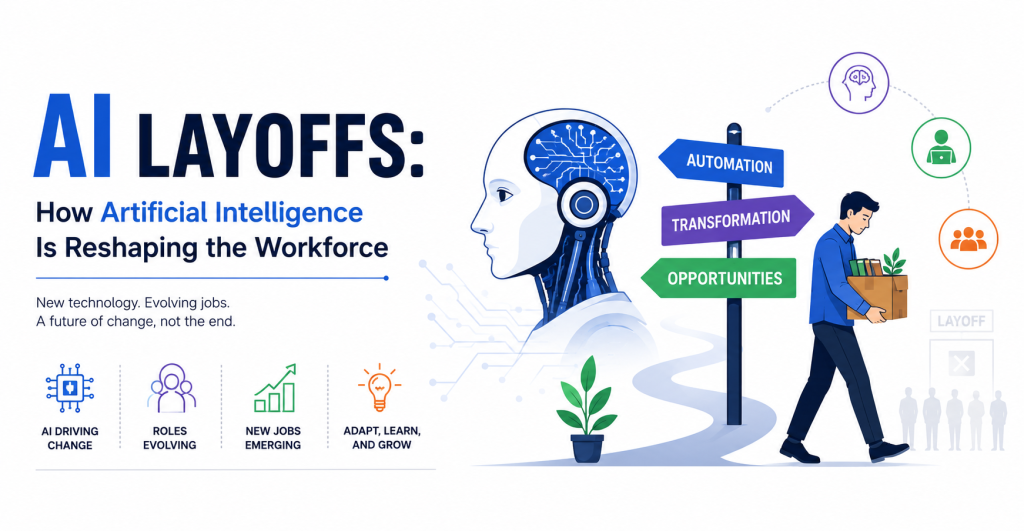

Not long ago, artificial intelligence was viewed as a tool that could help employees work faster and smarter. Today, it has become one of the biggest topics in boardrooms around the world not just because of what it can do, but because of what it means for the future of work.
Over the past year, headlines about companies restructuring their workforce while investing heavily in AI have become increasingly common. From technology giants to financial institutions, businesses are rethinking how work gets done. In many cases, this has led to difficult decisions, including layoffs, role restructuring, and hiring freezes.
But is artificial intelligence simply replacing jobs?
The reality is far more complex.
AI isn’t just eliminating roles it is redefining them. While some traditional jobs are disappearing, entirely new opportunities are emerging. The workplace isn’t vanishing; it’s evolving.
The Shift Started Long Before the Headlines
Automation isn’t new.
Factories have used machines for decades, banks introduced ATMs years ago, and self-checkout systems have become common in supermarkets. Every major technological breakthrough has changed the nature of work.
Artificial intelligence, however, is different.
Unlike previous technologies that primarily automated physical tasks, AI can perform cognitive work. It can write reports, analyze data, summarize meetings, answer customer questions, generate software code, translate languages, and even create marketing content within seconds.
This ability to automate knowledge-based tasks is why businesses are adopting AI faster than many experts expected.
For organizations under pressure to improve efficiency and reduce operating costs, AI has become more than an innovation it has become a competitive advantage.
Why Companies Are Restructuring Their Workforce
When businesses invest millions or even billions of dollars in AI infrastructure, they naturally begin evaluating where automation can improve productivity.
Many repetitive and time-consuming tasks that once required large teams can now be completed much faster with AI assistance.
For example:
- Customer service teams use AI chatbots to answer routine questions.
- Marketing departments rely on AI for content creation and campaign analysis.
- Software developers use AI coding assistants to speed up programming.
- Human resources teams automate resume screening and candidate communication.
- Finance departments use AI for reporting, forecasting, and fraud detection.
This doesn’t always eliminate jobs entirely, but it often changes how many people are needed to complete the same amount of work.
As a result, many organizations are redesigning their workforce around AI-enabled productivity.
AI Is Replacing Tasks, Not Entire Careers
One of the biggest misconceptions surrounding AI is that it replaces entire professions overnight.
In reality, AI primarily replaces tasks rather than complete jobs.
Consider a graphic designer.
AI can generate concepts, remove backgrounds, and create visual variations in seconds. However, understanding a client’s vision, developing brand identity, making creative decisions, and delivering emotional storytelling still require human expertise.
The same applies to lawyers, accountants, marketers, teachers, journalists, healthcare professionals, and engineers.
AI can handle repetitive work.
Humans continue to provide judgment, creativity, leadership, empathy, and strategic thinking.
The future workplace will likely combine both.
The Rise of AI-Augmented Employees
Rather than replacing employees entirely, many businesses are creating what experts call AI-augmented workforces.
Employees are learning to collaborate with AI instead of competing against it.
A marketing professional may use AI to draft content before refining it.
A software engineer may generate code using AI before reviewing and optimizing it.
A financial analyst may use AI to process large datasets before making business recommendations.
Instead of reducing productivity, AI often multiplies it.
Employees who understand how to work alongside AI are becoming increasingly valuable.
New Jobs Are Emerging Faster Than Many Realize
Every technological revolution creates new careers.
Artificial intelligence is no exception.
Just a few years ago, roles such as Prompt Engineer, AI Trainer, AI Ethics Specialist, Machine Learning Operations Engineer, and AI Product Manager were relatively uncommon.
Today, demand for these skills continues to grow.
Organizations also require professionals who can:
- Manage AI systems
- Monitor AI performance
- Ensure responsible AI usage
- Protect sensitive data
- Develop AI-powered applications
- Train employees to use AI effectively
This means the workforce is not simply shrinking it is shifting toward new skill sets.
The Skills That Matter Most
As AI handles more routine work, human skills become increasingly valuable.
Employers are placing greater emphasis on abilities that machines struggle to replicate.
These include:
- Critical thinking
- Problem-solving
- Leadership
- Emotional intelligence
- Communication
- Creativity
- Strategic decision-making
- Adaptability
- Collaboration
Technical skills remain important, but combining them with strong interpersonal abilities creates a significant competitive advantage.
In an AI-powered workplace, the most valuable employees will likely be those who know how to combine technology with human judgment.
Why Continuous Learning Is No Longer Optional
One of the biggest lessons emerging from the AI revolution is that learning cannot stop after graduation.
Technology is evolving faster than traditional education systems.
Professionals across industries are investing in new skills through online courses, certifications, workshops, and practical experience.
Learning about AI doesn’t necessarily mean becoming a programmer.
Understanding how AI works, where it creates value, and how to use it responsibly can benefit professionals in almost every field.
The willingness to learn may become more important than existing qualifications.
Businesses Face Challenges Too
Although AI offers enormous potential, companies also face important challenges.
Implementing AI successfully requires:
- Significant investment
- Employee training
- Data security
- Regulatory compliance
- Ethical governance
- Organizational change management
Simply replacing employees with AI rarely guarantees success.
Businesses still depend on experienced professionals who understand customers, build relationships, solve unexpected problems, and make strategic decisions.
Companies that combine technological innovation with human expertise are likely to achieve the strongest long-term results.
What Does the Future Workforce Look Like?
The future of work is unlikely to be fully human or fully automated.
Instead, it will probably be collaborative.
Routine tasks will increasingly be handled by AI.
Humans will focus on innovation, creativity, leadership, relationship building, and complex decision-making.
Many jobs will evolve rather than disappear.
New roles will emerge.
Existing careers will require new skills.
The organizations that succeed won’t necessarily be those using the most AI they’ll be the ones using AI most effectively while empowering their people.
Final Thoughts
Artificial intelligence is undoubtedly reshaping the workforce, but the conversation should extend beyond layoffs.
While automation is changing certain roles, it is also creating opportunities that didn’t exist just a few years ago. History has shown that every major technological shift transforms employment rather than eliminating it entirely, and AI appears to be following a similar path.
The key challenge for both businesses and professionals is adaptation.
Companies must learn how to integrate AI responsibly while supporting employees through change. Individuals, meanwhile, should view AI not as a competitor but as a powerful tool that can enhance productivity and unlock new career possibilities.
The future belongs neither to artificial intelligence alone nor to humans working without technology.
It belongs to those who understand how the two can work together.
In the years ahead, the question will no longer be “Will AI replace jobs?”
Instead, it will be:
“How prepared are we to work alongside AI in a rapidly changing world?”