
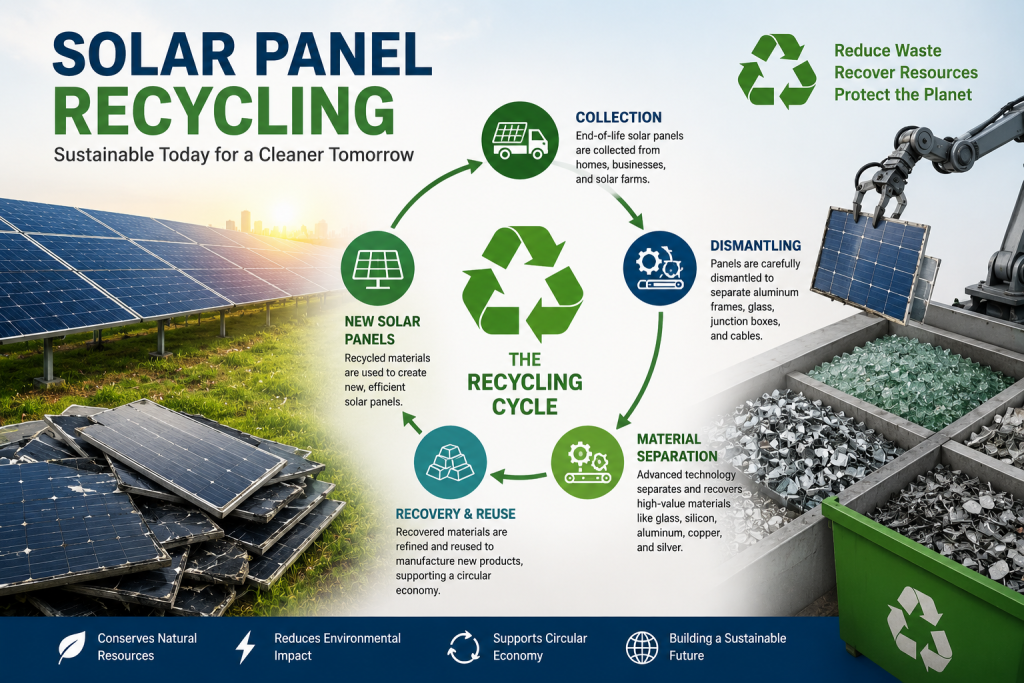

As solar energy adoption continues to accelerate worldwide, attention is increasingly shifting toward what happens when solar panels reach the end of their operational life. Millions of photovoltaic (PV) panels installed over the past two decades are expected to retire in the coming years, creating a growing need for efficient recycling solutions. Solar panel recycling has emerged as a critical component of the renewable energy ecosystem, supporting resource conservation, reducing electronic waste, and enabling a circular economy.
Governments, manufacturers, and recycling companies are investing in advanced recycling technologies to recover valuable materials such as glass, aluminum, silicon, copper, and silver from end-of-life solar panels. At the same time, stricter environmental regulations and sustainability goals are encouraging responsible disposal and material recovery practices.
As the global solar industry continues expanding, solar panel recycling is expected to play an increasingly important role in minimizing environmental impact while improving resource efficiency. Innovations in recycling processes, supportive government policies, and increasing awareness of sustainable waste management are shaping the future of this emerging industry.
What Is Solar Panel Recycling?
Solar panel recycling is the process of recovering valuable materials from photovoltaic (PV) panels after they reach the end of their useful life. Instead of sending discarded panels to landfills, specialized recycling facilities separate and recover components such as glass, aluminum frames, silicon wafers, copper wiring, plastics, and precious metals that can be reused in manufacturing new products.
Most solar panels have an operational lifespan of approximately 25 to 30 years. As early generations of installations begin reaching retirement, recycling has become essential for reducing waste, conserving natural resources, and supporting sustainable renewable energy development.
Modern recycling methods include mechanical separation, thermal treatment, and chemical processing to maximize material recovery while minimizing environmental impact.
Why Solar Panel Recycling Is Growing Rapidly
The rapid expansion of solar energy installations worldwide is creating an increasing volume of end-of-life photovoltaic panels. Governments and environmental agencies are introducing regulations that encourage responsible disposal and recycling to prevent landfill waste and recover valuable raw materials.
Growing demand for critical minerals such as silicon, silver, copper, and aluminum is making recycled materials more economically valuable. Recovering these materials reduces dependence on mining while lowering manufacturing costs and carbon emissions.
The renewable energy industry’s commitment to sustainability is also driving investment in advanced recycling technologies capable of achieving higher recovery rates with lower environmental impact.
Additionally, manufacturers are increasingly adopting circular economy strategies by designing solar panels that are easier to dismantle, repair, and recycle at the end of their lifecycle.
Key Trends Shaping Solar Panel Recycling
Several emerging trends are transforming the solar panel recycling industry.
Advanced recycling technologies are improving recovery rates for valuable materials while reducing processing costs and energy consumption.
Governments across multiple regions are implementing stricter electronic waste regulations and extended producer responsibility (EPR) policies that require manufacturers to manage end-of-life solar panels responsibly.
Automation is improving sorting, dismantling, and material separation processes, increasing recycling efficiency and reducing labor requirements.
Circular economy initiatives are encouraging manufacturers to incorporate recycled materials into the production of new photovoltaic panels and renewable energy components.
Research into next-generation recycling methods is enabling higher recovery of silicon and precious metals that were previously difficult to extract economically.
Increasing collaboration between solar manufacturers, recycling companies, and governments is strengthening recycling infrastructure and expanding collection networks globally.
Applications Across Industries
Solar panel recycling supports sustainability across multiple industries.
Renewable energy companies recycle retired photovoltaic systems to recover valuable materials and reduce environmental impact.
Manufacturers use recycled glass, aluminum, silicon, and metals in producing new solar panels and other industrial products.
Construction companies utilize recovered materials in infrastructure projects and sustainable building applications.
Electronic waste management companies integrate photovoltaic recycling into broader recycling operations to improve resource recovery.
Government agencies promote recycling initiatives to meet environmental regulations, reduce landfill waste, and support circular economy objectives.
Research institutions continue developing innovative recycling technologies that improve material recovery and reduce processing costs.
Major Technologies Driving Solar Panel Recycling
Several technological innovations are accelerating improvements in photovoltaic recycling.
Mechanical recycling systems efficiently separate aluminum frames, glass, and other structural materials.
Thermal treatment processes remove polymer layers that bind solar panel components together.
Chemical processing technologies recover high-purity silicon, silver, and other valuable metals from photovoltaic cells.
Robotic dismantling systems improve recycling efficiency while reducing labor-intensive operations.
Material recovery technologies continue advancing to increase recycling rates while minimizing waste generation.
Digital monitoring systems help track end-of-life panels, optimize collection logistics, and improve recycling operations.
Challenges Facing Solar Panel Recycling
Despite rapid growth, several challenges continue to affect the industry.
Recycling infrastructure remains limited in many regions, making collection and transportation costly.
Recovering high-purity silicon and precious metals can still be technically complex and economically challenging.
The diversity of solar panel designs and materials requires specialized recycling processes.
Insufficient awareness regarding proper disposal methods contributes to landfill waste in some markets.
Developing cost-effective recycling technologies remains a priority as end-of-life solar panel volumes continue increasing.
Future Outlook
The future of solar panel recycling is expected to become more efficient, scalable, and economically viable. As millions of photovoltaic panels approach the end of their operational life, demand for advanced recycling solutions will continue rising.
Governments are expected to strengthen recycling regulations while encouraging investments in collection infrastructure and material recovery technologies.
Manufacturers will increasingly design solar panels with recyclability in mind, supporting circular economy initiatives and reducing lifecycle environmental impact.
Technological innovations will improve recovery rates for valuable materials, lowering recycling costs and reducing dependence on newly mined resources.
As renewable energy continues expanding globally, solar panel recycling will become an essential pillar of sustainable energy development, ensuring that clean energy technologies remain environmentally responsible throughout their entire lifecycle.
Conclusion
Solar panel recycling is becoming an increasingly important part of the global renewable energy transition. By recovering valuable materials, reducing electronic waste, and supporting circular economy principles, the industry helps maximize the environmental benefits of solar power.
As recycling technologies continue advancing and governments strengthen sustainability initiatives, photovoltaic recycling will play a vital role in creating a more resource-efficient and environmentally sustainable energy future. Investments in recycling infrastructure, innovation, and responsible waste management will ensure that the growth of solar energy remains both economically and environmentally sustainable.