
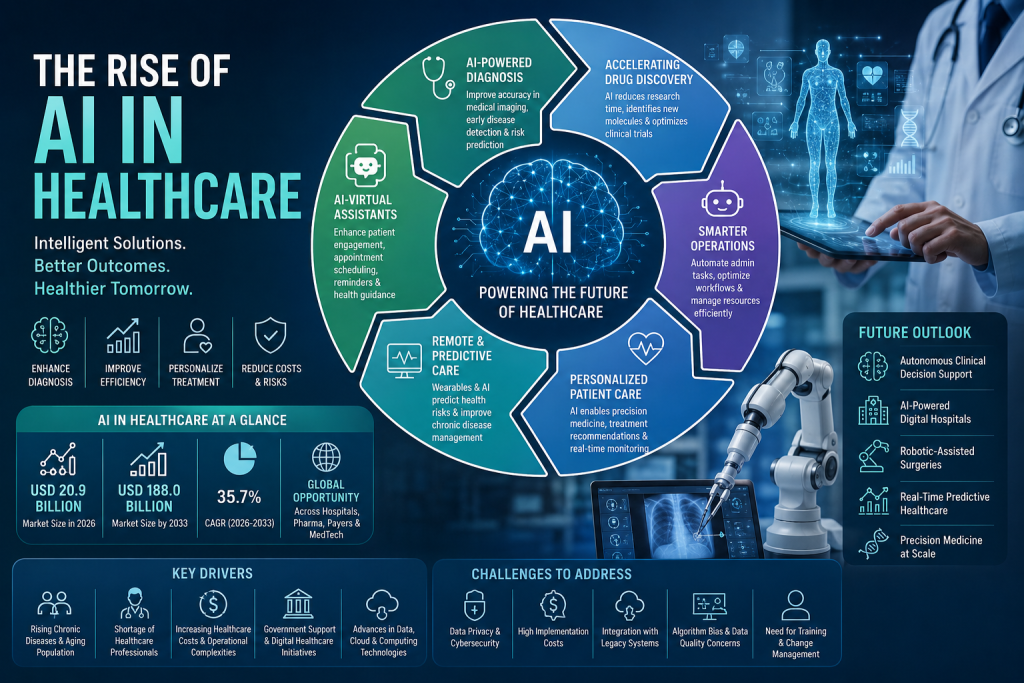

Artificial Intelligence (AI) is rapidly transforming the global healthcare industry, becoming one of the most influential technologies shaping patient care, medical research, and hospital operations. In 2026, AI is no longer viewed as an experimental innovation—it has become a strategic priority for healthcare providers, pharmaceutical companies, medical device manufacturers, and governments worldwide.
Healthcare organizations are increasingly adopting AI-powered solutions to improve diagnostic accuracy, automate administrative tasks, accelerate drug discovery, personalize treatments, and optimize hospital workflows. As healthcare systems continue to face rising patient volumes, workforce shortages, and increasing operational costs, AI is emerging as a critical solution for delivering efficient, accessible, and data-driven healthcare services.
Industry experts believe AI will play a central role in shaping the future of global healthcare over the next decade.
Understanding AI in Healthcare
Artificial Intelligence in healthcare refers to the use of machine learning, deep learning, natural language processing (NLP), computer vision, and predictive analytics to support medical decision-making and healthcare operations.
Unlike conventional software systems, AI can analyze massive volumes of clinical data, identify complex patterns, generate predictive insights, and assist healthcare professionals in making faster and more accurate decisions.
AI applications now span disease diagnosis, medical imaging, virtual health assistants, robotic surgery, remote patient monitoring, electronic health records (EHR), hospital management, and pharmaceutical research.
Continuous improvements in cloud computing, high-performance processors, and healthcare data availability are making AI increasingly scalable across healthcare ecosystems.
Why AI Adoption Is Accelerating
Several factors are driving the rapid adoption of AI across the healthcare sector.
One of the biggest drivers is the growing shortage of healthcare professionals worldwide. AI enables clinicians to automate repetitive administrative tasks, allowing them to focus more on patient care.
The increasing prevalence of chronic diseases, aging populations, and growing healthcare expenditures are also encouraging hospitals to adopt AI-powered diagnostic and predictive tools.
Governments are supporting digital healthcare initiatives through investments in AI research, electronic health infrastructure, and regulatory frameworks that encourage responsible AI adoption.
Patients are becoming more comfortable with digital healthcare services, including AI-powered symptom checkers, virtual consultations, and personalized treatment recommendations.
Additionally, pharmaceutical companies are leveraging AI to reduce drug discovery timelines, improve clinical trial efficiency, and accelerate new therapy development.
Key AI in Healthcare Trends Reshaping the Industry
Several emerging trends are defining AI adoption in healthcare during 2026.
Generative AI is becoming an essential tool for automating clinical documentation, generating medical summaries, and assisting healthcare professionals with administrative workflows.
AI-powered medical imaging solutions are improving the detection of cancer, cardiovascular diseases, neurological disorders, and other complex conditions with greater speed and precision.
Predictive analytics platforms are helping hospitals identify high-risk patients, forecast disease progression, and improve preventive healthcare strategies.
AI-driven virtual assistants and chatbots are enhancing patient engagement by providing appointment scheduling, medication reminders, and health guidance.
Precision medicine is also expanding as AI enables personalized treatment planning based on genomic, clinical, and lifestyle data.
Remote patient monitoring solutions integrated with AI are improving chronic disease management by continuously analyzing real-time patient data collected from wearable devices.
Industries Leading AI in Healthcare Adoption
Multiple healthcare sectors are rapidly integrating AI technologies.
Hospitals and healthcare systems are deploying AI to optimize patient scheduling, reduce diagnostic errors, automate documentation, and improve operational efficiency.
Pharmaceutical and biotechnology companies are using AI for drug discovery, biomarker identification, clinical trial optimization, and molecular research.
Medical imaging providers are integrating AI algorithms into radiology workflows to improve image interpretation and diagnostic confidence.
Health insurance companies are utilizing AI to streamline claims processing, detect fraud, assess risks, and improve customer service.
Medical device manufacturers are embedding AI into smart diagnostic equipment, wearable health monitors, and robotic surgical systems.
Telemedicine providers are leveraging AI to enhance virtual consultations, remote diagnostics, and personalized patient support.
Technology Is Powering the Next Generation of Healthcare
Rapid advances in digital technologies are accelerating AI innovation across healthcare.
Cloud computing enables healthcare organizations to securely process and analyze large-scale clinical datasets while reducing infrastructure costs.
Natural Language Processing (NLP) helps convert unstructured clinical notes into meaningful insights, improving documentation accuracy and patient record management.
Computer vision technologies continue to revolutionize medical imaging by assisting radiologists in detecting abnormalities more efficiently.
Internet of Things (IoT)-enabled wearable devices continuously collect patient health data, allowing AI systems to deliver proactive healthcare recommendations.
Generative AI and large language models are transforming physician workflows by reducing administrative burdens and supporting evidence-based clinical decisions.
Together, these technologies are enabling smarter, faster, and more connected healthcare ecosystems.
Challenges Still Need to Be Addressed
Despite significant progress, AI implementation continues to face several challenges.
Healthcare organizations must address concerns related to data privacy, cybersecurity, and compliance with evolving healthcare regulations.
High implementation costs and integration with legacy hospital information systems remain barriers, particularly for smaller healthcare providers.
AI models require access to high-quality, diverse clinical datasets to minimize algorithmic bias and ensure reliable outcomes across different patient populations.
Healthcare professionals also require training to effectively interpret AI-generated insights while maintaining human oversight in clinical decision-making.
Building patient trust, improving transparency, and establishing ethical AI governance frameworks will remain essential for widespread adoption.
What the Future Holds
Industry analysts expect AI adoption across healthcare to accelerate significantly over the coming years.
Future developments are likely to include autonomous clinical decision support systems, AI-powered digital hospitals, personalized precision medicine, robotic-assisted surgeries, and real-time predictive healthcare platforms.
Generative AI will continue transforming clinical documentation and patient communication, while advances in multimodal AI are expected to improve diagnostic accuracy across multiple specialties.
Greater collaboration among healthcare providers, technology companies, regulators, and research institutions will further drive AI innovation globally.
A New Era of Intelligent Healthcare
The rapid rise of AI marks a transformative shift in how healthcare is delivered worldwide.
Organizations that strategically adopt AI technologies can improve patient outcomes, enhance operational efficiency, reduce healthcare costs, and accelerate medical innovation.
In 2026, AI in Healthcare is no longer an emerging technology—it has become one of the most influential forces reshaping the future of global healthcare.