
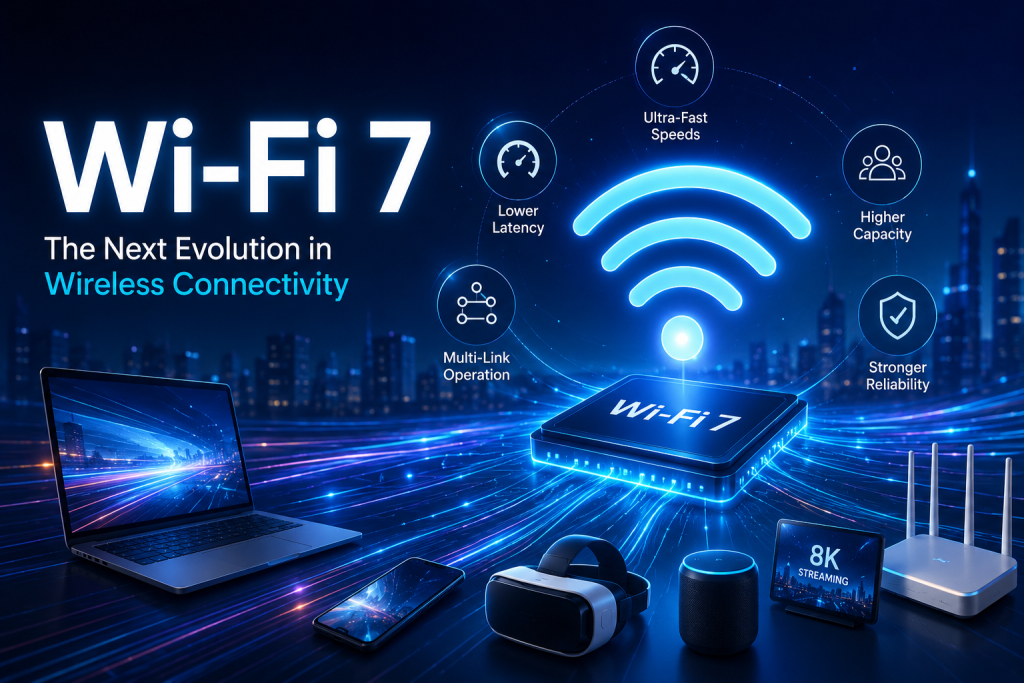

As internet usage continues to surge across homes, businesses, and public spaces, the demand for faster, more reliable wireless connectivity has never been greater. From AI-powered applications and cloud gaming to 8K video streaming and smart homes, today’s digital experiences require networks that can handle massive amounts of data with minimal delay. This growing demand has paved the way for Wi-Fi 7, the newest generation of wireless networking technology.
Often referred to as the next major leap in Wi-Fi performance, Wi-Fi 7 promises significantly faster speeds, lower latency, and improved efficiency compared to previous wireless standards. While Wi-Fi 6 and Wi-Fi 6E introduced major improvements, Wi-Fi 7 is designed to support an increasingly connected world where dozens—even hundreds—of devices operate simultaneously.
As businesses modernize their infrastructure and consumers upgrade their home networks, Wi-Fi 7 is emerging as one of the most important technology trends shaping the future of digital connectivity.
What Is Wi-Fi 7?
Wi-Fi 7, officially based on the IEEE 802.11be standard, represents the latest advancement in wireless networking technology. It builds upon the capabilities of Wi-Fi 6 and Wi-Fi 6E while introducing new features that dramatically improve wireless performance.
The technology is engineered to deliver:
- Ultra-high wireless speeds
- Lower latency for real-time applications
- Increased network capacity
- Better performance in crowded environments
- Improved reliability across multiple connected devices
Rather than simply increasing maximum speed, Wi-Fi 7 focuses on creating a smoother and more responsive wireless experience for modern applications.
Why Wi-Fi 7 Is Trending
Several technological shifts are driving global interest in Wi-Fi 7.
Growing Connected Device Ecosystems
Modern households now include smartphones, laptops, smart TVs, gaming consoles, security cameras, smart appliances, and dozens of IoT devices. Managing these simultaneous connections efficiently requires next-generation wireless technology.
AI-Powered Applications
Artificial intelligence workloads increasingly rely on cloud computing and real-time data processing. Faster wireless connections help reduce delays when interacting with AI assistants, cloud-based tools, and intelligent automation systems.
Hybrid Work Culture
Remote and hybrid work continue to increase demand for stable video conferencing, cloud collaboration, and secure remote access. Wi-Fi 7 is designed to provide smoother performance during bandwidth-intensive work activities.
High-Quality Entertainment
Consumers are streaming higher-resolution content than ever before. From 4K and 8K video to cloud gaming and virtual reality, entertainment platforms benefit from faster wireless speeds and lower latency.
Key Features of Wi-Fi 7
Faster Wireless Speeds
Wi-Fi 7 significantly increases theoretical wireless throughput compared to previous generations, making large downloads, backups, and streaming much faster.
Lower Latency
Reduced network delay improves responsiveness for applications such as online gaming, virtual meetings, augmented reality, and remote collaboration.
Multi-Link Operation (MLO)
One of Wi-Fi 7’s most notable innovations is Multi-Link Operation, which allows compatible devices to use multiple frequency bands simultaneously for improved speed, stability, and reduced congestion.
Wider Channel Bandwidth
Wi-Fi 7 supports wider wireless channels, allowing larger amounts of data to be transmitted at once, improving overall network efficiency.
Better Performance in Crowded Areas
Whether in airports, stadiums, offices, campuses, or apartment complexes, Wi-Fi 7 is designed to maintain reliable performance even when many users are connected simultaneously.
Industries Benefiting from Wi-Fi 7
Wi-Fi 7 is expected to support digital transformation across numerous sectors.
Healthcare
Hospitals can improve wireless connectivity for connected medical equipment, telemedicine, patient monitoring, and digital healthcare systems.
Education
Schools and universities increasingly rely on cloud learning platforms, online collaboration, and connected classrooms that require reliable high-speed internet.
Manufacturing
Smart factories use thousands of connected sensors and automated machines that benefit from faster, low-latency wireless communication.
Retail
Retailers can enhance customer experiences through smart checkout systems, digital displays, inventory tracking, and connected payment solutions.
Smart Homes
Consumers will enjoy smoother streaming, faster smart home automation, enhanced security systems, and improved connectivity for growing numbers of IoT devices.
Wi-Fi 7 and Emerging Technologies
Wi-Fi 7 is expected to play a major role alongside several rapidly growing technologies.
- Artificial Intelligence
- Edge Computing
- Internet of Things (IoT)
- Cloud Computing
- Extended Reality (XR)
- Smart Cities
- Autonomous Systems
- Industrial Automation
These technologies depend on high-speed, low-latency wireless communication to operate efficiently.
Challenges to Adoption
Despite its advantages, Wi-Fi 7 adoption will take time.
Organizations must upgrade compatible routers, access points, and client devices before realizing its full benefits. Many existing devices continue to use Wi-Fi 5 or Wi-Fi 6, meaning widespread migration will occur gradually.
Network infrastructure investments and spectrum availability may also influence deployment timelines in different regions.
The Future of Wi-Fi 7
Industry momentum suggests Wi-Fi 7 is moving from early adoption toward mainstream deployment across enterprise and consumer environments. Device manufacturers continue expanding Wi-Fi 7 support across smartphones, laptops, networking equipment, and smart devices, while organizations are upgrading wireless infrastructure to support AI workloads, dense IoT deployments, and high-performance applications. As compatible hardware becomes more common, Wi-Fi 7 is expected to become the foundation for next-generation connected experiences.
Conclusion
Wi-Fi 7 represents more than just another wireless upgrade—it marks a significant step toward the future of connectivity. With faster speeds, improved reliability, reduced latency, and enhanced support for modern digital applications, the technology is well-positioned to power the next generation of homes, businesses, and smart environments.
As digital transformation accelerates across industries, Wi-Fi 7 will become an essential building block for AI-driven services, cloud computing, immersive entertainment, and the expanding Internet of Things. For organizations and consumers alike, embracing Wi-Fi 7 today means preparing for a more connected, efficient, and intelligent future.