
The workplace has undergone a dramatic transformation over the past few years. Hybrid work is no longer a temporary solution—it has become the preferred work model for organizations worldwide. Employees now expect the flexibility to work from home, corporate offices, or remote locations while staying productive and connected. To support this shift, businesses are investing heavily in smart office technologies and AI collaboration tools that improve communication, automate workflows, and enhance employee experiences.
From intelligent meeting rooms and occupancy sensors to AI-powered virtual assistants and project management platforms, technology is reshaping how modern teams collaborate. As organizations continue embracing digital transformation, hybrid work technology trends are expected to redefine the future of work.
The Rise of Hybrid Work
Hybrid work combines in-office and remote working, allowing employees to choose where they work based on business needs and personal preferences. This model offers greater flexibility while helping companies reduce operational costs and attract top talent.
However, managing distributed teams requires advanced digital infrastructure. Businesses must ensure seamless communication, secure data sharing, efficient scheduling, and equal collaboration opportunities regardless of employee location. This need has accelerated the adoption of AI-powered workplace technologies.
Smart Offices Are Becoming the New Standard
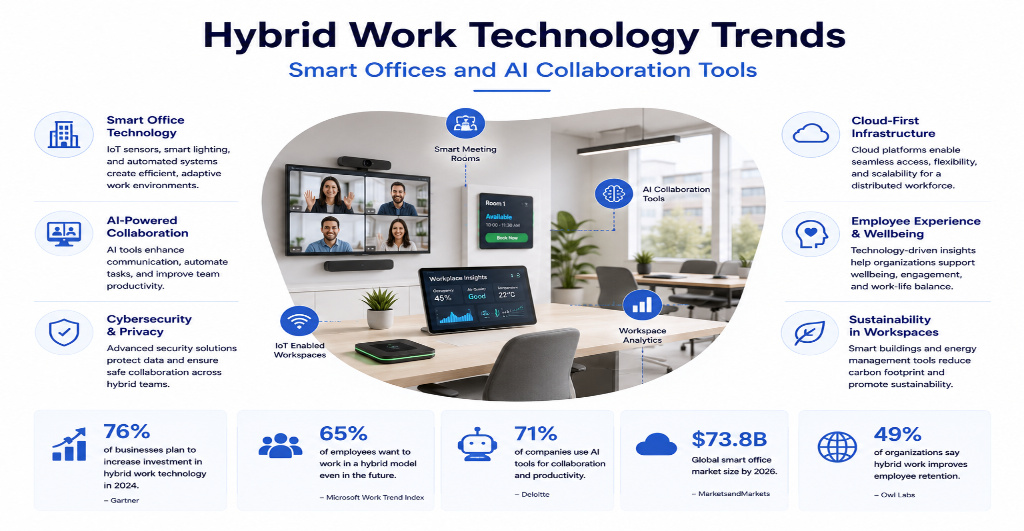
Smart offices use connected devices, IoT sensors, cloud computing, and artificial intelligence to create efficient, energy-saving, and employee-friendly workspaces.
Some of the most popular smart office technologies include:
Intelligent Meeting Rooms
Modern conference rooms now feature AI-enabled cameras, automatic speaker tracking, real-time transcription, and noise cancellation. These features ensure remote employees enjoy the same meeting experience as those physically present.
Occupancy and Space Management
IoT sensors monitor office occupancy in real time, allowing organizations to optimize desk allocation, meeting room availability, and energy consumption. Employees can reserve workspaces through mobile applications before arriving at the office.
Smart Access Control
Facial recognition, digital badges, and smartphone-based entry systems improve workplace security while reducing physical contact. These systems also help organizations monitor visitor management and employee attendance.
Energy-Efficient Buildings
Smart lighting, automated climate control, and AI-driven building management systems reduce electricity usage and operating expenses while supporting corporate sustainability initiatives.
AI Collaboration Tools Are Transforming Teamwork
Artificial intelligence has become one of the biggest drivers of workplace productivity. AI-powered collaboration tools help employees complete tasks faster while reducing repetitive manual work.
AI Meeting Assistants
Virtual meeting assistants can:
- Record meetings automatically
- Generate meeting summaries
- Capture action items
- Translate conversations in real time
- Schedule follow-up meetings
These capabilities save valuable time and ensure important discussions are never missed.
Intelligent Project Management
Modern project management platforms use AI to:
- Predict project delays
- Recommend task priorities
- Identify workload imbalances
- Automate routine workflows
- Improve resource allocation
This enables project managers to make faster and more informed decisions.
AI Chatbots for Employee Support
Organizations are increasingly deploying AI chatbots to answer HR questions, assist with IT troubleshooting, manage leave requests, and provide onboarding support. Employees receive instant assistance without waiting for human support teams.
AI-Powered Knowledge Management
Instead of searching through countless emails or documents, employees can ask AI assistants natural language questions and receive accurate answers within seconds. This significantly improves productivity and knowledge sharing.
Cloud Collaboration Continues to Expand
Cloud-based collaboration platforms remain the backbone of hybrid work environments. Employees can securely access files, applications, and communication tools from virtually anywhere.
Cloud collaboration offers several advantages:
- Real-time document editing
- Automatic file synchronization
- Version control
- Secure remote access
- Cross-device compatibility
- Faster team collaboration
As cloud infrastructure becomes more advanced, organizations can support global workforces without compromising performance or security.
Cybersecurity Is More Important Than Ever
Hybrid work has expanded the attack surface for cybercriminals. Employees access company resources from multiple devices and locations, making cybersecurity a top priority.
Organizations are investing in:
- Zero Trust security frameworks
- Multi-factor authentication
- AI-powered threat detection
- Endpoint security solutions
- Identity and access management
- Secure cloud environments
Artificial intelligence is helping cybersecurity teams detect suspicious behavior faster while automatically responding to potential threats before they cause damage.
Employee Experience Is Driving Technology Investments
Companies increasingly recognize that employee satisfaction directly impacts productivity and retention. Smart workplace technologies are being designed with employee experience at the center.
Examples include:
- Personalized workplace applications
- AI wellness recommendations
- Flexible workspace booking
- Digital employee onboarding
- Virtual collaboration spaces
- Automated administrative tasks
These innovations reduce workplace friction and allow employees to focus on meaningful work.
Data Analytics Is Improving Workplace Decisions
Organizations now use workplace analytics to understand how employees interact with office spaces and digital tools.
AI-powered analytics help businesses:
- Measure workspace utilization
- Improve office layouts
- Optimize meeting schedules
- Monitor employee engagement
- Forecast workforce needs
- Reduce operational costs
Data-driven insights enable companies to continuously improve their hybrid work strategies.
Emerging Hybrid Work Technology Trends
Several innovations are expected to shape the next generation of hybrid workplaces.
Generative AI Integration
Generative AI is becoming a virtual coworker capable of writing reports, generating presentations, summarizing research, creating meeting notes, and assisting with coding and content creation.
Digital Twins for Offices
Organizations are beginning to create virtual replicas of office buildings to simulate occupancy, optimize facility management, and improve workplace planning.
Extended Reality (XR) Collaboration
Virtual Reality (VR) and Augmented Reality (AR) are enabling immersive meetings, remote training, virtual product demonstrations, and collaborative design sessions.
AI-Powered Workforce Automation
Routine administrative processes such as expense approvals, scheduling, compliance reporting, and document management are increasingly being automated using AI workflows.
Predictive Workplace Intelligence
AI systems are evolving from simply analyzing data to predicting employee needs, maintenance requirements, resource allocation, and business performance.
Challenges Businesses Must Address
Despite rapid innovation, hybrid work technologies present several challenges.
Organizations must overcome:
- Employee resistance to new technologies
- Data privacy concerns
- Integration with legacy systems
- Rising cybersecurity risks
- Training requirements
- High implementation costs for advanced solutions
Developing a clear digital transformation strategy is essential for maximizing technology investments.
The Future of Hybrid Work
Hybrid work will continue evolving as artificial intelligence, cloud computing, automation, and smart office technologies become more sophisticated. Future workplaces will rely on intelligent systems capable of anticipating employee needs, automating routine tasks, and supporting seamless collaboration across distributed teams.
Organizations that invest in AI collaboration tools, secure digital infrastructure, and employee-centric workplace experiences will gain a competitive advantage by improving productivity, innovation, and workforce satisfaction.
Conclusion
The future of work is increasingly hybrid, connected, and AI-driven. Smart offices are creating more efficient and sustainable workplaces, while AI collaboration tools are transforming communication, decision-making, and productivity. As businesses adapt to changing workforce expectations, investing in intelligent workplace technologies will be essential for long-term success. Companies that embrace these innovations today will be better positioned to build agile, resilient, and highly collaborative work environments for the years ahead.