
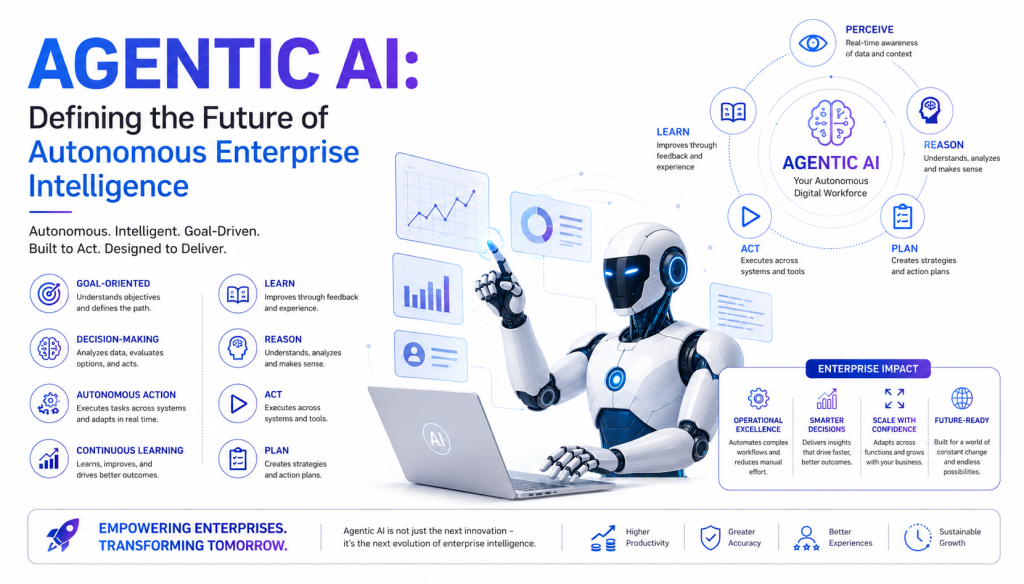

Artificial intelligence has rapidly evolved from rule-based automation to advanced generative models capable of creating content, analyzing data, and supporting complex decision-making. The next major milestone in this evolution is Agentic AI, autonomous AI systems capable of planning, reasoning, executing workflows, and continuously adapting with minimal human intervention.
Unlike traditional AI assistants that respond to user prompts, Agentic AI is designed to achieve predefined goals independently. These intelligent systems can analyze information, formulate execution strategies, collaborate with software applications, coordinate multiple AI agents, and complete end-to-end business processes. Agentic AI is widely viewed as the next evolution, extending these capabilities from content generation to autonomous execution across enterprise operations.
Agentic AI: Moving Beyond Generative AI
Generative AI excels at creating text, images, code, and insights. Agentic AI goes further by independently taking action.
Instead of answering a customer inquiry, an Agentic AI platform can:
- Understand the request
- Access enterprise databases
- Verify inventory
- Coordinate logistics
- Process payments
- Schedule deliveries
- Notify stakeholders
- Monitor task completion
This shift transforms AI from an intelligent assistant into an autonomous digital workforce.
Why Enterprises Are Investing in Agentic AI
Businesses are under constant pressure to improve operational efficiency while managing increasingly complex digital ecosystems. Enterprise software environments often include hundreds of interconnected applications, creating challenges for manual workflow management.
Recent industry research highlights this accelerating demand:
- More than 80% of enterprises are expected to integrate AI-powered autonomous agents into selected business processes before the end of the decade.
- Gartner predicts that by 2028, at least 33% of enterprise software applications will include Agentic AI capabilities, compared with less than 1% today.
- Gartner also estimates that 15% of routine workplace decisions could be made autonomously through Agentic AI by 2028, significantly reducing manual intervention.
These forecasts demonstrate that organizations are transitioning from AI-assisted workflows toward AI-managed operations.
Core Capabilities of Agentic AI
Agentic AI combines multiple advanced technologies into a unified intelligent system.
Autonomous Planning
AI agents independently convert strategic objectives into actionable workflows by breaking complex problems into smaller executable tasks.
Advanced Reasoning
Unlike conventional automation, Agentic AI evaluates multiple variables simultaneously before selecting the most effective course of action.
Persistent Memory
Long-term contextual memory allows AI agents to remember previous interactions, improving consistency and personalization throughout extended workflows.
Enterprise Integration
Modern AI agents connect seamlessly with:
- ERP systems
- CRM platforms
- Financial applications
- Supply chain software
- HR platforms
- Business intelligence tools
- Cloud productivity suites
This integration enables complete workflow automation rather than isolated task execution.
Continuous Learning
Every completed workflow improves future performance through adaptive learning and feedback analysis.
Industry Applications
Healthcare
Healthcare organizations are deploying Agentic AI to automate administrative operations, summarize medical histories, support physicians, optimize hospital resources, and accelerate pharmaceutical research.
AI-assisted drug discovery has already demonstrated remarkable efficiency gains. Studies indicate that AI can reduce early-stage drug discovery timelines by 30–50%, potentially saving hundreds of millions of dollars during pharmaceutical development.
Financial Services
Banks and insurance providers increasingly use Agentic AI for:
- Fraud detection
- Credit risk assessment
- Portfolio management
- Regulatory compliance
- Customer onboarding
- Claims processing
According to industry estimates, AI-powered automation can reduce operational costs in financial services by 20–30% while significantly improving decision speed.
Manufacturing
Manufacturers integrate Agentic AI with Industrial IoT platforms to optimize production scheduling, monitor equipment, predict failures, and coordinate supply chains.
Predictive maintenance powered by AI has demonstrated the ability to:
- Reduce equipment downtime by 30–50%
- Lower maintenance costs by 10–40%
- Increase equipment lifespan by 20–40%
Customer Experience
Agentic AI enables organizations to resolve complete customer journeys rather than isolated support tickets.
Research indicates that AI-powered customer service automation can reduce response times by up to 80% while improving customer satisfaction through faster issue resolution.
Software Engineering
Software development is rapidly embracing autonomous AI agents capable of:
- Writing code
- Executing tests
- Detecting vulnerabilities
- Deploying applications
- Monitoring production environments
- Resolving software issues
Industry analysts estimate that AI-assisted development tools can improve developer productivity by 20–45%, depending on project complexity.
Multi-Agent Collaboration
A defining characteristic of Agentic AI is multi-agent collaboration.
Instead of relying on a single AI assistant, organizations deploy specialized agents dedicated to finance, procurement, cybersecurity, legal operations, marketing, research, and customer service.
These agents exchange information, coordinate decisions, and optimize enterprise workflows collectively.
Industry analysts expect multi-agent architectures to become standard within large enterprises over the next five years as organizations seek greater scalability and operational resilience.
Strategic Business Benefits
Organizations implementing Agentic AI can realize substantial operational improvements.
Higher Productivity
AI agents automate repetitive knowledge work, enabling professionals to focus on innovation and strategic planning.
Studies suggest that knowledge workers could automate 20–40% of routine activities using advanced AI technologies.
Lower Operating Costs
Autonomous workflow execution reduces manual processing while improving operational consistency.
Many organizations report automation-driven cost reductions of 15–30% across administrative functions.
Faster Decision-Making
AI agents continuously analyze real-time enterprise data, allowing businesses to respond to operational changes significantly faster than traditional manual processes.
Enhanced Customer Engagement
Persistent contextual understanding enables personalized customer interactions that improve retention and long-term customer value.
Challenges and Governance
Despite its transformative potential, Agentic AI introduces governance challenges that organizations must address carefully.
Key priorities include:
- Responsible AI governance
- Human oversight
- Cybersecurity
- Data privacy
- Explainability
- Regulatory compliance
- Ethical decision-making
Industry surveys consistently show that over 70% of executives identify AI governance and trust as among the most important factors influencing enterprise AI adoption.
Future Role of Agentic AI
Over the next decade, Agentic AI is expected to become the operational intelligence layer of digital enterprises. Instead of simply assisting employees, AI agents will coordinate complex workflows across departments, suppliers, customers, and digital platforms.
The convergence of Agentic AI with cloud computing, edge computing, robotics, digital twins, and the Internet of Things (IoT) will create highly autonomous business ecosystems capable of making real-time decisions with minimal human intervention.
Organizations that invest in Agentic AI today are expected to gain significant competitive advantages through improved productivity, faster innovation cycles, and greater operational agility.
Final Thoughts
Agentic AI represents the next evolution of enterprise artificial intelligence, shifting from passive assistance to autonomous execution. By combining reasoning, planning, memory, software integration, and continuous learning, autonomous AI agents are poised to transform industries ranging from healthcare and finance to manufacturing and customer service.
While governance, transparency, and security remain essential considerations, the long-term outlook is highly promising. As enterprise adoption accelerates, Agentic AI is expected to become a foundational technology for the intelligent organizations of the future, augmenting human expertise, streamlining operations, and enabling a new era of autonomous, data-driven decision-making.